Choi Eunju, Kim Eunji, Kim Ji Hye, Yoon Keejung, Kim Sunggyu, Lee Jongsung, Cho Jae Youl
Department of Integrative Biotechnology, Sungkyunkwan University, Suwon, Republic of Korea.
Research and Business Foundation, Sungkyunkwan University, Suwon, Republic of Korea.
J Ginseng Res. 2019 Oct;43(4):692-698. doi: 10.1016/j.jgr.2019.07.001. Epub 2019 Jul 25.
Breast cancer is a severe disease and the second leading cause of cancer death in women worldwide. To surmount this, various diagnosis and treatment options for breast cancer have been developed. One of the most effective strategies for cancer treatment is to induce apoptosis using naturally occurring compounds. Compound K (CK) is a ginseng saponin metabolite generated by human intestinal bacteria. CK has been studied for its cardioprotective, antiinflammatory, and liver-protective effects; however, the role of CK in breast cancer is not fully understood.
To investigate the anticancer effects of CK in SKBR3 and MDA-MB-231 cells, cell viability assays and flow cytometry analysis were used. In addition, the direct targets of CK anticancer activity were identified using immunoblotting analysis and overexpression experiments. Invasion, migration, and clonogenic assays were carried out to determine the effects of CK on cancer metastasis.
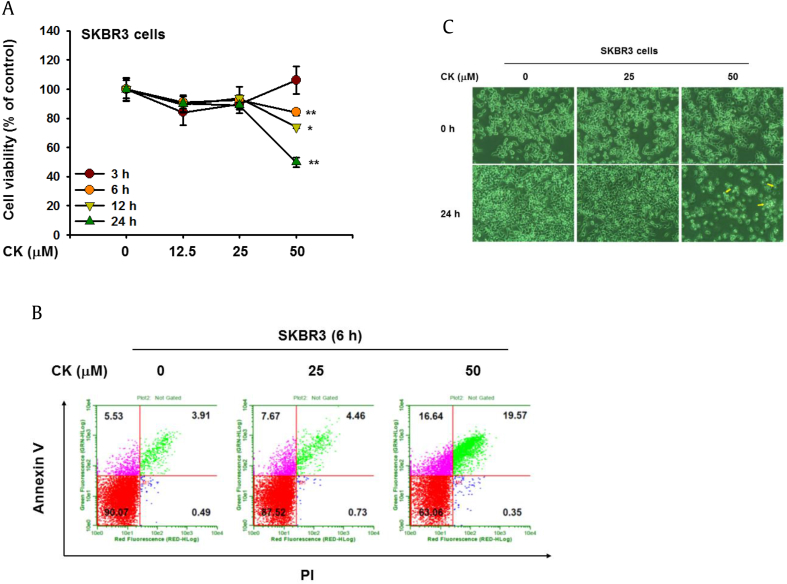
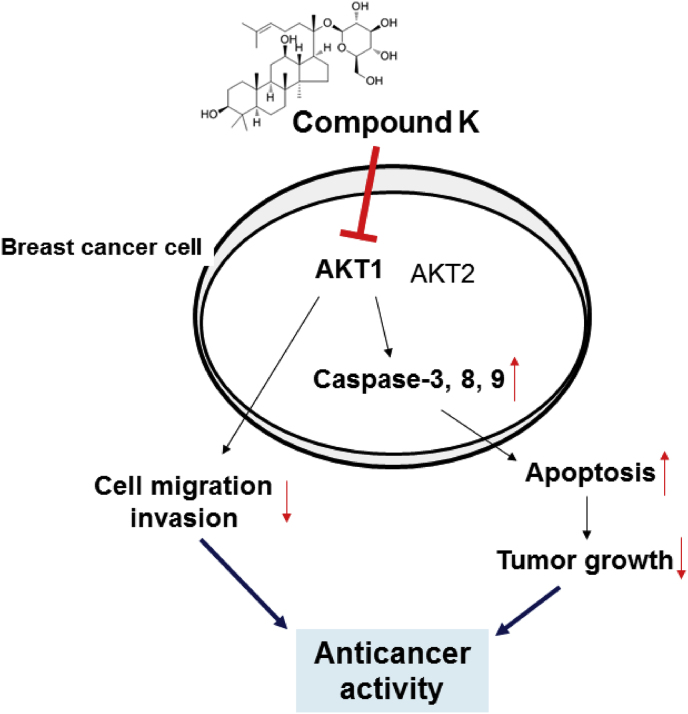
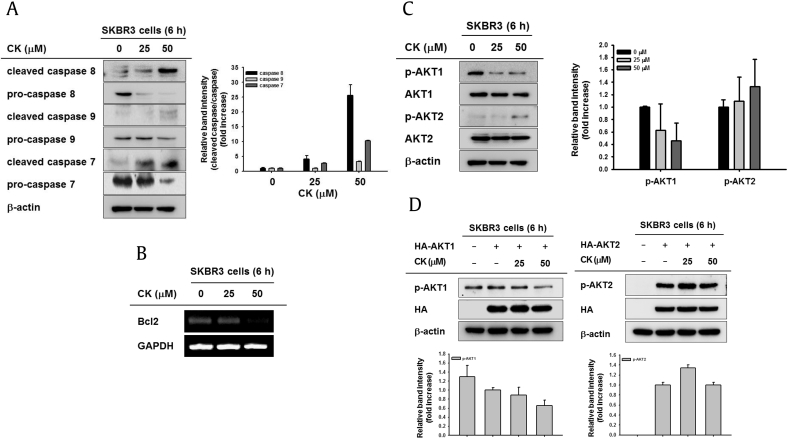
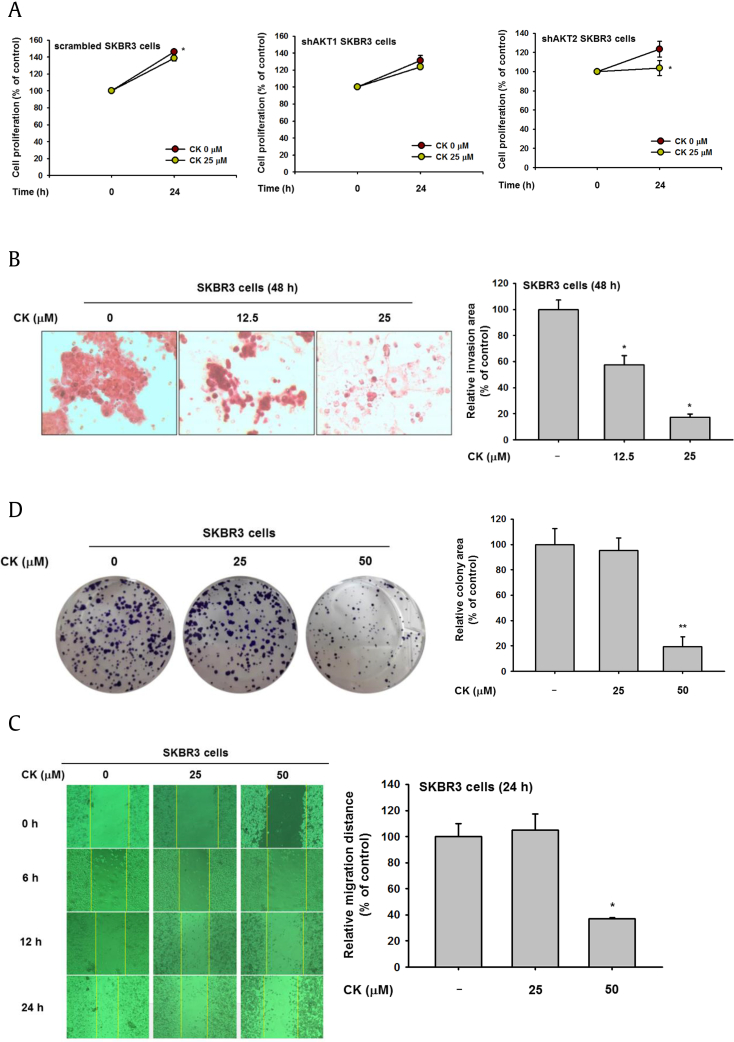
CK-induced cell apoptosis in SKBR3 cells as determined through 3-(4-5-dimethylthiazol-2-yl)-2-5-diphenyltetrazolium bromide assays, propidium iodide (PI) and annexin V staining, and morphological changes. CK increased the cleaved forms of caspase-7, caspase-8, and caspase-9, whereas the expression of was reduced by CK. In assays probing the cell survival pathway, CK activated only AKT1 and not AKT2. Moreover, CK inhibited breast cancer cell invasion, migration, and colony formation. Through regulation of AKT1 activity, CK exerts anticancer effects by inducing apoptosis.
Our results suggest that CK could be used as a therapeutic compound for breast cancer.
乳腺癌是一种严重疾病,是全球女性癌症死亡的第二大主要原因。为克服这一问题,已开发出多种乳腺癌的诊断和治疗方法。癌症治疗最有效的策略之一是使用天然化合物诱导细胞凋亡。化合物K(CK)是一种由人体肠道细菌产生的人参皂苷代谢产物。CK已被研究其对心脏的保护、抗炎和肝脏保护作用;然而,CK在乳腺癌中的作用尚未完全了解。
为研究CK对SKBR3和MDA-MB-231细胞的抗癌作用,使用了细胞活力测定和流式细胞术分析。此外,通过免疫印迹分析和过表达实验确定CK抗癌活性的直接靶点。进行侵袭、迁移和克隆形成测定以确定CK对癌症转移的影响。
通过3-(4-5-二甲基噻唑-2-基)-2-5-二苯基四氮唑溴盐测定、碘化丙啶(PI)和膜联蛋白V染色以及形态学变化确定,CK诱导SKBR3细胞凋亡。CK增加了半胱天冬酶-7、半胱天冬酶-8和半胱天冬酶-9的裂解形式,而CK降低了[此处原文缺失某个蛋白名称]的表达。在探索细胞存活途径的测定中,CK仅激活AKT1而不激活AKT2。此外,CK抑制乳腺癌细胞的侵袭、迁移和集落形成。通过调节AKT1活性,CK通过诱导细胞凋亡发挥抗癌作用。
我们的结果表明,CK可作为乳腺癌的治疗化合物。