Mitra Ankita, Rahmawati Laily, Lee Hwa Pyoung, Kim Seung A, Han Chang-Kyun, Hyun Sun Hee, Cho Jae Youl
Department of Integrative Biotechnology and Biomedical Institute for Convergence at SKKU (BICS), Sungkyunkwan University, Suwon, Republic of Korea.
R&D Headquarters, Korea Ginseng Corporation, Daejeon, Republic of Korea.
J Ginseng Res. 2022 Sep;46(5):690-699. doi: 10.1016/j.jgr.2022.04.003. Epub 2022 May 4.
Few studies reported the therapeutic effect of Korean Red Ginseng (KRG) in lung inflammatory diseases. However, the anti-inflammatory role and underlying molecular in cadmium-induced lung injury have been poorly understood, directly linked to chronic lung diseases (CLDs): chronic obstructive pulmonary disease (COPD), cancer etc. Therefore, in this study we aim to investigate the therapeutic activities of water extract of KRG (KRG-WE) in mouse cadmium-induced lung injury model.
The anti-inflammatory roles and underlying mechanisms of KRG-WE were evaluated under cadmium-stimulated lung epithelial cells (A549) and HEK293T cell line and in cadmium-induced lung injury mouse model using semi-quantitative polymerase chain reaction (RT-PCR), quantitative real-time PCR (qPCR), luciferase assay, immunoblotting, and FACS.
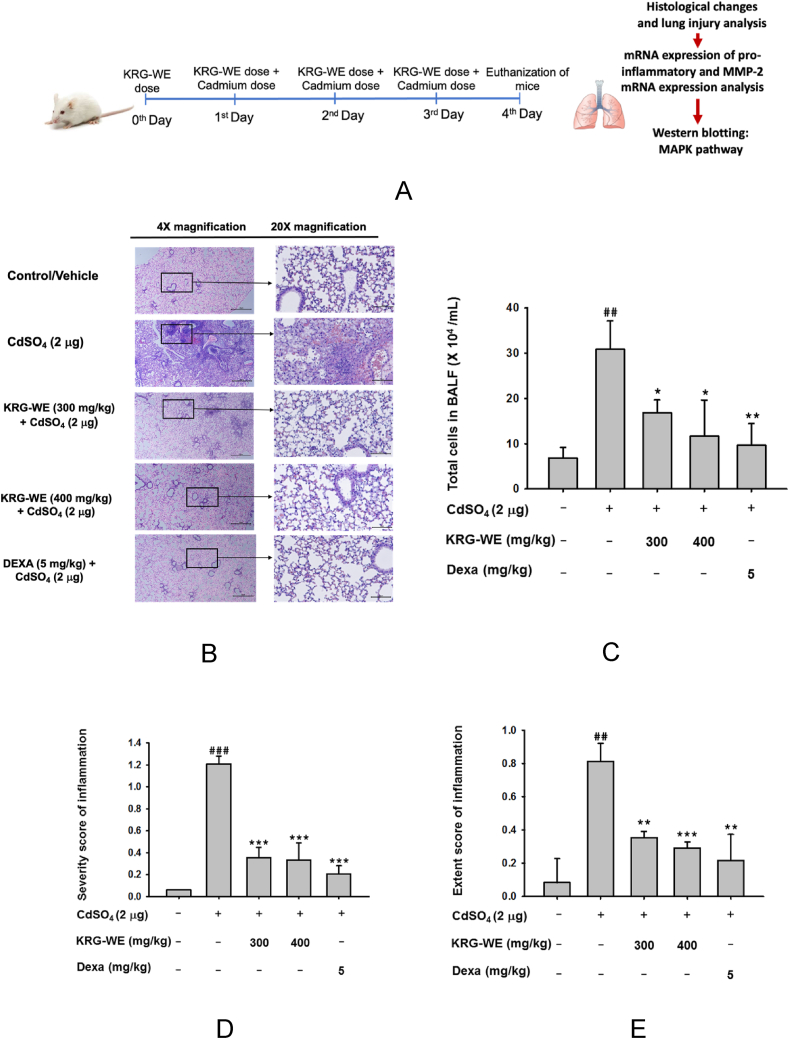
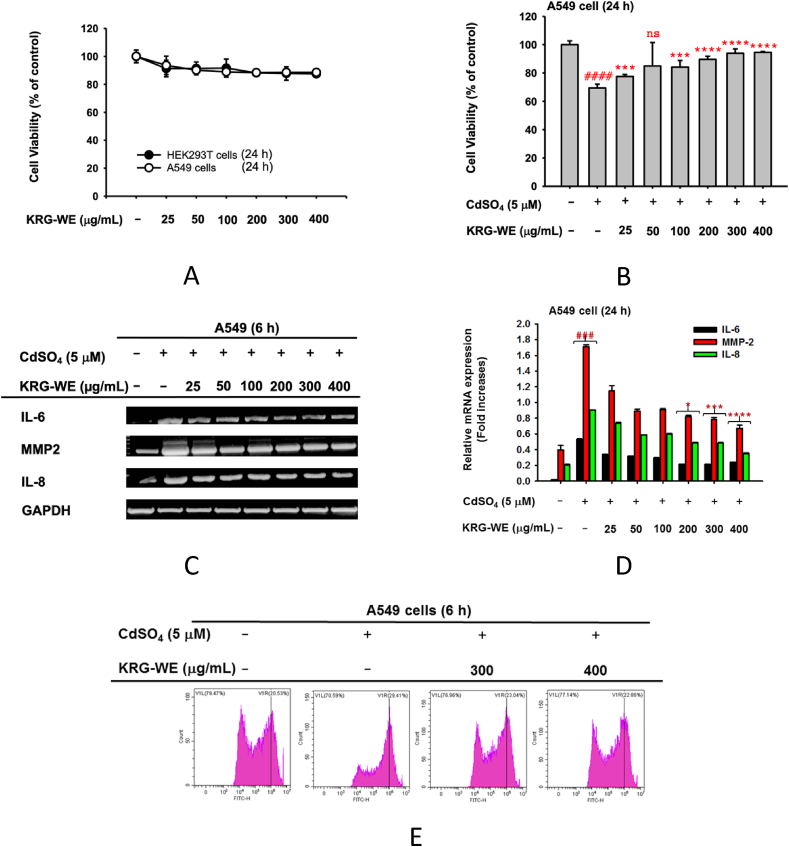
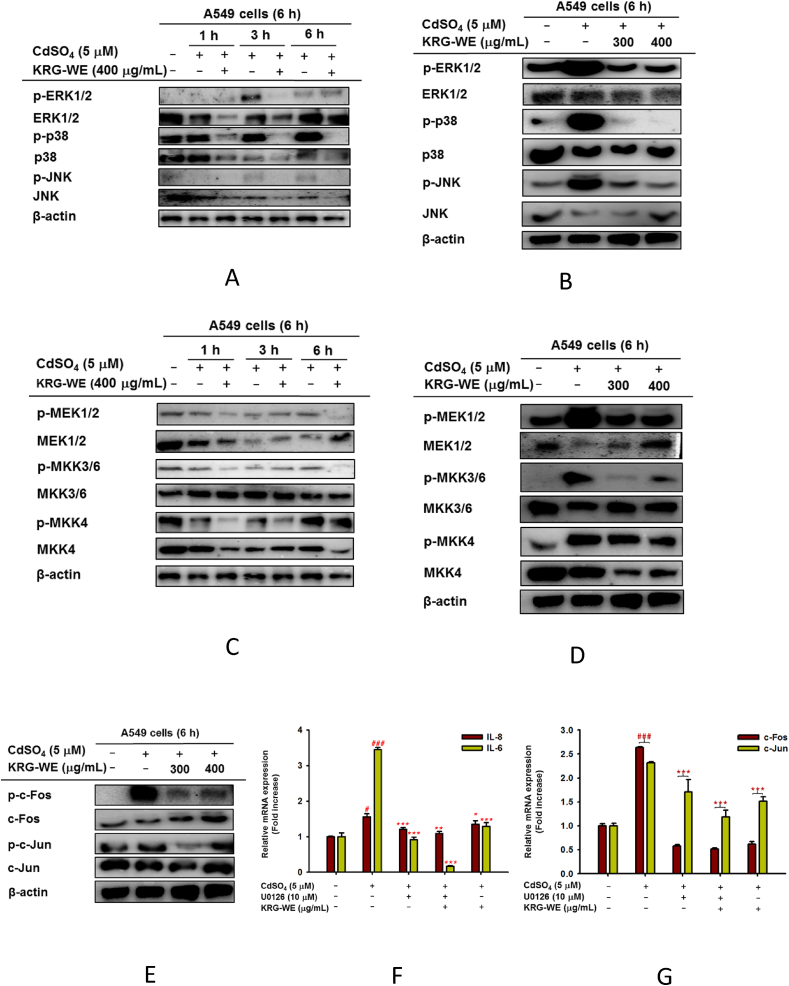
KRG-WE strongly ameliorated the symptoms of CdSO-induced lung injury in mice according to total cell number in bronchoalveolar lavage fluid (BALF) and severity scores as well as cytokine levels. KRG-WE significantly suppressed the upregulation of inflammatory signaling comprising mitogen-activated protein kinases (MAPK) and their upstream enzymes. In study, KRG-WE suppressed expression of interleukin (IL)-6, matrix metalloproteinase (MMP)-2, and IL-8 while promoting recovery in CdSO-treated A549 cells. Similarly, KRG-WE reduced phosphorylation of MAPK and c-Jun/c-Fos in cadmium-exposed A549 cells.
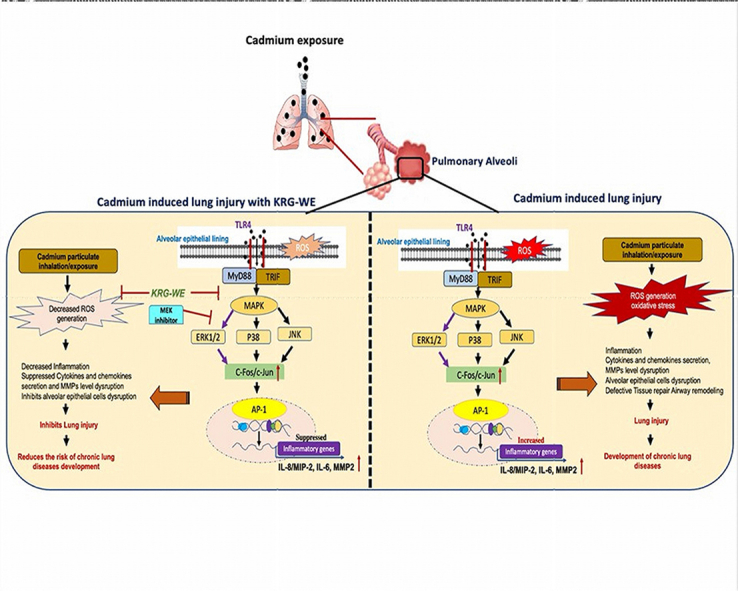
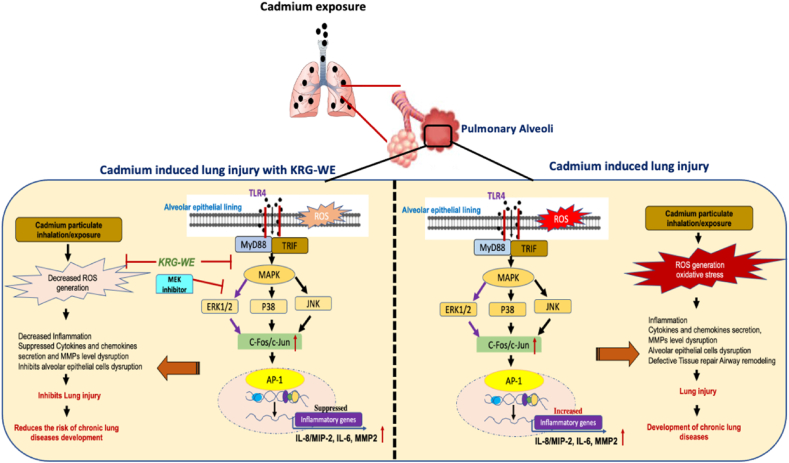
KRG-WE was found to attenuate symptoms of cadmium-induced lung injury and reduce the expression of inflammatory genes by suppression of MAPK/AP-1-mediated pathway.
很少有研究报道高丽参(KRG)在肺部炎症性疾病中的治疗效果。然而,镉诱导的肺损伤中的抗炎作用及其潜在分子机制尚未得到充分了解,而这与慢性肺部疾病(CLD)直接相关,如慢性阻塞性肺疾病(COPD)、癌症等。因此,在本研究中,我们旨在研究高丽参水提取物(KRG-WE)在小鼠镉诱导的肺损伤模型中的治疗活性。
使用半定量聚合酶链反应(RT-PCR)、定量实时PCR(qPCR)、荧光素酶测定、免疫印迹和流式细胞术,在镉刺激的肺上皮细胞(A549)和HEK293T细胞系以及镉诱导的肺损伤小鼠模型中评估KRG-WE的抗炎作用及其潜在机制。
根据支气管肺泡灌洗液(BALF)中的总细胞数、严重程度评分以及细胞因子水平,KRG-WE显著改善了CdSO诱导的小鼠肺损伤症状。KRG-WE显著抑制了包括丝裂原活化蛋白激酶(MAPK)及其上游酶在内的炎症信号的上调。在研究中,KRG-WE抑制了白细胞介素(IL)-6、基质金属蛋白酶(MMP)-2和IL-8的表达,同时促进了CdSO处理的A549细胞的恢复。同样,KRG-WE降低了镉暴露的A549细胞中MAPK和c-Jun/c-Fos的磷酸化。
发现KRG-WE可减轻镉诱导的肺损伤症状,并通过抑制MAPK/AP-1介导的途径降低炎症基因的表达。