• 文献检索
  • 文档翻译
  • 深度研究
  • 学术资讯
  • Suppr Zotero 插件Zotero 插件
  • 邀请有礼
  • 套餐&价格
  • 历史记录
应用&插件
Suppr Zotero 插件Zotero 插件浏览器插件Mac 客户端Windows 客户端微信小程序
定价
高级版会员购买积分包购买API积分包
服务
文献检索文档翻译深度研究API 文档MCP 服务
关于我们
关于 Suppr公司介绍联系我们用户协议隐私条款
关注我们

Suppr 超能文献

核心技术专利:CN118964589B侵权必究
粤ICP备2023148730 号-1Suppr @ 2026

文献检索

告别复杂PubMed语法,用中文像聊天一样搜索,搜遍4000万医学文献。AI智能推荐,让科研检索更轻松。

立即免费搜索

文件翻译

保留排版,准确专业,支持PDF/Word/PPT等文件格式,支持 12+语言互译。

免费翻译文档

深度研究

AI帮你快速写综述,25分钟生成高质量综述,智能提取关键信息,辅助科研写作。

立即免费体验

化合物K的生产:成就与展望

Compound K Production: Achievements and Perspectives.

作者信息

Chu Luan Luong, Hanh Nguyen Trinh Yen, Quyen My Linh, Nguyen Quang Huy, Lien Tran Thi Phuong, Do Khanh Van

机构信息

Faculty of Biotechnology, Chemistry and Environmental Engineering, Phenikaa University, Hanoi 12116, Vietnam.

Faculty of Biology, University of Science, Vietnam National University, Hanoi (VNU), 334 Nguyen Trai, Thanh Xuan, Hanoi 10000, Vietnam.

出版信息

Life (Basel). 2023 Jul 14;13(7):1565. doi: 10.3390/life13071565.

DOI:10.3390/life13071565
PMID:37511939
原文链接:https://pmc.ncbi.nlm.nih.gov/articles/PMC10381408/
Abstract

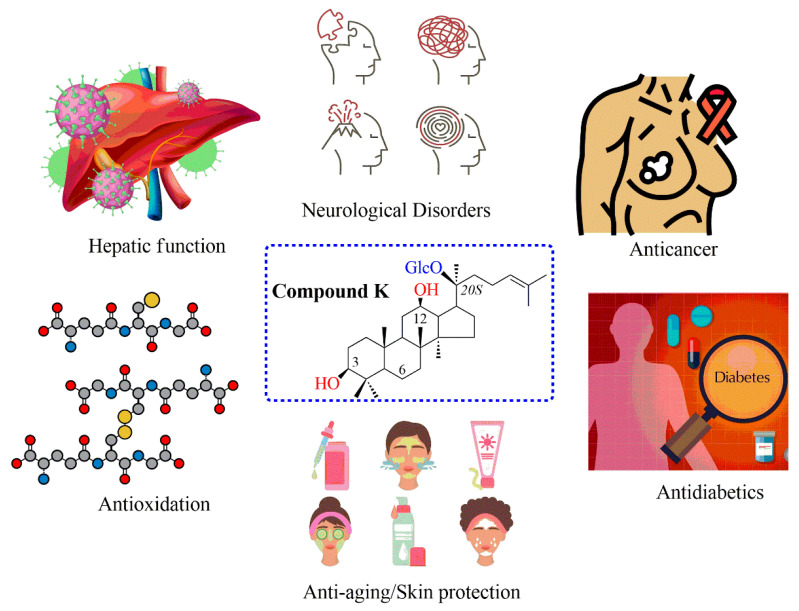
Compound K (CK) is one of the major metabolites found in mammalian blood and organs following oral administration of plants. CK, also known as minor ginsenoside, can be absorbed in the systemic circulation. It has garnered significant attention in healthcare and medical products due to its pharmacological activities, such as antioxidation, anticancer, antiproliferation, antidiabetics, neuroprotection, and anti-atherogenic activities. However, CK is not found in natural ginseng plants but in traditional chemical synthesis, which uses toxic solvents and leads to environmental pollution during the harvest process. Moreover, enzymatic reactions are impractical for industrial CK production due to low yield and high costs. Although CK could be generated from major ginsenosides, most ginsenosides, including protopanaxatriol-oleanane and ocotillol-type, are not converted into CK by catalyzing β-glucosidase. Therefore, microbial cell systems have been used as a promising solution, providing a safe and efficient approach to CK production. This review provides a summary of various approaches for the production of CK, including chemical and enzymatic reactions, biotransformation by the human intestinal bacteria and endophytes as well as engineered microbes. Moreover, the approaches for CK production have been discussed to improve the productivity of target compounds.

摘要

化合物K(CK)是哺乳动物口服植物后在血液和器官中发现的主要代谢产物之一。CK,也被称为次要人参皂苷,可被全身循环吸收。由于其药理活性,如抗氧化、抗癌、抗增殖、抗糖尿病、神经保护和抗动脉粥样硬化活性,它在医疗保健和医疗产品中受到了广泛关注。然而,天然人参植物中不存在CK,而是通过传统化学合成得到,这种合成方法使用有毒溶剂,并且在收获过程中会导致环境污染。此外,由于产率低和成本高,酶促反应对于工业生产CK并不实用。虽然CK可以由主要人参皂苷生成,但大多数人参皂苷,包括原人参三醇-齐墩果烷型和奥科梯木醇型,不能通过催化β-葡萄糖苷酶转化为CK。因此,微生物细胞系统已被用作一种有前途的解决方案,为CK的生产提供了一种安全有效的方法。本文综述了生产CK的各种方法,包括化学和酶促反应、人肠道细菌和内生菌的生物转化以及工程微生物。此外,还讨论了提高目标化合物生产率的CK生产方法。
https://cdn.ncbi.nlm.nih.gov/pmc/blobs/4f5e/10381408/d2e6fceba7fb/life-13-01565-g004.jpg
https://cdn.ncbi.nlm.nih.gov/pmc/blobs/4f5e/10381408/6bfdb0c20fe4/life-13-01565-g001.jpg
https://cdn.ncbi.nlm.nih.gov/pmc/blobs/4f5e/10381408/bc44d2e77f80/life-13-01565-g002.jpg
https://cdn.ncbi.nlm.nih.gov/pmc/blobs/4f5e/10381408/0279a7a4e9a8/life-13-01565-g003.jpg
https://cdn.ncbi.nlm.nih.gov/pmc/blobs/4f5e/10381408/d2e6fceba7fb/life-13-01565-g004.jpg
https://cdn.ncbi.nlm.nih.gov/pmc/blobs/4f5e/10381408/6bfdb0c20fe4/life-13-01565-g001.jpg
https://cdn.ncbi.nlm.nih.gov/pmc/blobs/4f5e/10381408/bc44d2e77f80/life-13-01565-g002.jpg
https://cdn.ncbi.nlm.nih.gov/pmc/blobs/4f5e/10381408/0279a7a4e9a8/life-13-01565-g003.jpg
https://cdn.ncbi.nlm.nih.gov/pmc/blobs/4f5e/10381408/d2e6fceba7fb/life-13-01565-g004.jpg

相似文献

1
Compound K Production: Achievements and Perspectives.化合物K的生产:成就与展望
Life (Basel). 2023 Jul 14;13(7):1565. doi: 10.3390/life13071565.
2
Production of ginsenoside compound K by microbial cell factory using synthetic biology-based strategy: a review.利用基于合成生物学的策略通过微生物细胞工厂生产人参皂苷Compound K:综述
Biotechnol Lett. 2023 Feb;45(2):163-174. doi: 10.1007/s10529-022-03326-y. Epub 2022 Dec 22.
3
Production of Minor Ginsenoside CK from Major Ginsenosides by Biotransformation and Its Advances in Targeted Delivery to Tumor Tissues Using Nanoformulations.通过生物转化从主要人参皂苷制备次要人参皂苷CK及其使用纳米制剂靶向递送至肿瘤组织的研究进展。
Nanomaterials (Basel). 2022 Sep 30;12(19):3427. doi: 10.3390/nano12193427.
4
Biotransformation of ginsenoside compound K using β-glucosidase in deep eutectic solvents.利用β-葡萄糖苷酶在深共晶溶剂中对人参皂苷化合物 K 的生物转化。
Bioprocess Biosyst Eng. 2024 Oct;47(10):1647-1657. doi: 10.1007/s00449-024-03056-7. Epub 2024 Jun 27.
5
High-density immobilization of a ginsenoside-transforming β-glucosidase for enhanced food-grade production of minor ginsenosides.高浓度固定化转化人参皂苷的β-葡萄糖苷酶,以增强食品级低人参皂苷的生产。
Appl Microbiol Biotechnol. 2019 Sep;103(17):7003-7015. doi: 10.1007/s00253-019-09951-4. Epub 2019 Jul 9.
6
Ginseng polysaccharides enhanced ginsenoside Rb1 and microbial metabolites exposure through enhancing intestinal absorption and affecting gut microbial metabolism.人参多糖通过增强肠道吸收和影响肠道微生物代谢来增强人参皂苷 Rb1 和微生物代谢物的暴露。
J Ethnopharmacol. 2018 Apr 24;216:47-56. doi: 10.1016/j.jep.2018.01.021. Epub 2018 Jan 31.
7
Pharmacokinetics of Ginsenoside Compound K From a Compound K Fermentation Product, CK-30, and From Red Ginseng Extract in Healthy Korean Subjects. Ginsenoside Compound K 的药代动力学:来自 Compound K 发酵产品 CK-30 和红参提取物在健康韩国受试者中的研究。
Clin Pharmacol Drug Dev. 2021 Nov;10(11):1358-1364. doi: 10.1002/cpdd.949. Epub 2021 Apr 21.
8
Enhanced biotransformation of the minor ginsenosides in red ginseng extract by Penicillium decumbens β-glucosidase.斜卧青霉β-葡萄糖苷酶增强红参提取物中次要人参皂苷的生物转化
Enzyme Microb Technol. 2022 Jan;153:109941. doi: 10.1016/j.enzmictec.2021.109941. Epub 2021 Nov 10.
9
Chemical Diversity of Panax ginseng, Panax quinquifolium, and Panax notoginseng.人参、西洋参和三七的化学多样性。
J Ginseng Res. 2012 Jan;36(1):1-15. doi: 10.5142/jgr.2012.36.1.1.
10
Complete Biotransformation of Protopanaxatriol-Type Ginsenosides in Leaf Extract to Aglycon Protopanaxatriol by β-Glycosidases from and .人参三醇型人参皂苷在叶片提取物中通过来自[具体来源1]和[具体来源2]的β-糖苷酶完全生物转化为苷元人参三醇
J Microbiol Biotechnol. 2018 Feb 28;28(2):255-261. doi: 10.4014/jmb.1709.09053.

引用本文的文献

1
Ginseng Nanosizing: The Second Spring of Ginseng Therapeutic Applications.人参纳米化:人参治疗应用的又一春天。
Antioxidants (Basel). 2025 Aug 5;14(8):961. doi: 10.3390/antiox14080961.
2
Pharmacokinetic variability of 20(S)-protopanaxadiol-type ginsenosides Rb1, rd, and compound K from Korean red ginseng in experimental rodents.韩国红参中20(S)-原人参二醇型人参皂苷Rb1、Rd和化合物K在实验啮齿动物体内的药代动力学变异性。
Sci Rep. 2025 Aug 1;15(1):28072. doi: 10.1038/s41598-025-13873-9.
3
Anticancer Mechanisms of Ginsenoside Compound K: A Review.

本文引用的文献

1
Identification of two key UDP-glycosyltransferases responsible for the ocotillol-type ginsenoside majonside-R2 biosynthesis in Panax vietnamensis var. fuscidiscus.鉴定出两个关键的 UDP-糖基转移酶,负责越南人参变种fuscidiscus 中奥克梯隆型人参皂苷 majonside-R2 的生物合成。
Planta. 2023 May 13;257(6):119. doi: 10.1007/s00425-023-04143-x.
2
Biotransformation of High Concentrations of Ginsenoside Substrate into Compound K by β-glycosidase from .β-葡萄糖苷酶转化高浓度人参皂苷底物生成化合物 K
Genes (Basel). 2023 Apr 12;14(4):897. doi: 10.3390/genes14040897.
3
Discrepancy Study of the Chemical Constituents of Panax Ginseng from Different Growth Environments with UPLC-MS-Based Metabolomics Strategy.
人参皂苷Compound K的抗癌机制:综述
Diseases. 2025 May 5;13(5):143. doi: 10.3390/diseases13050143.
4
Anti-Colorectal Cancer Activity of and Its Active Components, Ginsenosides: A Review.人参及其活性成分人参皂苷的抗结直肠癌活性:综述
Int J Mol Sci. 2025 Mar 13;26(6):2593. doi: 10.3390/ijms26062593.
5
The Chemopreventive Effect of Ginsenoside Compound K Is Regulated by PARP-1 Hyperactivation, Which Is Promoted by p62-Dependent SIRT6 Degradation.人参皂苷Compound K的化学预防作用受PARP-1过度激活调节,而PARP-1过度激活由p62依赖的SIRT6降解所促进。
Nutrients. 2025 Jan 31;17(3):539. doi: 10.3390/nu17030539.
6
Herbal Remedies for Hepatic Inflammation: Unravelling Pathways and Mechanisms for Therapeutic Intervention.用于肝脏炎症的草药疗法:揭示治疗干预的途径和机制
Curr Pharm Des. 2025;31(2):128-139. doi: 10.2174/0113816128348771240925100639.
7
Endophytic fungi of Panax sokpayensis produce bioactive ginsenoside Compound K in flask fermentation.三七内生真菌在摇瓶发酵中产生具有生物活性的人参皂苷Compound K。
Sci Rep. 2024 Apr 23;14(1):9318. doi: 10.1038/s41598-024-56441-3.
8
Bioconversion, Pharmacokinetics, and Therapeutic Mechanisms of Ginsenoside Compound K and Its Analogues for Treating Metabolic Diseases.人参皂苷Compound K及其类似物治疗代谢性疾病的生物转化、药代动力学和治疗机制
Curr Issues Mol Biol. 2024 Mar 11;46(3):2320-2342. doi: 10.3390/cimb46030148.
不同生长环境人参化学成分的差异性研究:基于 UPLC-MS 的代谢组学策略。
Molecules. 2023 Mar 24;28(7):2928. doi: 10.3390/molecules28072928.
4
Compartmentalization engineering of yeasts to overcome precursor limitations and cytotoxicity in terpenoid production.通过酵母的区室化工程克服萜类化合物生产中的前体限制和细胞毒性。
Front Bioeng Biotechnol. 2023 Feb 23;11:1132244. doi: 10.3389/fbioe.2023.1132244. eCollection 2023.
5
Depression in Major Neurodegenerative Diseases and Strokes: A Critical Review of Similarities and Differences among Neurological Disorders.主要神经退行性疾病和中风中的抑郁症:对神经疾病异同的批判性综述
Brain Sci. 2023 Feb 13;13(2):318. doi: 10.3390/brainsci13020318.
6
Comprehensive Identification of Ginsenosides in the Roots and Rhizomes of Based on Their Molecular Features-Oriented Precursor Ions Selection and Targeted MS/MS Analysis.基于分子特征导向的前体离子选择和靶向 MS/MS 分析对 根和根茎中的人参皂苷进行全面鉴定。
Molecules. 2023 Jan 17;28(3):941. doi: 10.3390/molecules28030941.
7
Compound K: A systematic review of its anticancer properties and probable mechanisms.化合物 K:对其抗癌特性及可能机制的系统评价。
Fundam Clin Pharmacol. 2023 Aug;37(4):684-712. doi: 10.1111/fcp.12874. Epub 2023 Jan 31.
8
Diversity of Culturable Endophytic Fungi in Crocus sativus and Their Correlation with Crocin Content.藏红花中可培养内生真菌的多样性及其与西红花苷含量的相关性
Curr Microbiol. 2023 Jan 9;80(2):73. doi: 10.1007/s00284-023-03177-4.
9
Insights into bacterial endophytic diversity and isolation with a focus on their potential applications -A review.关于细菌内生菌多样性及分离的见解,重点关注其潜在应用——综述
Microbiol Res. 2023 Jan;266:127256. doi: 10.1016/j.micres.2022.127256. Epub 2022 Nov 13.
10
Impact of mannoprotein N-glycosyl phosphorylation and branching on the sorption of wine polyphenols by yeasts and yeast cell walls.甘露糖蛋白 N-糖基化磷酸化和支化对葡萄酒多酚被酵母和酵母细胞壁吸附的影响。
Food Chem. 2023 Mar 1;403:134326. doi: 10.1016/j.foodchem.2022.134326. Epub 2022 Sep 19.