• 文献检索
  • 文档翻译
  • 深度研究
  • 学术资讯
  • Suppr Zotero 插件Zotero 插件
  • 邀请有礼
  • 套餐&价格
  • 历史记录
应用&插件
Suppr Zotero 插件Zotero 插件浏览器插件Mac 客户端Windows 客户端微信小程序
定价
高级版会员购买积分包购买API积分包
服务
文献检索文档翻译深度研究API 文档MCP 服务
关于我们
关于 Suppr公司介绍联系我们用户协议隐私条款
关注我们

Suppr 超能文献

核心技术专利:CN118964589B侵权必究
粤ICP备2023148730 号-1Suppr @ 2026

文献检索

告别复杂PubMed语法,用中文像聊天一样搜索,搜遍4000万医学文献。AI智能推荐,让科研检索更轻松。

立即免费搜索

文件翻译

保留排版,准确专业,支持PDF/Word/PPT等文件格式,支持 12+语言互译。

免费翻译文档

深度研究

AI帮你快速写综述,25分钟生成高质量综述,智能提取关键信息,辅助科研写作。

立即免费体验

人类免疫缺陷病毒/获得性免疫缺陷综合征(HIV/AIDS)患者皮肤药物不良反应的最新情况

An Update on Adverse Cutaneous Drug Reactions in HIV/AIDS.

作者信息

Hoosen Koraisha, Mosam Anisa, Dlova Ncoza Cordelia, Grayson Wayne

机构信息

Department of Dermatology, Nelson R Mandela School of Medicine, University of KwaZulu-Natal, Durban, South Africa.

Division of Anatomical Pathology, School of Pathology, Faculty of Health Sciences, University of the Witwatersrand, Johannesburg, South Africa.

出版信息

Dermatopathology (Basel). 2019 Jun 26;6(2):111-125. doi: 10.1159/000496389. eCollection 2019 Apr-Jun.

DOI:10.1159/000496389
PMID:31700852
原文链接:https://pmc.ncbi.nlm.nih.gov/articles/PMC6827458/
Abstract

BACKGROUND

The global mortality from HIV and the cutaneous burden of infective, inflammatory and malignant diseases in the setting of AIDS have significantly declined following the advent of highly active antiretroviral therapy. Regrettably, there has been a contemporaneous escalation in the incidence of adverse cutaneous drug reactions (ACDR), with studies attesting that HIV-positive individuals are a hundred times more susceptible to drug reactions than the general population, and advanced immunodeficiency portending an even greater risk. Several variables are accountable for this amplified risk in HIV.

SUMMARY

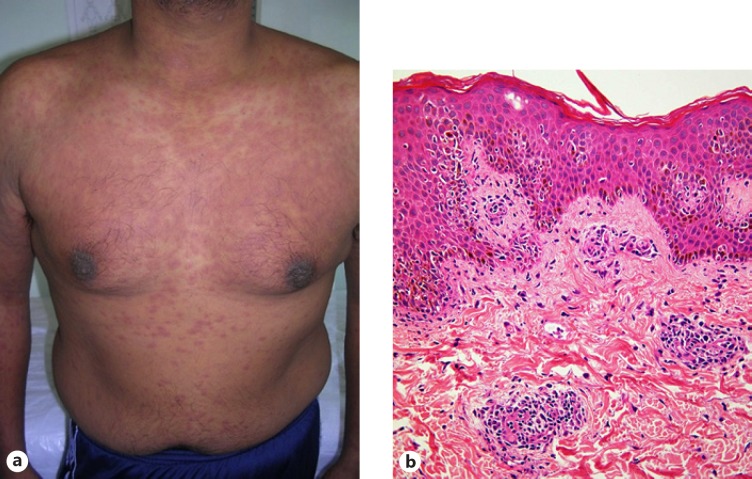
Adverse reactions to trimethoprim-sulfamethoxazole are the most common, increasing from approximately 2-8% in the general population over to 43% amongst HIV-positive individuals to approximately 69% in subjects with AIDS. Antituberculosis drugs and antiretrovirals are also well-known instigators of ACDR. Cutaneous reactions range from mild morbilliform eruptions to severe, life-threatening manifestations in the form of Stevens-Johnson syndrome/toxic epidermal necrolysis. Histological features vary from vacuolar interface changes to full-thickness epidermal necrosis with subepidermal blister formation. A precipitous diagnosis of the ACDR, clinically and histologically if necessary, together with the isolation of the causative drug is critical. The identification process, however, is often complex and multifaceted due to polypharmacy and inconclusive data on which drugs are the most likely offending agents, especially against the background of tuberculosis co-infection.

KEY MESSAGES

Whilst milder cutaneous reactions are treated symptomatically, severe reactions mandate immediate treatment discontinuation without rechallenge. Further studies are required to establish safe rechallenge guidelines in resource-limited settings with a high HIV and tuberculosis prevalence.

摘要

背景

高效抗逆转录病毒疗法出现后,全球艾滋病相关的HIV死亡率以及感染性、炎症性和恶性疾病的皮肤负担显著下降。遗憾的是,与此同时,药物性皮肤不良反应(ACDR)的发生率却在上升,研究表明,HIV阳性个体发生药物反应的易感性比普通人群高百倍,而严重免疫缺陷者的风险更高。HIV感染人群中这种风险增加有几个变量可以解释。

总结

甲氧苄啶-磺胺甲恶唑的不良反应最为常见,在普通人群中的发生率约为2%-8%,在HIV阳性个体中升至43%,在艾滋病患者中约为69%。抗结核药物和抗逆转录病毒药物也是引起ACDR的常见原因。皮肤反应范围从轻度麻疹样皮疹到严重的、危及生命的史蒂文斯-约翰逊综合征/中毒性表皮坏死松解症。组织学特征从空泡界面改变到全层表皮坏死伴表皮下疱形成。必要时从临床和组织学上迅速诊断ACDR,并找出致病药物至关重要。然而,由于联合用药以及关于哪些药物最可能是致病因素的数据尚无定论,尤其是在合并结核感染的情况下,识别过程往往复杂且涉及多方面。

关键信息

轻度皮肤反应进行对症治疗,而严重反应则必须立即停药且不再重新用药。在HIV和结核病高流行的资源有限环境中,需要进一步研究以制定安全的重新用药指南。
https://cdn.ncbi.nlm.nih.gov/pmc/blobs/d839/6827458/814d7323b22c/dpa-0006-0111-g07.jpg
https://cdn.ncbi.nlm.nih.gov/pmc/blobs/d839/6827458/64d3b2462a32/dpa-0006-0111-g01.jpg
https://cdn.ncbi.nlm.nih.gov/pmc/blobs/d839/6827458/cfb90eadc66c/dpa-0006-0111-g02.jpg
https://cdn.ncbi.nlm.nih.gov/pmc/blobs/d839/6827458/c1101b947e1a/dpa-0006-0111-g03.jpg
https://cdn.ncbi.nlm.nih.gov/pmc/blobs/d839/6827458/f2f6dedf6cc6/dpa-0006-0111-g04.jpg
https://cdn.ncbi.nlm.nih.gov/pmc/blobs/d839/6827458/95bf08726a02/dpa-0006-0111-g05.jpg
https://cdn.ncbi.nlm.nih.gov/pmc/blobs/d839/6827458/b7cf627f0b8c/dpa-0006-0111-g06.jpg
https://cdn.ncbi.nlm.nih.gov/pmc/blobs/d839/6827458/814d7323b22c/dpa-0006-0111-g07.jpg
https://cdn.ncbi.nlm.nih.gov/pmc/blobs/d839/6827458/64d3b2462a32/dpa-0006-0111-g01.jpg
https://cdn.ncbi.nlm.nih.gov/pmc/blobs/d839/6827458/cfb90eadc66c/dpa-0006-0111-g02.jpg
https://cdn.ncbi.nlm.nih.gov/pmc/blobs/d839/6827458/c1101b947e1a/dpa-0006-0111-g03.jpg
https://cdn.ncbi.nlm.nih.gov/pmc/blobs/d839/6827458/f2f6dedf6cc6/dpa-0006-0111-g04.jpg
https://cdn.ncbi.nlm.nih.gov/pmc/blobs/d839/6827458/95bf08726a02/dpa-0006-0111-g05.jpg
https://cdn.ncbi.nlm.nih.gov/pmc/blobs/d839/6827458/b7cf627f0b8c/dpa-0006-0111-g06.jpg
https://cdn.ncbi.nlm.nih.gov/pmc/blobs/d839/6827458/814d7323b22c/dpa-0006-0111-g07.jpg

相似文献

1
An Update on Adverse Cutaneous Drug Reactions in HIV/AIDS.人类免疫缺陷病毒/获得性免疫缺陷综合征(HIV/AIDS)患者皮肤药物不良反应的最新情况
Dermatopathology (Basel). 2019 Jun 26;6(2):111-125. doi: 10.1159/000496389. eCollection 2019 Apr-Jun.
2
Diagnostic patch testing following tuberculosis-associated cutaneous adverse drug reactions induces systemic reactions in HIV-infected persons.诊断性斑贴试验可诱发 HIV 感染者出现结核相关性皮肤药物不良反应的全身性反应。
Br J Dermatol. 2016 Jul;175(1):150-6. doi: 10.1111/bjd.14492. Epub 2016 May 26.
3
Severe cutaneous reactions associated with the use of human immunodeficiency virus medications.与使用人类免疫缺陷病毒药物相关的严重皮肤反应。
Acta Derm Venereol. 2003;83(1):1-9. doi: 10.1080/00015550310002611.
4
Adverse cutaneous reactions to thiacetazone for tuberculosis treatment in Tanzania.坦桑尼亚治疗结核病时对氨硫脲的皮肤不良反应。
Lancet. 1995 Sep 9;346(8976):657-60. doi: 10.1016/s0140-6736(95)92278-4.
5
Increased drug reactions in HIV-1-positive patients: a possible explanation based on patterns of immune dysregulation seen in HIV-1 disease. The Military Medical Consortium for the Advancement of Retroviral Research (MMCARR).HIV-1阳性患者药物反应增加:基于HIV-1疾病中免疫失调模式的一种可能解释。军事逆转录病毒研究促进医学联盟(MMCARR)。
Clin Exp Dermatol. 1997 May;22(3):118-23.
6
Cutaneous adverse drug reactions caused by antituberculosis drugs.抗结核药物引起的皮肤药物不良反应。
Inflamm Allergy Drug Targets. 2014;13(4):241-8. doi: 10.2174/1871528113666140717113358.
7
Prevalence of cutaneous drug eruptions in adult Nigerians with HIV/AIDS.尼日利亚成年艾滋病病毒/艾滋病患者皮肤药物疹的患病率。
Niger Postgrad Med J. 2010 Jun;17(2):160-3.
8
Adverse cutaneous reactions to mood stabilizers.心境稳定剂的皮肤不良反应。
Am J Clin Dermatol. 2003;4(1):21-30. doi: 10.2165/00128071-200304010-00003.
9
Tuberculosis结核病
10
[Cutaneous reactions to drugs].[药物引起的皮肤反应]
Ned Tijdschr Geneeskd. 2004 Feb 28;148(9):415-20.

引用本文的文献

1
First-Line Antituberculosis Drug Challenge Reactions in Drug Reaction With Eosinophilia and Systemic Symptoms Syndrome in an HIV Endemic Setting.HIV 流行地区药物反应伴嗜酸性粒细胞增多和全身症状综合征中一线抗结核药物挑战反应。
J Allergy Clin Immunol Pract. 2024 Oct;12(10):2798-2808.e12. doi: 10.1016/j.jaip.2024.05.045. Epub 2024 Jun 7.
2
Erythema Multiforme in an HIV+ Patient on Highly Active Antiretroviral Therapy After Starting Paxlovid (Nirmatrelvir-Ritonivir).一名接受高效抗逆转录病毒治疗的HIV阳性患者在开始服用帕罗韦德(奈玛特韦-利托那韦)后出现多形红斑。
Cureus. 2024 Mar 19;16(3):e56487. doi: 10.7759/cureus.56487. eCollection 2024 Mar.
3

本文引用的文献

1
Severe antiretroviral-associated skin reactions in South African patients: a case series and case-control analysis.南非患者中严重的抗逆转录病毒相关皮肤反应:病例系列与病例对照分析
Pharmacoepidemiol Drug Saf. 2016 Nov;25(11):1313-1319. doi: 10.1002/pds.4067. Epub 2016 Jul 27.
2
High daily doses of trimethoprim/sulfamethoxazole are an independent risk factor for adverse reactions in patients with pneumocystis pneumonia and AIDS.对于患有肺孢子菌肺炎和艾滋病的患者,每日大剂量服用甲氧苄啶/磺胺甲恶唑是发生不良反应的一个独立危险因素。
J Chin Med Assoc. 2016 Jun;79(6):314-9. doi: 10.1016/j.jcma.2016.01.007. Epub 2016 Mar 22.
3
Exploring the association between erythema multiforme and HIV infection: some mechanisms and implications.
探讨多形性红斑与 HIV 感染之间的关联:一些机制和意义。
AIDS Res Ther. 2024 Apr 18;21(1):24. doi: 10.1186/s12981-024-00607-6.
4
Clinicoepidemiological study of adverse cutaneous drug reactions among immunocompromised children at a tertiary care hospital.一家三级护理医院中免疫功能低下儿童皮肤药物不良反应的临床流行病学研究
Indian J Sex Transm Dis AIDS. 2023 Jan-Jun;44(1):24-29. doi: 10.4103/ijstd.ijstd_33_22. Epub 2023 Jun 6.
5
Case report: Savolitinib induced severe adverse reactions resembling septic shock in an HIV-1-positive patient with advanced non-small cell lung cancer.病例报告:在一名患有晚期非小细胞肺癌的HIV-1阳性患者中,赛沃替尼引发了类似感染性休克的严重不良反应。
Front Pharmacol. 2023 Feb 2;14:1089184. doi: 10.3389/fphar.2023.1089184. eCollection 2023.
6
Incidence of Allergic Drug Eruption due to Cotrimoxazole in HIV-Positive Individuals with CD4 ≤200 Cells/ul.HIV 阳性且 CD4 细胞计数≤200 个/μL 的个体中,复方磺胺甲噁唑所致药物过敏反应的发生率。
J Int Assoc Provid AIDS Care. 2023 Jan-Dec;22:23259582221146946. doi: 10.1177/23259582221146946.
7
Immune-Mediated Adverse Drug Reactions (IM-ARDs) in the Form of Drug-Induced Immune Thrombocytopenia and Cutaneous Adverse Drug Reactions (CARD) Due to Clindamycin in an Human Immunodeficieny Virus (HIV) Patient.免疫介导的药物不良反应(IM-ARDs),表现为药物诱导的免疫性血小板减少症和 HIV 患者克林霉素所致的药物性皮肤不良反应(CARD)。
Am J Case Rep. 2023 Jan 5;24:e938358. doi: 10.12659/AJCR.938358.
8
IFN-γ ELISpot in Severe Cutaneous Adverse Reactions to First-Line Antituberculosis Drugs in an HIV Endemic Setting.IFN-γ ELISpot 在 HIV 流行地区一线抗结核药物致严重皮肤不良反应中的应用。
J Invest Dermatol. 2022 Nov;142(11):2920-2928.e5. doi: 10.1016/j.jid.2022.05.1059. Epub 2022 Jun 1.
9
Drug-Induced Severe Cutaneous Adverse Reactions: Insights Into Clinical Presentation, Immunopathogenesis, Diagnostic Methods, Treatment, and Pharmacogenomics.药物性严重皮肤不良反应:对临床表现、免疫发病机制、诊断方法、治疗及药物基因组学的见解
Front Pharmacol. 2022 Apr 20;13:832048. doi: 10.3389/fphar.2022.832048. eCollection 2022.
10
The Correlated Risk Factors for Severe Liver Damage Among HIV-Positive Inpatients With Abnormal Liver Tests.肝功能检查异常的HIV阳性住院患者发生严重肝损伤的相关危险因素。
Front Med (Lausanne). 2022 Feb 22;9:817370. doi: 10.3389/fmed.2022.817370. eCollection 2022.
Polymorphism in glutamate cysteine ligase catalytic subunit (GCLC) is associated with sulfamethoxazole-induced hypersensitivity in HIV/AIDS patients.
谷氨酸半胱氨酸连接酶催化亚基(GCLC)的多态性与 HIV/AIDS 患者中磺胺甲恶唑诱导的过敏反应有关。
BMC Med Genomics. 2012 Jul 23;5:32. doi: 10.1186/1755-8794-5-32.
4
Cutaneous adverse drug reactions to anti-tuberculosis drugs: state of the art and into the future.抗结核药物的皮肤不良反应:现状与未来。
Expert Rev Anti Infect Ther. 2012 Apr;10(4):475-86. doi: 10.1586/eri.12.13.
5
Outcomes of reintroducing anti-tuberculosis drugs following cutaneous adverse drug reactions.抗结核药物皮肤不良反应后再引入的结果。
Int J Tuberc Lung Dis. 2011 Dec;15(12):1649-57. doi: 10.5588/ijtld.10.0698.
6
Drug reaction with eosinophilia and systemic symptoms (DRESS): a clinical update and review of current thinking.药物反应伴嗜酸性粒细胞增多和全身症状(DRESS):临床更新和当前思维回顾。
Clin Exp Dermatol. 2011 Jan;36(1):6-11. doi: 10.1111/j.1365-2230.2010.03967.x.
7
Cutaneous leukocytoclastic vasculitis due to anti-tuberculosis medications, rifampin and pyrazinamide.抗结核药物利福平与吡嗪酰胺致皮肤白细胞碎裂性血管炎。
Allergy Asthma Immunol Res. 2010 Jan;2(1):55-8. doi: 10.4168/aair.2010.2.1.55. Epub 2009 Dec 30.
8
Adverse events to antituberculosis therapy: influence of HIV and antiretroviral drugs.抗结核治疗的不良事件:HIV和抗逆转录病毒药物的影响
Int J STD AIDS. 2009 May;20(5):339-45. doi: 10.1258/ijsa.2008.008361.
9
Treatment outcomes among patients with multidrug-resistant tuberculosis: systematic review and meta-analysis.耐多药结核病患者的治疗结果:系统评价与荟萃分析。
Lancet Infect Dis. 2009 Mar;9(3):153-61. doi: 10.1016/S1473-3099(09)70041-6.
10
Clinical study of cutaneous drug eruptions in 200 patients.200例皮肤药物疹的临床研究
Indian J Dermatol Venereol Leprol. 2008 Jul-Aug;74(4):430. doi: 10.4103/0378-6323.42883.