Office of Disease Prevention, National Institutes of Health, North Bethesda, Maryland.
Scientific Consulting Group, Inc, Gaithersburg, Maryland.
JAMA Netw Open. 2019 Nov 1;2(11):e1914718. doi: 10.1001/jamanetworkopen.2019.14718.
No studies to date have examined support by the National Institutes of Health (NIH) for primary and secondary prevention research in humans and related methods research that measures the leading risk factors or causes of death or disability as outcomes or exposures.
To characterize NIH support for such research.
This serial cross-sectional study randomly sampled NIH grants and cooperative agreements funded during fiscal years 2012 through 2017. For awards with multiple subprojects, each was treated as a separate project. Study characteristics, outcomes, and exposures were coded from October 2015 through February 2019. Analyses weighted to reflect the sampling scheme were completed in March through June 2019. Using 2017 data from the Centers for Disease Control and Prevention and 2016 data from the Global Burden of Disease project, the leading risk factors and causes of death and disability in the United States were identified.
The main outcome was the percentage of the NIH prevention research portfolio measuring a leading risk factor or cause of death or disability as an outcome or exposure.
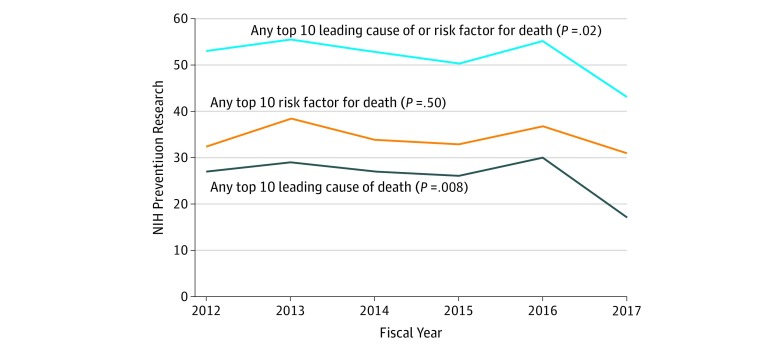
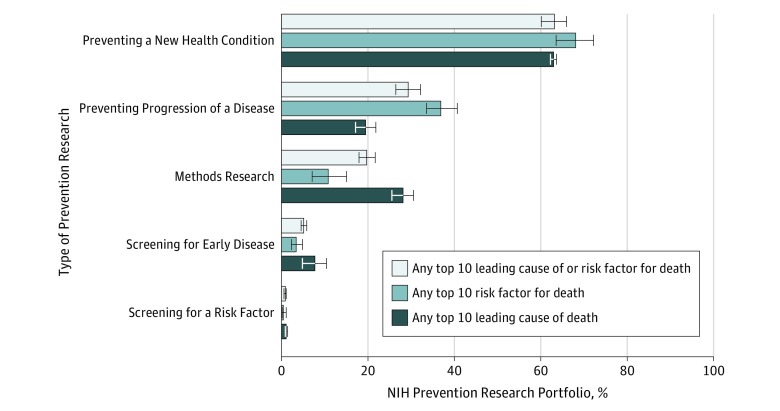
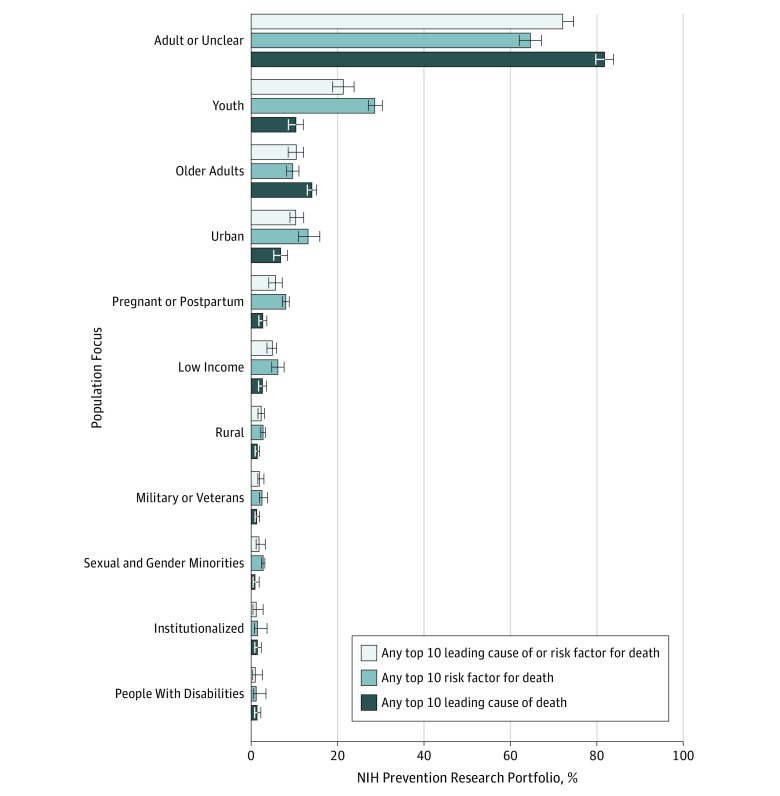
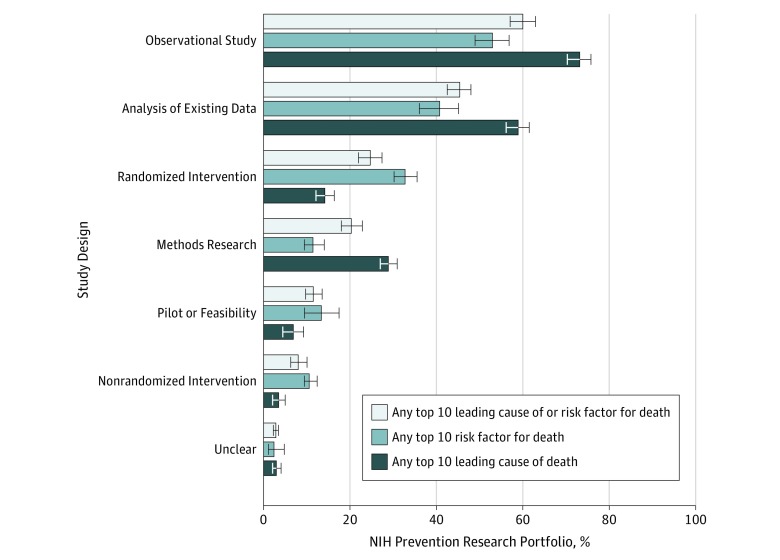
A total of 11 082 research projects were coded. Only 25.9% (95% CI, 24.0%-27.8%) of prevention research projects measured a leading cause of death as an outcome or exposure, although these leading causes were associated with 74.0% of US mortality. Only 34.0% (95% CI, 32.2%-35.9%) measured a leading risk factor for death, although these risk factors were associated with 57.3% of mortality. Only 31.4% (95% CI, 29.6%-33.3%) measured a leading risk factor for disability-adjusted life-years lost, although these risk factors were associated with 42.1% of disability-adjusted life-years lost. Relatively few projects included a randomized clinical trial (24.6%; 95% CI, 22.5%-26.9%) or involved more than 1 leading cause (3.3%; 95% CI, 2.6%-4.1%) or risk factor (8.8%; 95% CI, 7.9%-9.8%).
In this cross-sectional study, the leading risk factors and causes of death and disability were underrepresented in the NIH prevention research portfolio relative to their burden. Because so much is already known about these risk factors and causes, and because randomized interventions play such a vital role in the development of clinical and public health guidelines, it appears that greater attention should be given to develop and test interventions that address these risk factors and causes, addressing multiple risk factors or causes when possible.
迄今为止,尚无研究探讨美国国立卫生研究院(NIH)对人类一级和二级预防研究的支持情况,以及衡量主要死亡或残疾风险因素或病因的相关方法研究,而这些因素或病因是作为结果或暴露因素。
描述 NIH 对这类研究的支持情况。
本研究采用连续横断面设计,随机抽取了 2012 至 2017 财年期间资助的 NIH 拨款和合作协议。对于有多个子项目的奖项,每个子项目都被视为一个单独的项目。从 2015 年 10 月至 2019 年 2 月对研究特征、结果和暴露因素进行编码。分析采用加权法反映抽样方案,于 2019 年 3 月至 6 月完成。使用美国疾病控制与预防中心 2017 年的数据和全球疾病负担项目 2016 年的数据,确定了美国主要的死亡和残疾风险因素。
主要结局是 NIH 预防研究组合中测量主要死亡原因或残疾风险因素作为结果或暴露因素的比例。
共对 11082 个研究项目进行了编码。只有 25.9%(95%CI,24.0%-27.8%)的预防研究项目将主要死因作为结果或暴露因素进行了测量,尽管这些主要死因与美国 74.0%的死亡率相关。仅有 34.0%(95%CI,32.2%-35.9%)的项目测量了死亡的主要风险因素,尽管这些风险因素与 57.3%的死亡率相关。仅有 31.4%(95%CI,29.6%-33.3%)的项目测量了导致残疾调整生命年损失的主要风险因素,尽管这些风险因素与 42.1%的残疾调整生命年损失相关。相对较少的项目包括随机临床试验(24.6%;95%CI,22.5%-26.9%)或涉及多个主要病因(3.3%;95%CI,2.6%-4.1%)或风险因素(8.8%;95%CI,7.9%-9.8%)。
在这项横断面研究中,与这些风险因素和病因的负担相比,NIH 预防研究组合中主要的死亡和残疾风险因素和病因代表性不足。由于人们已经对这些风险因素和病因有了很多了解,并且随机干预措施在临床和公共卫生指南的制定中起着至关重要的作用,因此,似乎应该更加重视制定和测试针对这些风险因素和病因的干预措施,尽可能针对多个风险因素或病因。