Picón Eduardo, Juncos-Rabadán Onésimo, Lojo-Seoane Cristina, Campos-Magdaleno María, Mallo Sabela C, Nieto-Vietes Ana, Pereiro Arturo X, Facal David
Department of Methodology of Behavioral Sciences, University of Santiago de Compostela, Santiago de Compostela, 15782, Galicia, Spain.
Department of Developmental Psychology, University of Santiago de Compostela, Santiago de Compostela, 15782, Galicia, Spain.
Brain Sci. 2019 Nov 7;9(11):314. doi: 10.3390/brainsci9110314.
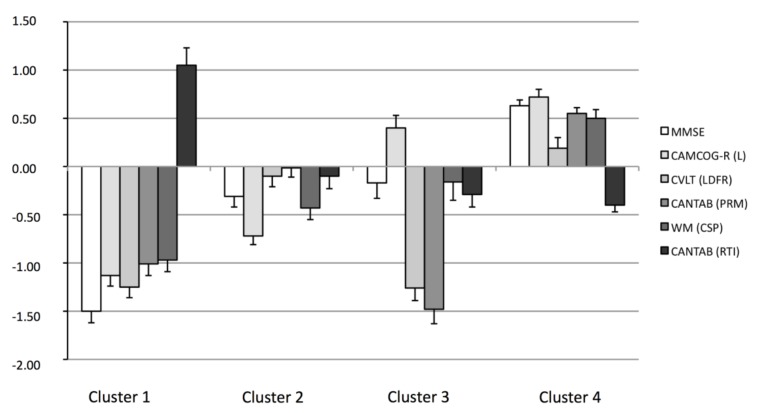
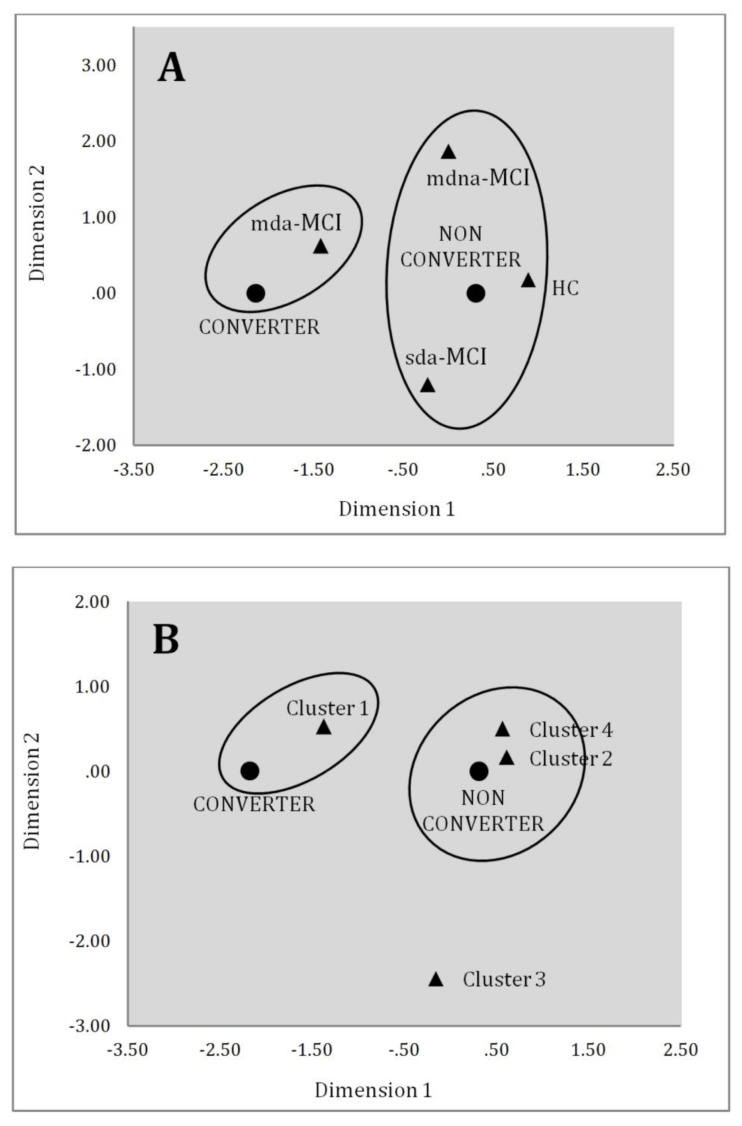
(1) Background: Early identification of mild cognitive impairment (MCI) in people reporting subjective cognitive complaints (SCC) and the study of progression of cognitive decline are important issues in dementia research. This paper examines whether empirically derived procedures predict progression from MCI to dementia. (2) Methods: At baseline, 192 participants with SCC were diagnosed according to clinical criteria as cognitively unimpaired (70), single-domain amnestic MCI (65), multiple-domain amnestic MCI (33) and multiple-domain non-amnestic MCI (24). A two-stage hierarchical cluster analysis was performed for empirical classification. Categorical regression analysis was then used to assess the predictive value of the clusters obtained. Participants were re-assessed after 36 months. (3) Results: Participants were grouped into four empirically derived clusters: Cluster 1, similar to multiple-domain amnestic MCI; Cluster 2, characterized by subjective cognitive decline (SCD) but with low scores in language and working memory; Cluster 3, with specific deterioration in episodic memory, similar to single-domain amnestic MCI; and Cluster 4, with SCD but with scores above the mean in all domains. The majority of participants who progressed to dementia were included in Cluster 1. (4) Conclusions: Cluster analysis differentiated between MCI and SCD in a sample of people with SCC and empirical criteria were more closely associated with progression to dementia than standard criteria.
(1) 背景:在报告主观认知主诉(SCC)的人群中早期识别轻度认知障碍(MCI)以及研究认知衰退的进展是痴呆症研究中的重要问题。本文探讨了根据经验得出的程序是否能预测从MCI发展为痴呆症的情况。(2) 方法:在基线时,192名有SCC的参与者根据临床标准被诊断为认知未受损(70人)、单领域遗忘型MCI(65人)、多领域遗忘型MCI(33人)和多领域非遗忘型MCI(24人)。进行了两阶段分层聚类分析以进行经验分类。然后使用分类回归分析来评估所获得聚类的预测价值。36个月后对参与者进行重新评估。(3) 结果:参与者被分为四个根据经验得出的聚类:聚类1,类似于多领域遗忘型MCI;聚类2,以主观认知衰退(SCD)为特征,但语言和工作记忆得分较低;聚类3,情景记忆有特定恶化,类似于单领域遗忘型MCI;聚类4,有SCD但所有领域得分均高于平均水平。进展为痴呆症的大多数参与者都在聚类1中。(4) 结论:聚类分析在有SCC的人群样本中区分了MCI和SCD,并且与发展为痴呆症的进展相关的经验标准比标准标准更为密切。