Institute of Physiology, Pathophysiology and Biophysics, Department of Biomedical Sciences, University of Veterinary Medicine, Vienna, Austria.
Rostock University Medical Center, Rostock, Mecklenburg-Vorpommern, Germany.
Biophys J. 2019 Nov 19;117(10):1845-1857. doi: 10.1016/j.bpj.2019.10.021. Epub 2019 Oct 24.
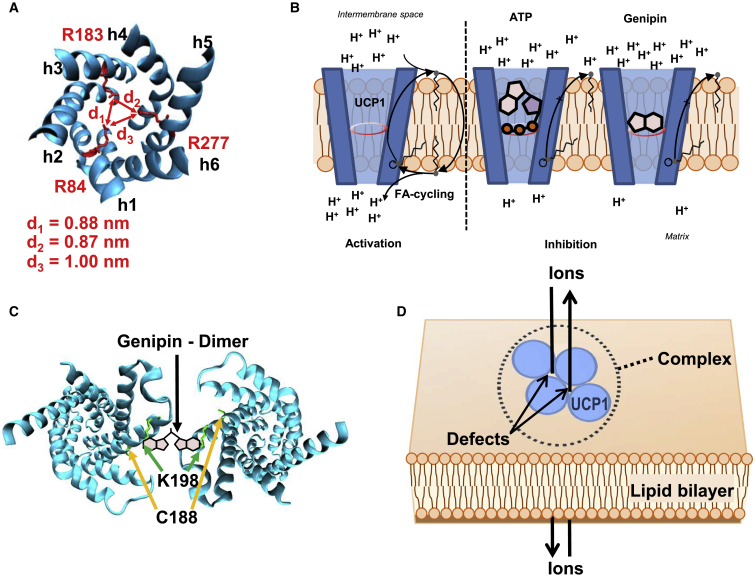
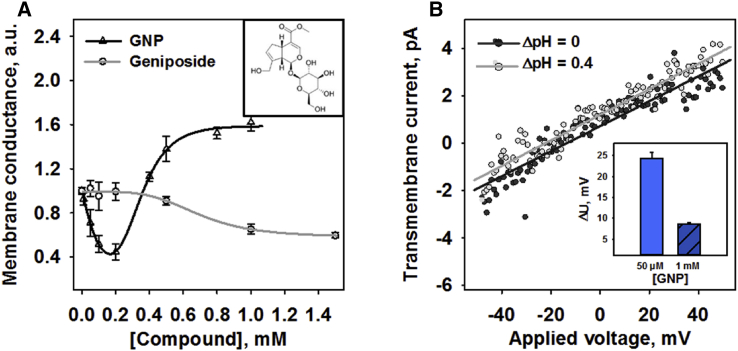
Genipin, a natural compound from Gardenia jasminoides, is a well-known compound in Chinese medicine that is used for the treatment of cancer, inflammation, and diabetes. The use of genipin in classical medicine is hindered because of its unknown molecular mechanisms of action apart from its strong cross-linking ability. Genipin is increasingly applied as a specific inhibitor of proton transport mediated by mitochondrial uncoupling protein 2 (UCP2). However, its specificity for UCP2 is questionable, and the underlying mechanism behind its action is unknown. Here, we investigated the effect of genipin in different systems, including neuroblastoma cells, isolated mitochondria, isolated mitochondrial proteins, and planar lipid bilayer membranes reconstituted with recombinant proteins. We revealed that genipin activated dicarboxylate carrier and decreased the activity of UCP1, UCP3, and complex III of the respiratory chain alongside with UCP2 inhibition. Based on competitive inhibition experiments, the use of amino acid blockers, and site-directed mutagenesis of UCP1, we propose a mechanism of genipin's action on UCPs. At low concentrations, genipin binds to arginine residues located in the UCP funnel, which leads to a decrease in UCP's proton transporting function in the presence of long chain fatty acids. At concentrations above 200 μM, the inhibitory action of genipin on UCPs is overlaid by increased nonspecific membrane conductance due to the formation of protein-genipin aggregates. Understanding the concentration-dependent mechanism of genipin action in cells will allow its targeted application as a drug in the above-mentioned diseases.
栀子苷是一种天然化合物,来自栀子,是中药中一种著名的化合物,用于治疗癌症、炎症和糖尿病。由于其作用机制不明,除了具有很强的交联能力外,栀子苷在经典医学中的应用受到阻碍。栀子苷越来越多地被用作线粒体解偶联蛋白 2 (UCP2) 介导的质子转运的特异性抑制剂。然而,其对 UCP2 的特异性存在疑问,其作用的潜在机制尚不清楚。在这里,我们研究了栀子苷在不同系统中的作用,包括神经母细胞瘤细胞、分离的线粒体、分离的线粒体蛋白和用重组蛋白重建的平面脂质双层膜。我们揭示,栀子苷激活二羧酸载体并降低 UCP1、UCP3 和呼吸链复合物 III 的活性,同时抑制 UCP2。基于竞争性抑制实验、氨基酸阻断剂的使用以及 UCP1 的定点突变,我们提出了栀子苷对 UCPs 作用的机制。在低浓度下,栀子苷结合 UCP 漏斗中位于精氨酸残基上,导致在长链脂肪酸存在下 UCP 的质子转运功能降低。在 200μM 以上的浓度下,由于形成蛋白-栀子苷聚集体,非特异性膜电导增加,掩盖了栀子苷对 UCPs 的抑制作用。了解栀子苷在细胞中的浓度依赖性作用机制将使其能够作为药物靶向应用于上述疾病。