Department of Biostatistics, Yale School of Public Health, New Haven, Connecticut, United States of America.
Yale College, New Haven, Connecticut, United States of America.
PLoS Med. 2019 Nov 12;16(11):e1002956. doi: 10.1371/journal.pmed.1002956. eCollection 2019 Nov.
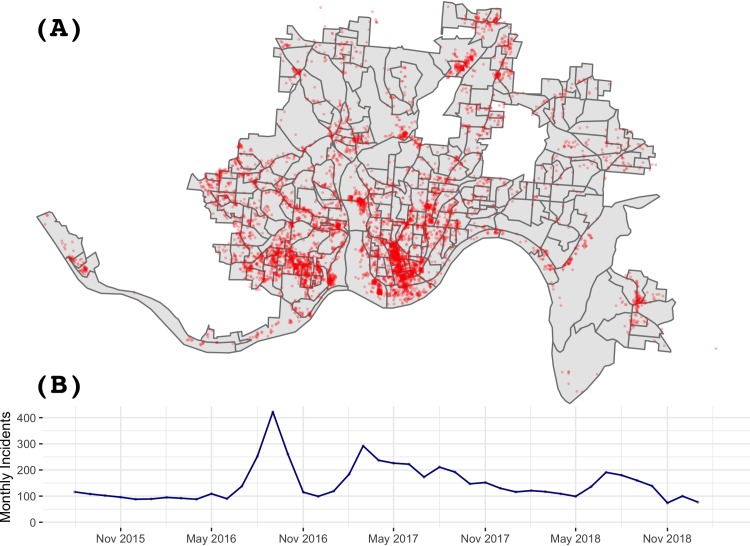
Opioid misuse and deaths are increasing in the United States. In 2017, Ohio had the second highest overdose rates in the US, with the city of Cincinnati experiencing a 50% rise in opioid overdoses since 2015. Understanding the temporal and geographic variation in overdose emergencies may help guide public policy responses to the opioid epidemic.
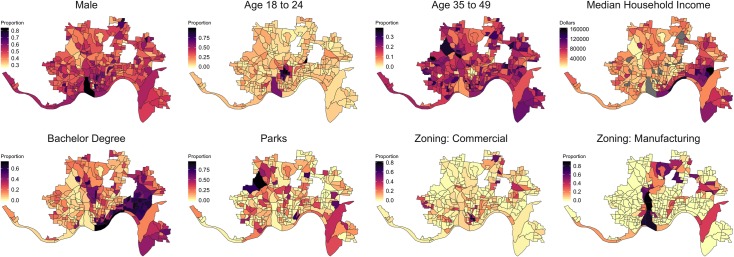
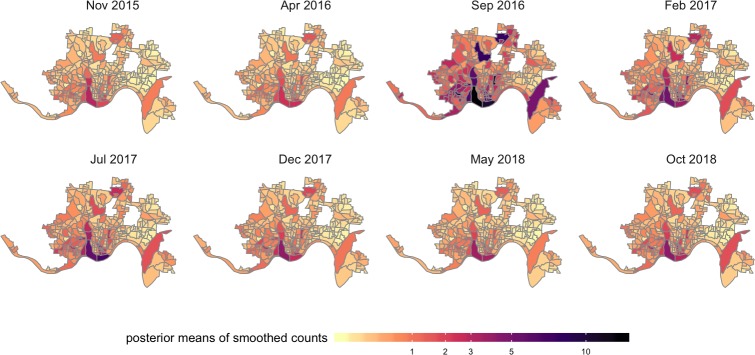
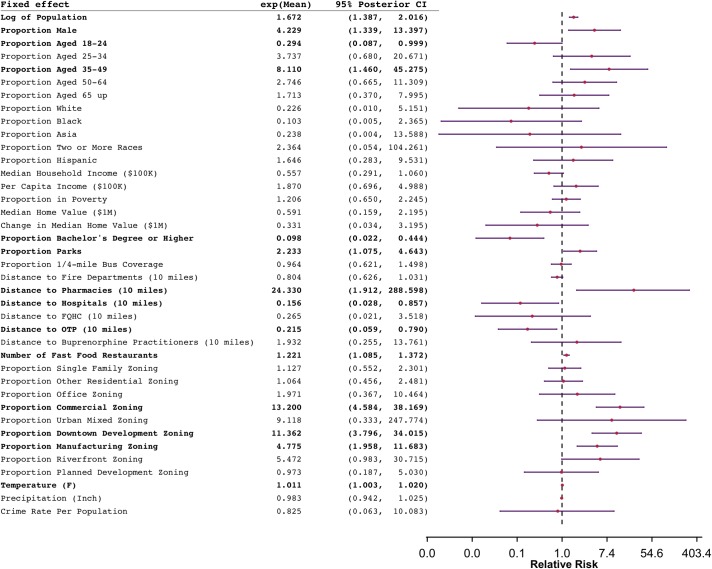
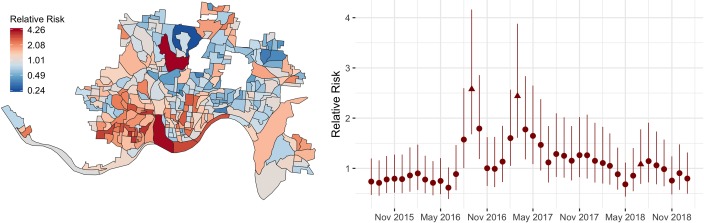
We used a publicly available data set of suspected heroin-related emergency calls (n = 6,246) to map overdose incidents to 280 census block groups in Cincinnati between August 1, 2015, and January 30, 2019. We used a Bayesian space-time Poisson regression model to examine the relationship between demographic and environmental characteristics and the number of calls within block groups. Higher numbers of heroin-related incidents were found to be associated with features of the built environment, including the proportion of parks (relative risk [RR] = 2.233; 95% credible interval [CI]: [1.075-4.643]), commercial (RR = 13.200; 95% CI: [4.584-38.169]), manufacturing (RR = 4.775; 95% CI: [1.958-11.683]), and downtown development zones (RR = 11.362; 95% CI: [3.796-34.015]). The number of suspected heroin-related emergency calls was also positively associated with the proportion of male population, the population aged 35-49 years, and distance to pharmacies and was negatively associated with the proportion aged 18-24 years, the proportion of the population with a bachelor's degree or higher, median household income, the number of fast food restaurants, distance to hospitals, and distance to opioid treatment programs. Significant spatial and temporal heterogeneity in the risks of incidents remained after adjusting for covariates. Limitations of this study include lack of information about the nature of incidents after dispatch, which may differ from the initial classification of being related to heroin, and lack of information on local policy changes and interventions.
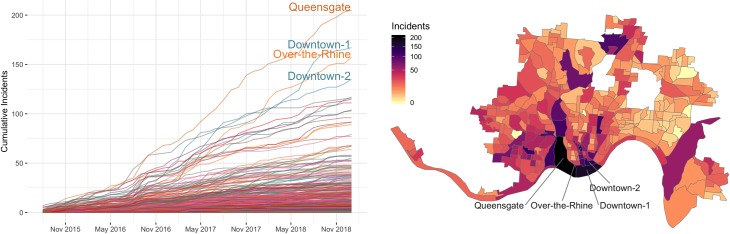
We identified areas with high numbers of reported heroin-related incidents and features of the built environment and demographic characteristics that are associated with these events in the city of Cincinnati. Publicly available information about opiate overdoses, combined with data on spatiotemporal risk factors, may help municipalities plan, implement, and target harm-reduction measures. In the US, more work is necessary to improve data availability in other cities and states and the compatibility of data from different sources in order to adequately measure and monitor the risk of overdose and inform health policies.
在美国,阿片类药物滥用和死亡人数不断增加。2017 年,俄亥俄州的用药过量率位居全美第二,辛辛那提市自 2015 年以来,阿片类药物用药过量人数增加了 50%。了解用药过量紧急情况的时间和地理变化,可能有助于指导应对阿片类药物流行的公共政策。
我们使用公开的疑似海洛因相关急救电话数据集(n=6246),将 2015 年 8 月 1 日至 2019 年 1 月 30 日期间辛辛那提市的用药过量事件映射到 280 个普查区。我们使用贝叶斯时空泊松回归模型,研究人口统计学和环境特征与区内电话呼叫数量之间的关系。结果发现,与海洛因有关的事件发生率较高与建筑环境特征有关,包括公园比例(相对风险[RR]=2.233;95%可信区间[CI]:[1.075-4.643])、商业(RR=13.200;95%CI:[4.584-38.169])、制造业(RR=4.775;95%CI:[1.958-11.683])和市中心开发区(RR=11.362;95%CI:[3.796-34.015])。疑似海洛因相关急救电话数量也与男性人口比例、35-49 岁人口比例、与药店的距离呈正相关,与 18-24 岁人口比例、拥有学士或更高学位的人口比例、家庭收入中位数、快餐店数量、与医院的距离和与阿片类药物治疗项目的距离呈负相关。在调整了协变量后,事件风险仍存在显著的空间和时间异质性。本研究的局限性包括缺乏派遣后事件性质的信息,这些信息可能与最初的海洛因相关分类不同,以及缺乏关于地方政策变化和干预措施的信息。
我们确定了辛辛那提市报告的海洛因相关事件数量较多的地区,以及与这些事件相关的建筑环境和人口统计学特征。有关阿片类药物过量的公开信息,结合时空风险因素数据,可能有助于市政当局规划、实施和针对减少伤害措施。在美国,还需要做更多的工作,以提高其他城市和州的数据可用性,并提高不同来源数据的兼容性,以便充分衡量和监测用药过量风险,并为卫生政策提供信息。