Keck School of Medicine of University of Southern California, Department of Emergency Medicine, Los Angeles, California.
The Lever Institute, Los Angeles, California.
West J Emerg Med. 2018 Jul;19(4):641-648. doi: 10.5811/westjem.2018.4.37054. Epub 2018 May 15.
The epidemic of opioid use disorder and opioid overdose carries extensive morbidity and mortality and necessitates a multi-pronged, community-level response. Bystander administration of the opioid overdose antidote naloxone is effective, but it is not universally available and requires consistent effort on the part of citizens to proactively carry naloxone. An alternate approach would be to position naloxone kits where they are most needed in a community, in a manner analogous to automated external defibrillators. We hypothesized that opioid overdoses would show geospatial clustering within a community, leading to potential target sites for such publicly deployed naloxone (PDN).
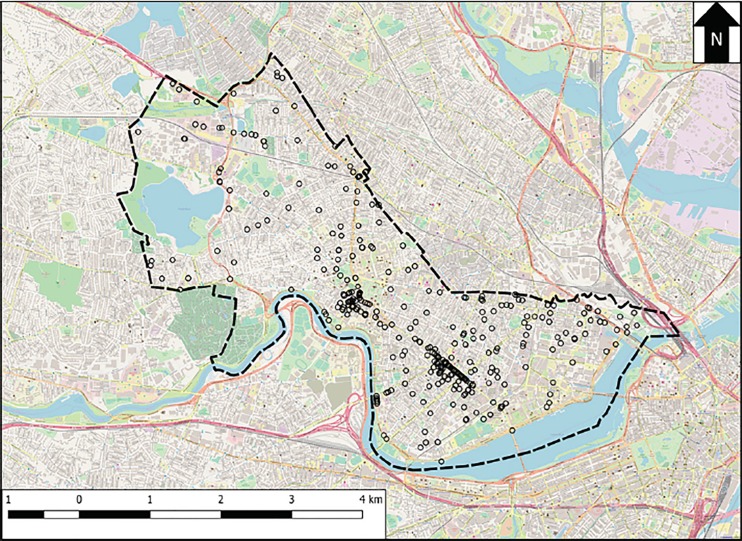
We performed a retrospective chart review of 700 emergency medical service (EMS) runs that involved opioid overdose or naloxone administration in Cambridge, Massachusetts, between October 16, 2016 and May 10, 2017. We used geospatial analysis to examine for clustering in general, and to identify specific clusters amenable to PDN sites.
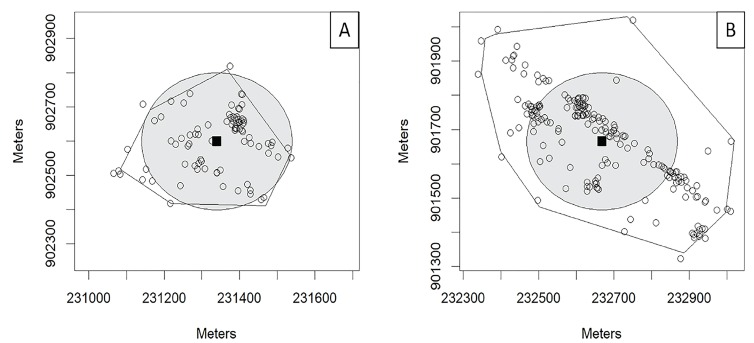
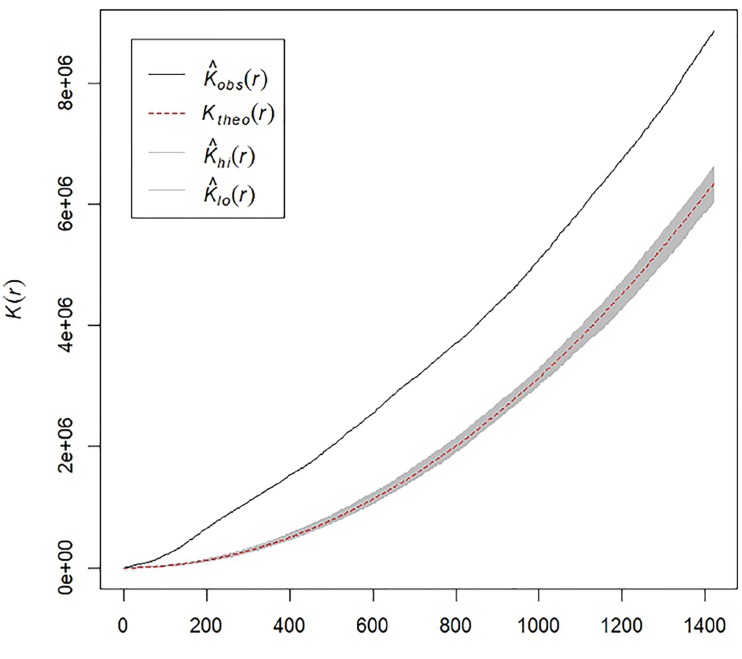
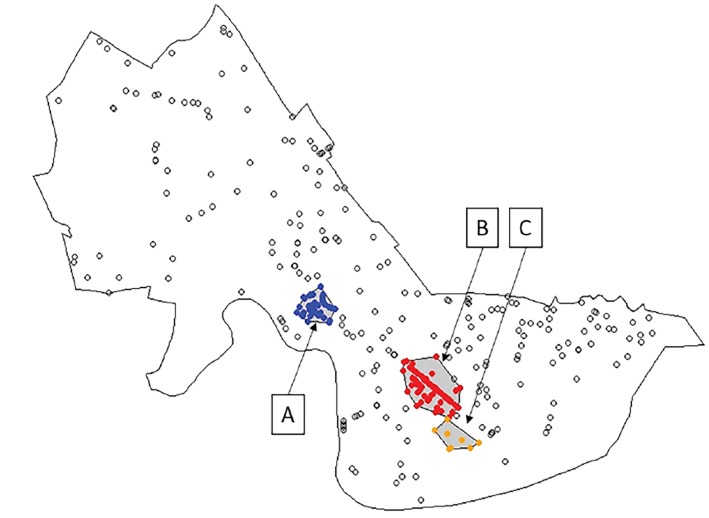
Opioid-related emergency medical services (EMS) runs in Cambridge, Massachusetts (MA), exhibit significant geospatial clustering, and we identified three clusters of opioid-related EMS runs in Cambridge, MA, with distinct characteristics. Models of PDN sites at these clusters show that approximately 40% of all opioid-related EMS runs in Cambridge, MA, would be accessible within 200 meters of PDN sites placed at cluster centroids.
Identifying clusters of opioid-related EMS runs within a community may help to improve community coverage of naloxone, and strongly suggests that PDN could be a useful adjunct to bystander-administered naloxone in stemming the tide of opioid-related death.
阿片类药物使用障碍和阿片类药物过量的流行带来了广泛的发病率和死亡率,需要采取多方面的社区一级应对措施。旁观者给予阿片类药物过量解毒剂纳洛酮是有效的,但它并不普遍可用,需要公民不断努力主动携带纳洛酮。另一种方法是将纳洛酮套件放置在社区中最需要的地方,类似于自动体外除颤器。我们假设社区内的阿片类药物过量会呈现出地理空间聚类,从而为这种公共部署的纳洛酮(PDN)提供潜在的目标地点。
我们对马萨诸塞州剑桥市 2016 年 10 月 16 日至 2017 年 5 月 10 日期间涉及阿片类药物过量或纳洛酮给药的 700 次紧急医疗服务(EMS)运行进行了回顾性图表审查。我们使用地理空间分析来检查一般的聚类,并确定适合 PDN 站点的特定聚类。
马萨诸塞州剑桥市(MA)的阿片类药物相关紧急医疗服务(EMS)运行显示出显著的地理空间聚类,我们确定了马萨诸塞州剑桥市的三个阿片类药物相关 EMS 运行集群,具有不同的特征。这些集群的 PDN 站点模型表明,马萨诸塞州剑桥市大约 40%的所有阿片类药物相关 EMS 运行都可以在距离 PDN 站点 200 米以内的地方获得。
在社区内确定阿片类药物相关 EMS 运行的集群可能有助于改善纳洛酮的社区覆盖率,并强烈表明 PDN 可以作为旁观者给予纳洛酮的有用辅助手段,以遏制阿片类药物相关死亡的浪潮。