Lee Sungcheol, Kim Hyungjun, Kim Jooyoung
Department of Sports Leader, College of Sports Science, Woosuk University, Jeonju, Korea.
Department of Physical Education, College of Natural Sciences, Kunsan National University, Gunsan, Korea.
J Exerc Rehabil. 2019 Oct 28;15(5):657-662. doi: 10.12965/jer.1938422.211. eCollection 2019 Oct.
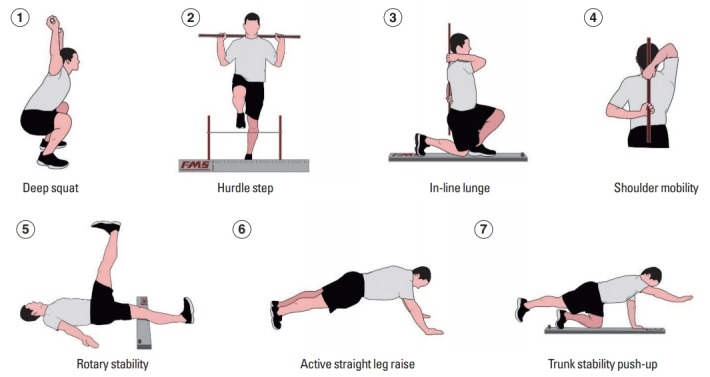
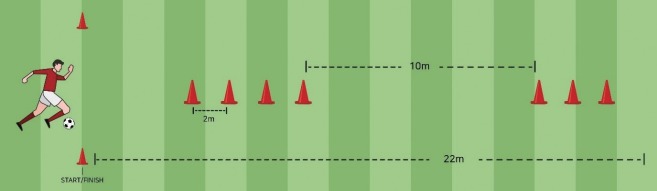
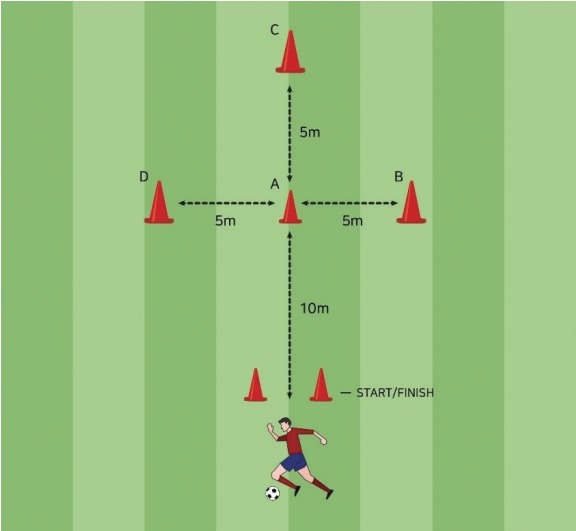
The objectives of this study were to compare the differences in physical performance of elite male collegiate soccer players according to the Functional Movement Screen (FMS) total scores and to investigate the association between the FMS total score and physical performance. A total of 20 elite male collegiate soccer players (mean age, 19.6±0.7 years; height, 173.4±4.4 cm; body weight, 66.9±7.3 kg; and body mass index, 22.0±2.0 kg/m) participated in the present study. The subjects were divided into two groups: the high FMS (FMS total score ≥14 points, n=10) and low FMS (FMS total score <14 points, n=10). All participants completed 10-m and 30-m sprint tests, the arrowhead agility test (right and left), and a coordination test. The statistical methods used to verify the study results were the independent sample -test and Kendall's Tau b correlation test. There were significant differences between the high and low FMS groups in the 10-m (=0.014) and 30-m sprint (=0.002) and arrowhead agility tests (right, =0.039). Conversely, there were no significant differences in the arrowhead agility (left) and coordination tests between the two groups (>0.05). Moreover, the FMS total score was found to have significant negative correlations with the 10-m sprint (=-0.444, =0.017), 30-m sprint (=-0.425, =0.016), and arrowhead agility tests (right, =-0.389, =0.023). These results suggest that higher FMS total scores could have a positive effect on the physical performance of the players.
本研究的目的是根据功能性动作筛查(FMS)总分比较精英男子大学足球运动员身体表现的差异,并研究FMS总分与身体表现之间的关联。共有20名精英男子大学足球运动员(平均年龄19.6±0.7岁;身高173.4±4.4厘米;体重66.9±7.3千克;体重指数22.0±2.0千克/平方米)参与了本研究。受试者被分为两组:高FMS组(FMS总分≥14分,n = 10)和低FMS组(FMS总分<14分,n = 10)。所有参与者均完成了10米和30米短跑测试、箭头敏捷性测试(左右)以及协调性测试。用于验证研究结果的统计方法为独立样本t检验和肯德尔tau b相关性检验。高FMS组和低FMS组在10米短跑(p = 0.014)、30米短跑(p = 0.002)和箭头敏捷性测试(右侧,p = 0.039)方面存在显著差异。相反,两组在箭头敏捷性测试(左侧)和协调性测试方面无显著差异(p>0.05)。此外,发现FMS总分与10米短跑(r = -0.444,p = 0.017)、30米短跑(r = -0.425,p = 0.016)以及箭头敏捷性测试(右侧,r = -0.389,p = 0.023)存在显著负相关。这些结果表明,较高的FMS总分可能对运动员的身体表现产生积极影响。