Dept. of Computer Science, ICMC-USP, Sao Carlos, Brazil.
Dept. of Computing and Mathematics, FFCLRP-USP, Ribeirao Preto, Brazil.
Sci Rep. 2019 Nov 14;9(1):16754. doi: 10.1038/s41598-019-53252-9.
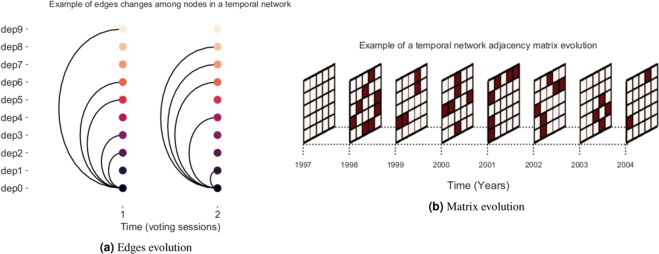
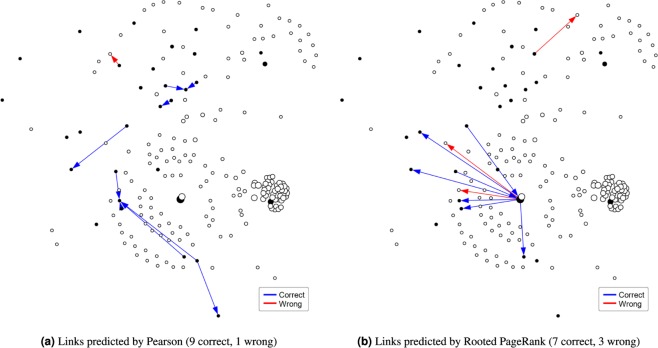
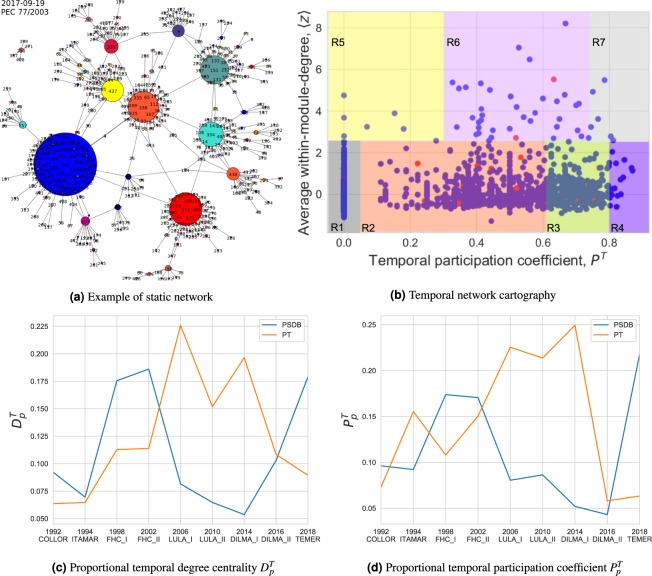
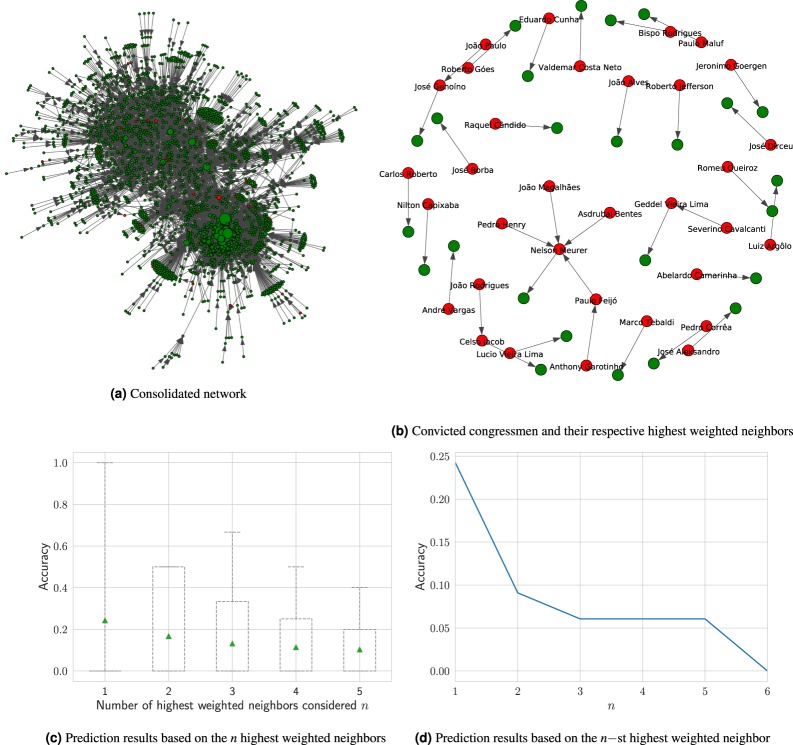
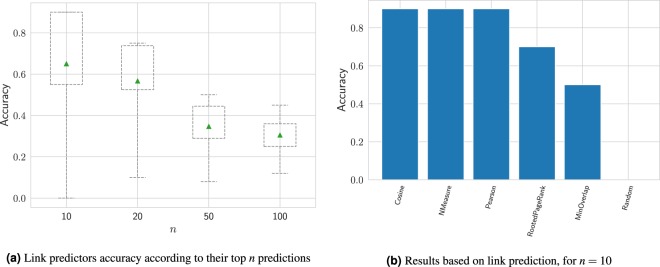
In this paper, we propose a network-based technique to analyze bills-voting data comprising the votes of Brazilian congressmen for a period of 28 years. The voting sessions are initially mapped into static networks, where each node represents a congressman and each edge stands for the similarity of votes between a pair of congressmen. Afterwards, the constructed static networks are converted to temporal networks. Our analyses on the temporal networks capture some of the main political changes happened in Brazil during the period of time under consideration. Moreover, we find out that the bills-voting networks can be used to identify convicted politicians, who commit corruption or other financial crimes. Therefore, we propose two conviction prediction methods, one is based on the highest weighted convicted neighbor and the other is based on link prediction techniques. It is a surprise to us that the high accuracy (up to 90% by the link prediction method) on predicting convictions is achieved only through bills-voting data, without taking into account any financial information beforehand. Such a feature makes possible to monitor congressmen just by considering their legal public activities. In this way, our work contributes to the large scale public data study using complex networks.
在本文中,我们提出了一种基于网络的技术,用于分析包含巴西国会议员 28 年投票数据的法案投票数据。投票会议最初被映射到静态网络中,其中每个节点代表一名国会议员,每条边代表一对国会议员之间投票的相似性。之后,构建的静态网络被转换为时间网络。我们对时间网络的分析捕捉到了在考虑的时间段内巴西发生的一些主要政治变化。此外,我们发现法案投票网络可用于识别犯有腐败或其他金融犯罪的被定罪政客。因此,我们提出了两种定罪预测方法,一种是基于最高加权定罪邻居的方法,另一种是基于链路预测技术的方法。令我们惊讶的是,仅通过法案投票数据即可实现高准确率(通过链路预测方法高达 90%)的定罪预测,而无需事先考虑任何财务信息。这样的功能使得仅通过考虑他们的合法公共活动就可以对国会议员进行监督。通过这种方式,我们的工作为使用复杂网络进行大规模公共数据研究做出了贡献。