Departamento de Física, Universidade Estadual de Maringá, Maringá, PR, 87020-900, Brazil.
Rio Grande do Sul Superintendency, Brazilian Federal Police, Porto Alegre, RS, 90160-093, Brazil.
Sci Rep. 2022 Sep 21;12(1):15746. doi: 10.1038/s41598-022-20025-w.
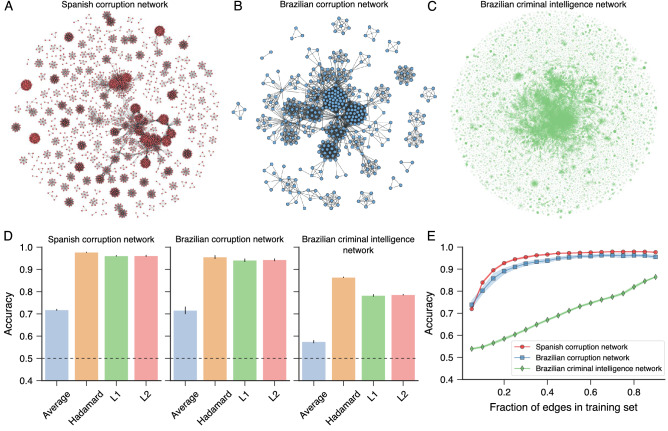
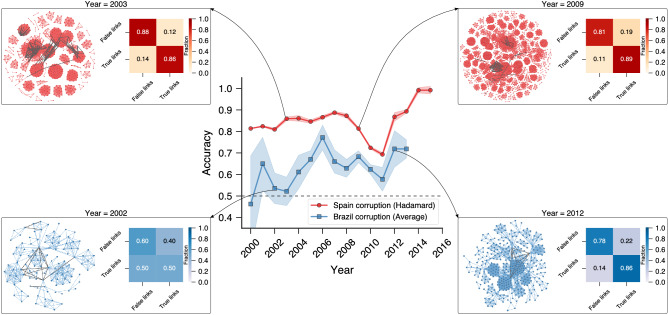
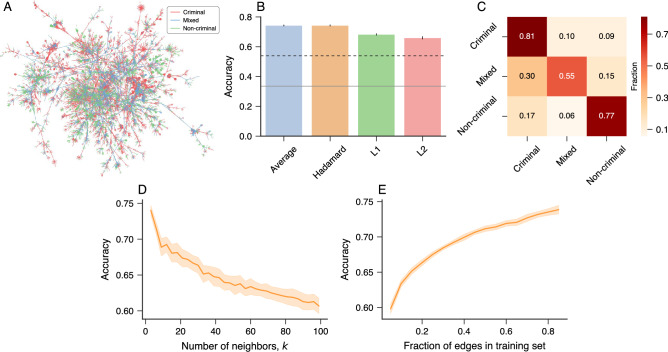
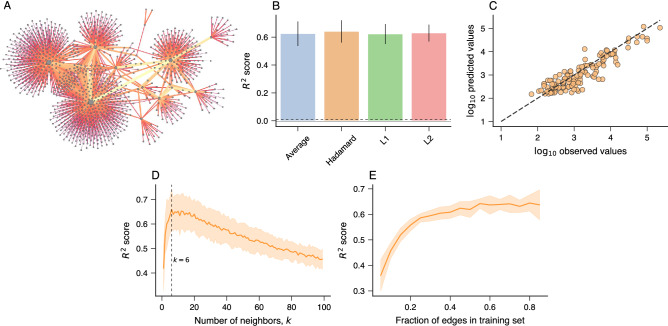
Recent research has shown that criminal networks have complex organizational structures, but whether this can be used to predict static and dynamic properties of criminal networks remains little explored. Here, by combining graph representation learning and machine learning methods, we show that structural properties of political corruption, police intelligence, and money laundering networks can be used to recover missing criminal partnerships, distinguish among different types of criminal and legal associations, as well as predict the total amount of money exchanged among criminal agents, all with outstanding accuracy. We also show that our approach can anticipate future criminal associations during the dynamic growth of corruption networks with significant accuracy. Thus, similar to evidence found at crime scenes, we conclude that structural patterns of criminal networks carry crucial information about illegal activities, which allows machine learning methods to predict missing information and even anticipate future criminal behavior.
最近的研究表明,犯罪网络具有复杂的组织结构,但这是否可以用于预测犯罪网络的静态和动态特性,仍鲜有研究。在这里,我们通过结合图表示学习和机器学习方法,表明政治腐败、警方情报和洗钱网络的结构特性可用于恢复缺失的犯罪伙伴关系,区分不同类型的犯罪和合法组织,以及预测犯罪代理人之间交换的总金额,准确率都非常高。我们还表明,我们的方法可以在腐败网络的动态增长过程中以很高的准确性预测未来的犯罪关系。因此,就像在犯罪现场发现的证据一样,我们得出结论,犯罪网络的结构模式携带有关于非法活动的关键信息,这使得机器学习方法能够预测缺失的信息,甚至可以预测未来的犯罪行为。