Department of Public Health and Policy, University of Liverpool, 3rd Floor, Whelan Building, Brownlow Hill, Liverpool, L69 3GB, UK.
Department of Prevention and Medical Education, Medical University of Gdansk, Gdansk, Poland.
Diabetologia. 2020 Jan;63(1):104-115. doi: 10.1007/s00125-019-05015-4. Epub 2019 Nov 15.
AIMS/HYPOTHESIS: Diabetes is associated with an increased risk of dementia. We estimated the potential impact of trends in diabetes prevalence upon mortality and the future burden of dementia and disability in England and Wales.
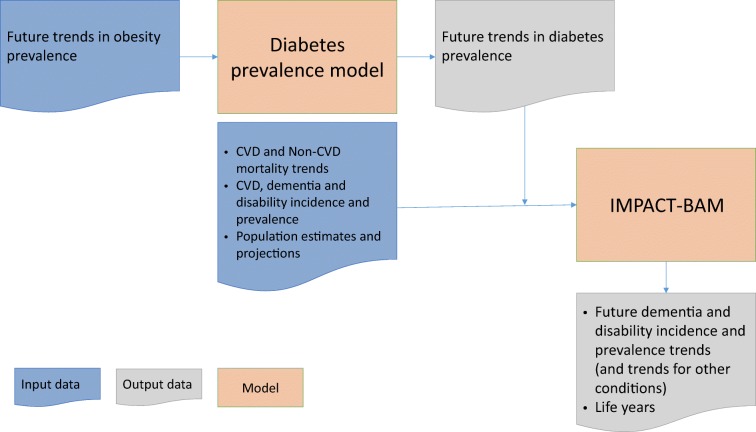
We used a probabilistic multi-state, open cohort Markov model to integrate observed trends in diabetes, cardiovascular disease and dementia to forecast the occurrence of disability and dementia up to the year 2060. Model input data were taken from the English Longitudinal Study of Ageing, Office for National Statistics vital data and published effect estimates for health-state transition probabilities. The baseline scenario corresponded to recent trends in obesity: a 26% increase in the number of people with diabetes by 2060. This scenario was evaluated against three alternative projected trends in diabetes: increases of 49%, 20% and 7%.
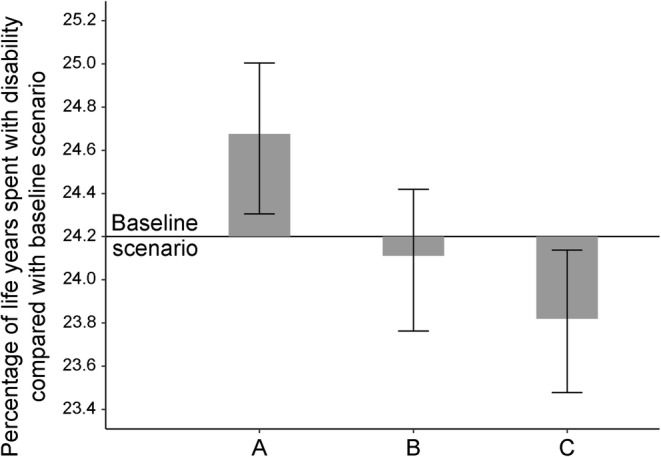
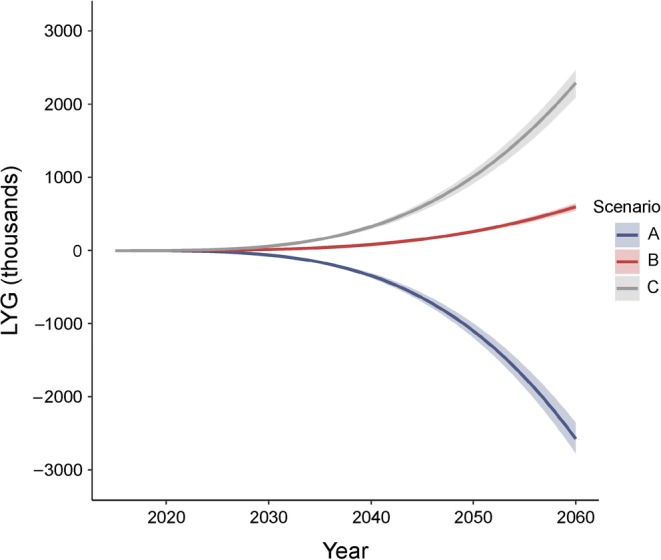
Our results suggest that changes in the trend in diabetes prevalence will lead to changes in mortality and incidence of dementia and disability, which will become visible after 10-15 years. If the relative prevalence of diabetes increases 49% by 2060, expected additional deaths would be approximately 255,000 (95% uncertainty interval [UI] 236,000-272,200), with 85,900 (71,500-101,600) cumulative additional cases of dementia and 104,900 (85,900-125,400) additional cases of disability. With a smaller relative increase in diabetes prevalence (7% increase by 2060), we estimated 222,200 (205,700-237,300) fewer deaths, and 77,000 (64,300-90,800) and 93,300 (76,700-111,400) fewer additional cases of dementia and disability, respectively, than the baseline case of a 26% increase in diabetes.
CONCLUSIONS/INTERPRETATION: Reducing the burden of diabetes could result in substantial reductions in the incidence of dementia and disability over the medium to long term.
目的/假设:糖尿病与痴呆风险增加有关。我们估计糖尿病患病率趋势对英格兰和威尔士的死亡率和未来痴呆症及残疾负担的潜在影响。
我们使用概率多状态、开放式队列马尔可夫模型,将糖尿病、心血管疾病和痴呆的观察趋势整合起来,预测 2060 年前残疾和痴呆的发生情况。模型输入数据取自英国老龄化纵向研究、国家统计局生命数据和已发表的健康状态转变概率影响估计。基线情景对应于肥胖的近期趋势:到 2060 年,糖尿病患者人数增加 26%。该情景与糖尿病三种不同预测趋势进行了对比:增加 49%、20%和 7%。
我们的研究结果表明,糖尿病患病率趋势的变化将导致痴呆和残疾的死亡率和发病率发生变化,这种变化将在 10-15 年后显现出来。如果到 2060 年糖尿病的相对流行率增加 49%,预计将增加约 25.5 万人死亡(95%置信区间[UI]23.6 万至 27.22 万),8.59 万(7.15 万至 10.16 万)例累积的痴呆症新发病例和 10.49 万(8.59 万至 12.54 万)例新的残疾病例。如果糖尿病的相对流行率增加较小(2060 年增加 7%),我们估计死亡人数将减少 22.22 万(20.57 万至 23.73 万),痴呆症和残疾的新发病例将分别减少 7.7 万(6.43 万至 9.08 万)和 9.33 万(7.67 万至 11.14 万),而不是糖尿病增加 26%的基线病例。
结论/解释:减少糖尿病的负担可能会在中短期内大大减少痴呆症和残疾的发病率。