Fan Lei, Zhou Peng, Chen Ao-Xiang, Liu Guang-Yu, Yu Ke-Da, Shao Zhi-Ming
Department of Breast Surgery, Fudan University Shanghai Cancer Center, Department of Oncology, Shanghai Medical College, Fudan University, Shanghai, 200032, P.R. China.
Parkway Health, Shanghai, P.R. China.
Oncoimmunology. 2019 Oct 15;8(12):e1673126. doi: 10.1080/2162402X.2019.1673126. eCollection 2019.
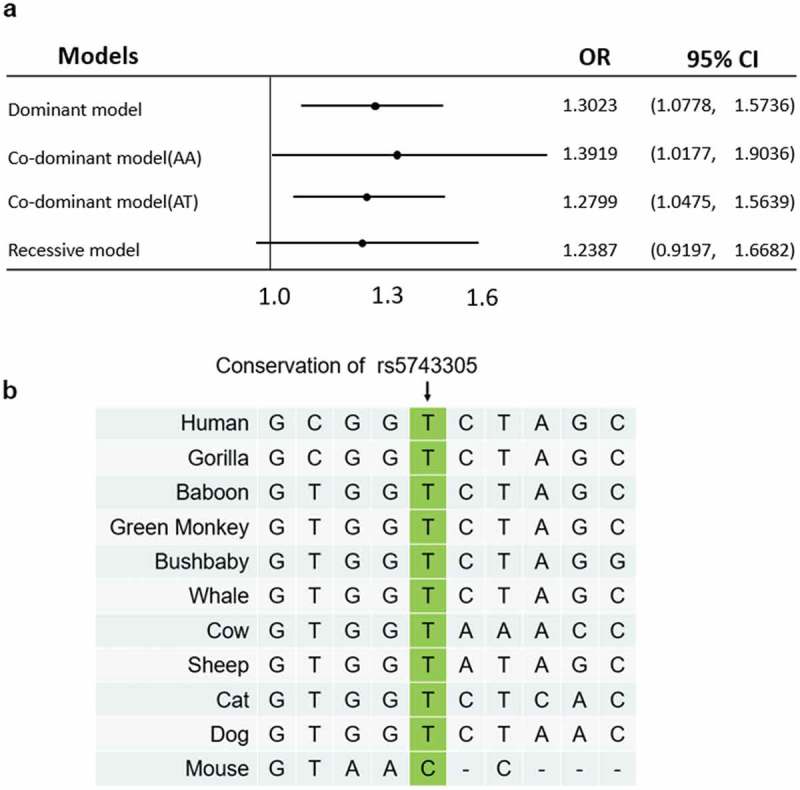
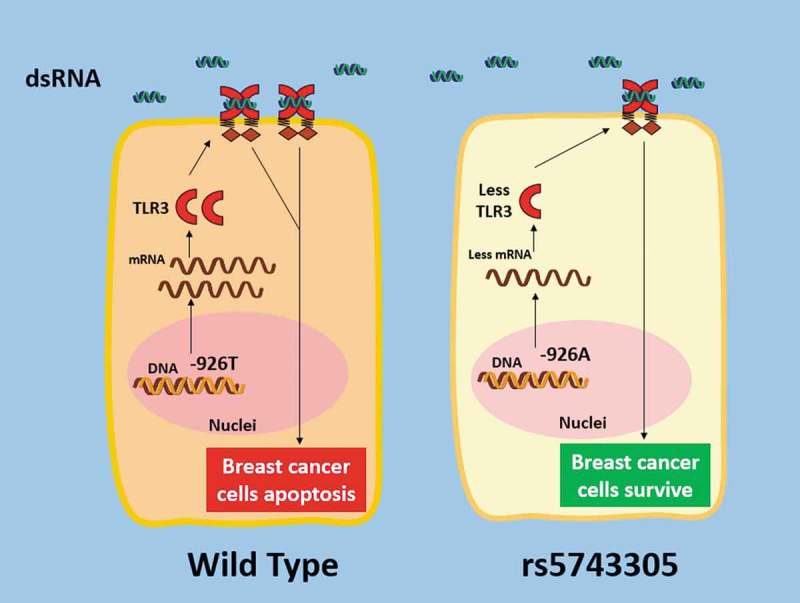
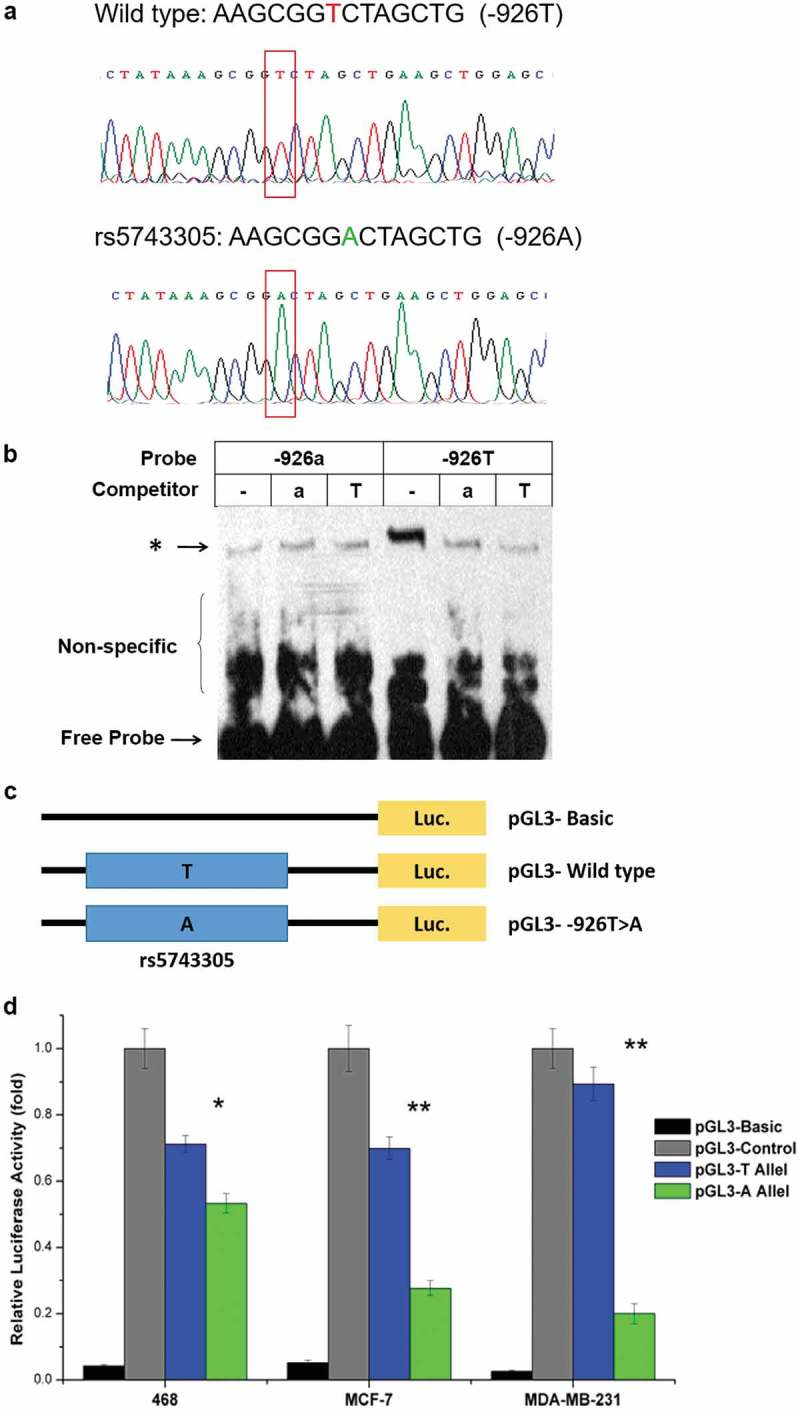
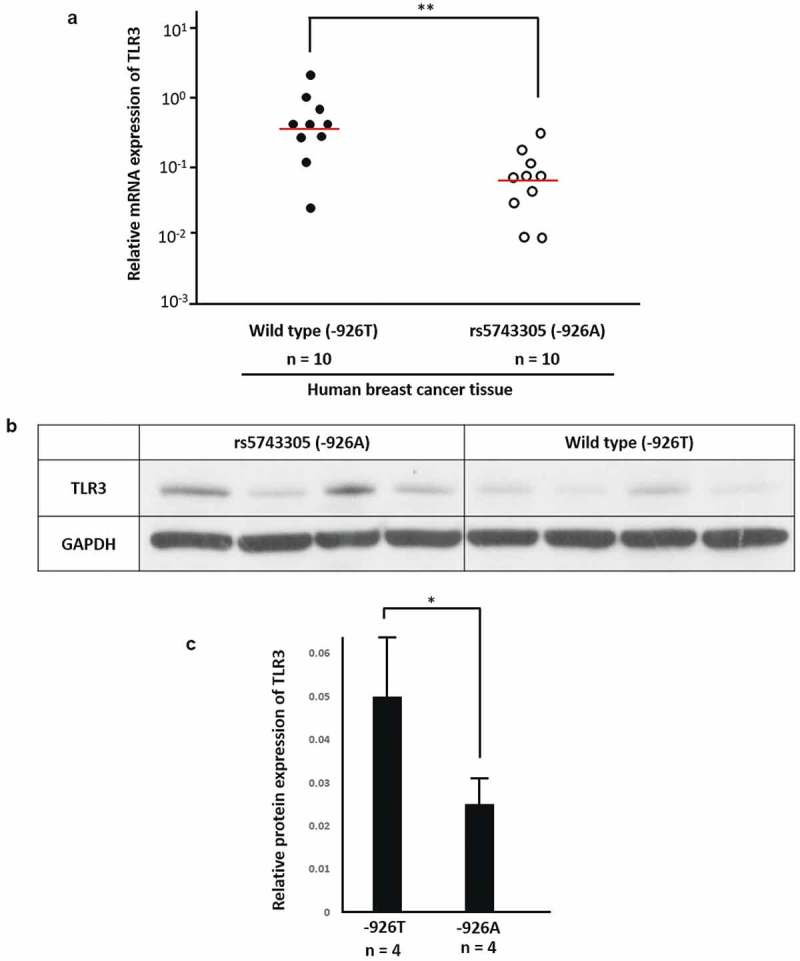
Toll-like receptor 3 (TLR3) is a viral sensor that induces apoptosis in response to double-stranded RNA (dsRNA). Common genetic changes in the TLR3 gene may influence breast cancer susceptibility and development. However, all of the polymorphisms in the previous study were only markers of the TLR3 gene, not causative polymorphisms. In this study, we performed a case-control study focusing on the relationship between rs5743305 (-926T>A), a single nucleotide polymorphism (SNP) in the promoter region of TLR3, and breast cancer. We found that the genetic variant rs5743305 increased the risk of breast cancer under the dominant and codominant models (dominant model: AT+AA vs TT.: OR = 1.3023, 95%CI: 1.0778-1.5736, = .0062; codominant model: AA vs. TT: OR = 1.3919, 95%CI: 1.0177-1.9036, = .0384; AT vs. TT: OR = 1.2799, 95%CI: 1.0475-1.5639, = .0158) but not under the recessive model (TT vs. AT+AA, OR = 1.2387, 95%CI: 0.9197-1.6682, = .1588). The same trends were found in the age-adjusted logistic regression study and stage 2 study. Furthermore, the electrophoretic mobility shift assay (EMSA) and luciferase reporter assay showed that rs5743305 decreased the transcriptional activity of TLR3. There was consistently reduced TLR3 mRNA and protein expression in human breast cancer samples from patients with TLR3 - 926A. Therefore, TLR3 rs5743305 increases the risk of breast cancer by decreasing the transcriptional activity of TLR3. This study may provide a better understanding of the genetic architecture underlying disease susceptibility and may advance the potential for preclinical prediction in future genetic testing.
Toll样受体3(TLR3)是一种病毒传感器,可响应双链RNA(dsRNA)诱导细胞凋亡。TLR3基因的常见遗传变化可能会影响乳腺癌的易感性和发展。然而,先前研究中的所有多态性都只是TLR3基因的标记,而非致病多态性。在本研究中,我们进行了一项病例对照研究,重点关注TLR3启动子区域的单核苷酸多态性(SNP)rs5743305(-926T>A)与乳腺癌之间的关系。我们发现,在显性和共显性模型下,基因变体rs5743305增加了乳腺癌风险(显性模型:AT+AA与TT相比:OR = 1.3023,95%CI:1.0778 - 1.5736,P = 0.0062;共显性模型:AA与TT相比:OR = 1.3919,95%CI:1.0177 - 1.9036,P = 0.0384;AT与TT相比:OR = 1.2799,95%CI:1.0475 - 1.5639,P = 0.0158),但在隐性模型下未增加(TT与AT+AA相比,OR = 1.2387,95%CI:0.9197 - 1.6682,P = 0.1588)。在年龄调整的逻辑回归研究和二期研究中也发现了相同趋势。此外,电泳迁移率变动分析(EMSA)和荧光素酶报告基因分析表明,rs5743305降低了TLR3的转录活性。在携带TLR3 - 926A的患者的人乳腺癌样本中,TLR3 mRNA和蛋白表达一直降低。因此,TLR3 rs5743305通过降低TLR3的转录活性增加了乳腺癌风险。本研究可能有助于更好地理解疾病易感性的遗传结构,并可能提高未来基因检测中临床前预测的潜力。