Department of Mechanical and Industrial Engineering, University of Illinois at Chicago, Chicago, IL, United States of America.
PLoS One. 2019 Nov 19;14(11):e0225002. doi: 10.1371/journal.pone.0225002. eCollection 2019.
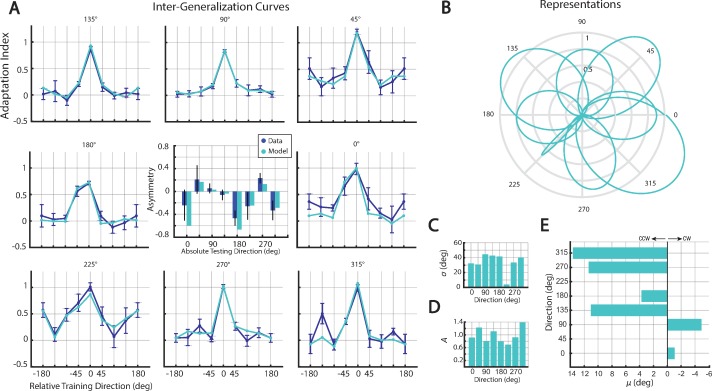
When learning a new motor behavior, e.g. reaching in a force field, the nervous system builds an internal representation. Examining how subsequent reaches in unpracticed directions generalize reveals this representation. Although often studied, it is not known how this representation changes across training directions, or how changes in reach direction and the corresponding changes in limb impedance, influence these measurements. We ran a force field adaptation experiment using eight groups of subjects each trained on one of eight standard directions and then tested for generalization in the remaining seven directions. Generalization in all directions was local and asymmetric, providing limited and unequal transfer to the left and right side of the trained target. These asymmetries were not consistent in either magnitude or direction, even after correcting for changes in limb impedance. Relying on a standard model for generalization the inferred representations inconsistently shifted to one side or the other of their respective training direction. A second model that accounted for limb impedance and variations in baseline trajectories explained more data and the inferred representations were centered on their respective training directions. Our results highlight the influence of limb mechanics and impedance on psychophysical measurements and their interpretations for motor learning.
当学习新的运动行为,例如在力场中进行伸展,神经系统会构建内部表示。通过检查在未练习的方向上进行后续伸展的泛化情况,可以揭示这种表示。尽管经常进行研究,但尚不清楚这种表示如何随训练方向而变化,或者伸展方向的变化和相应的肢体阻抗变化如何影响这些测量。我们进行了一项力场适应实验,使用八组受试者,每组受试者分别在八个标准方向上进行训练,然后在其余七个方向上进行测试以进行泛化。所有方向的泛化都是局部和不对称的,对训练目标的左右两侧提供了有限且不均等的转移。即使在校正了肢体阻抗的变化后,这些不对称性在幅度和方向上也不一致。依赖于一种用于泛化的标准模型,推断的表示不一致地偏向于其各自训练方向的一侧或另一侧。第二个考虑了肢体阻抗和基线轨迹变化的模型解释了更多的数据,并且推断的表示集中在各自的训练方向上。我们的结果强调了肢体力学和阻抗对运动学习的心理物理学测量及其解释的影响。