Jung Ah Yeoun, Kim Young Hyo
Department of Otorhinolaryngology, Inha University School of Medicine, Incheon, Korea.
Allergy Asthma Immunol Res. 2020 Jan;12(1):110-124. doi: 10.4168/aair.2020.12.1.110.
We evaluated the severity of olfactory disturbance (OD) in the murine model of allergic rhinitis (AR) and local allergic rhinitis (LAR) in mice. We also investigated the therapeutic effect of an intranasal steroid on OD.
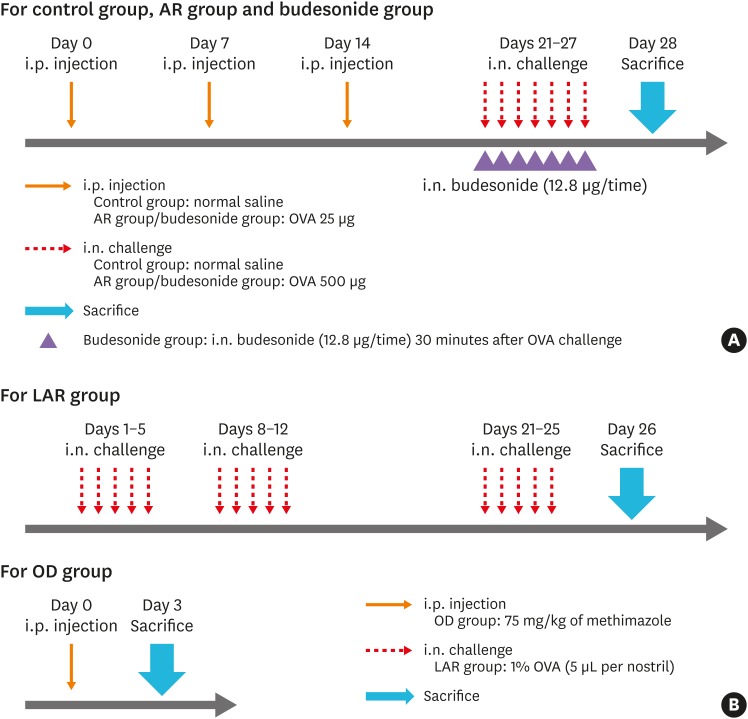
Forty BALB/c mice were divided into 5 groups (n = 8 for each). The control group was sensitized intraperitoneally (i.p.) and challenged intranasally (i.n.) with saline. Mice in the AR group got i.p. and i.n. ovalbumin (OVA) administration for AR induction. The LAR group was challenged i.n. with 1% OVA for inducing local nasal allergic inflammation, without inducing the systemic allergy. The OD group got an i.p. methimazole administration (75 mg/kg) to induce total destruction of olfactory mucosa. Mice in the intranasal budesonide group received i.n. budesonide (12.8 μ per time, 30 minutes after the i.n. OVA challenge) while using OVA to cause systemic allergies. We conducted a buried-food pellet test to functionally assess the degree of OD in each group by measuring the time taken until finding hidden food. We evaluated the damage to olfactory epithelium using histopathologic evaluation and compared the degree of olfactory marker protein (OMP) expression in olfactory epithelium using immunofluorescent staining.
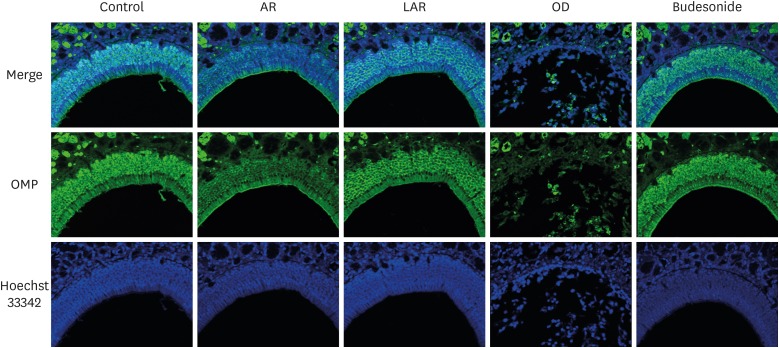
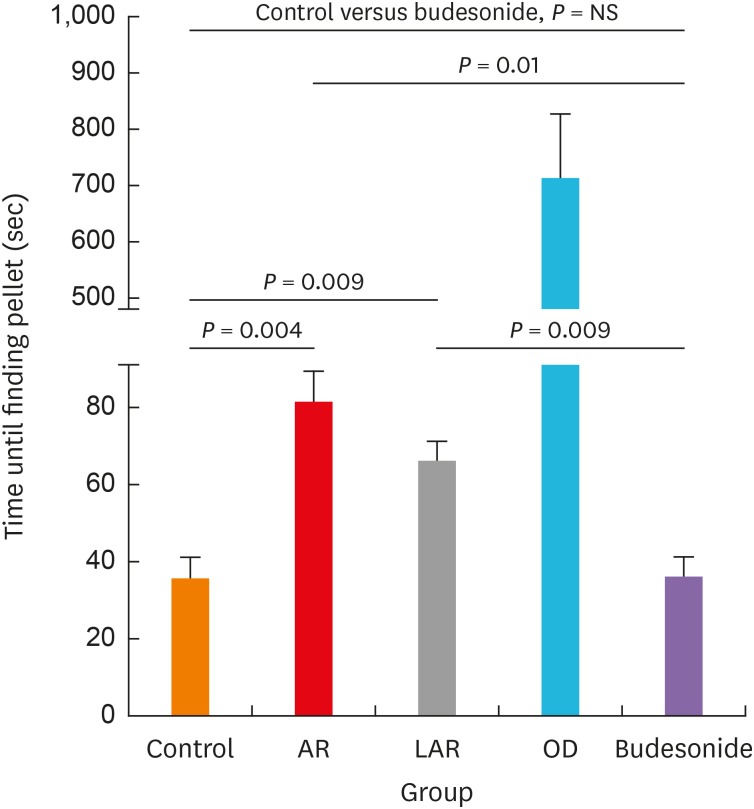
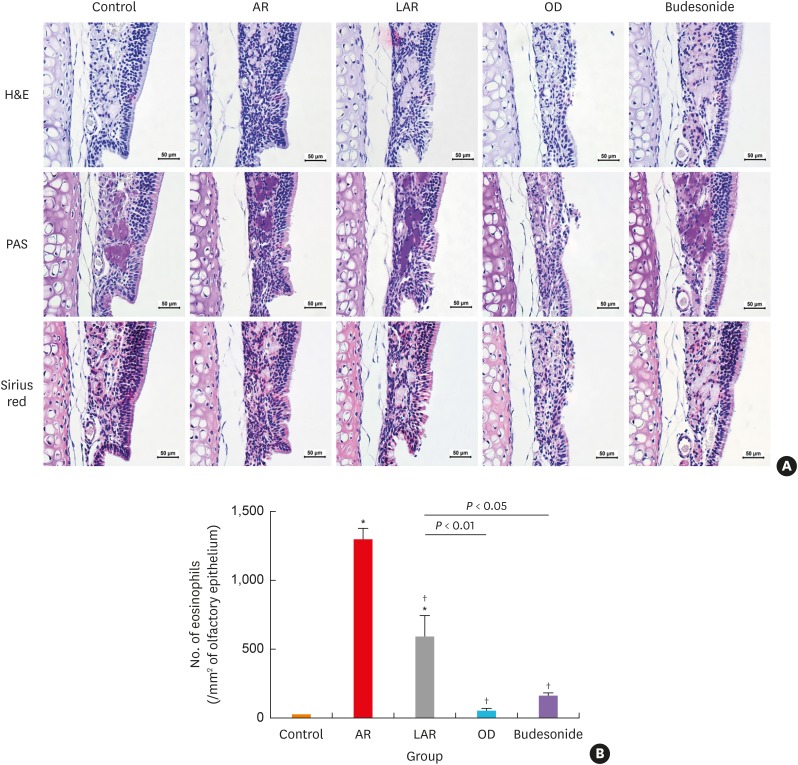
Mice of the AR (81.3 ± 19.8 seconds) and LAR groups (66.2 ± 12.7 seconds) spent significantly more time to detect the pellets than the control group (35.6 ± 12.2 seconds, < 0.01). After treatment, the intranasal budesonide group exhibited significantly better results (35.8 ± 11.9 seconds) compared with the AR and LAR groups ( < 0.01). The AR and LAR groups showed considerable olfactory epithelial damage and suppression of OMP expression compared with the control group. In the intranasal budesonide group, the olfactory lesions and OMP expression had improved substantially.
OD may be caused by olfactory epithelial damage and suppression of OMP expression in nasal allergic inflammation and could be reversed using an intranasal steroid.
我们评估了小鼠变应性鼻炎(AR)和局部变应性鼻炎(LAR)模型中嗅觉障碍(OD)的严重程度。我们还研究了鼻用类固醇对OD的治疗效果。
将40只BALB/c小鼠分为5组(每组n = 8)。对照组经腹腔内(i.p.)致敏,并用盐水经鼻内(i.n.)激发。AR组小鼠经腹腔内和鼻内给予卵清蛋白(OVA)以诱导AR。LAR组经鼻内给予1%OVA以诱导局部鼻变应性炎症,而不诱导全身过敏。OD组经腹腔内给予甲巯咪唑(75 mg/kg)以诱导嗅觉黏膜完全破坏。鼻内布地奈德组小鼠在经鼻内给予OVA激发后30分钟,经鼻内给予布地奈德(每次12.8 μ),同时使用OVA引起全身过敏。我们进行了埋藏食物颗粒试验,通过测量找到隐藏食物所需的时间来从功能上评估每组中OD的程度。我们使用组织病理学评估来评估嗅觉上皮的损伤,并使用免疫荧光染色比较嗅觉上皮中嗅觉标记蛋白(OMP)的表达程度。
AR组(81.3±19.8秒)和LAR组(66.2±12.7秒)的小鼠检测颗粒花费的时间明显多于对照组(35.6±12.2秒,P<0.01)。治疗后,鼻内布地奈德组与AR组和LAR组相比,表现出明显更好的结果(35.8±11.9秒,P<0.01)。与对照组相比,AR组和LAR组显示出相当程度的嗅觉上皮损伤和OMP表达抑制。在鼻内布地奈德组中,嗅觉病变和OMP表达有显著改善。
OD可能是由鼻变应性炎症中嗅觉上皮损伤和OMP表达抑制引起的,并且可以使用鼻用类固醇逆转。