Faculty of Medicine, Assiut University, Assiut, Egypt.
International Scholar, African Leadership Academy, 1050 Printech Road, Laser Park, Honeydew, Johannesburg, South Africa.
J Neurovirol. 2022 Apr;28(2):189-200. doi: 10.1007/s13365-022-01060-9. Epub 2022 Mar 5.
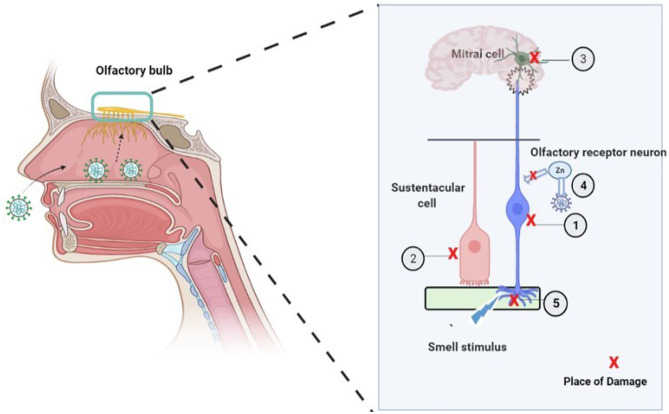
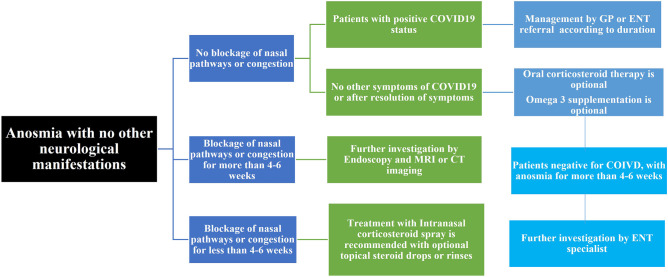
COVID-19 pandemic spreads worldwide, with more than 100 million positive cases and more than 2 million deaths. From the beginning of the COVID-19 pandemic, several otolaryngologists described many cases of a sudden loss of smell (anosmia) associated with the disease with or without additional symptoms. Anosmia is often the first and sometimes the only sign in the asymptomatic carriers of COVID-19. Still, this disorder is underestimated, and it is not life-threatening. However, it significantly decreases the quality of life. This olfactory dysfunction continues in several cases even after the nasopharyngeal swab was negative. The occurrence of anosmia can be used as a screening tool for COVID-19 patients and can be used to identify these patients to accomplish the isolation and tracking procedures. In this review, we highlighted the possible mechanisms of anosmia in COVID-19 patients, major pathologies and features of anosmia, implications of anosmia in early diagnosis of COVID-19, evaluation of the smell function during COVID-19, and management and treatment options of COVID-19 anosmia.
新冠疫情在全球蔓延,累计确诊病例超过 1 亿例,死亡病例超过 200 万例。自新冠疫情开始以来,多位耳鼻喉科医生描述了许多与该疾病相关的突发性嗅觉丧失(嗅觉障碍)病例,这些病例伴有或不伴有其他症状。嗅觉障碍通常是新冠无症状感染者的首发症状,有时也是唯一症状。尽管如此,这种疾病仍被低估,且不会危及生命,但它会显著降低生活质量。在一些情况下,即使鼻咽拭子检测结果为阴性,这种嗅觉功能障碍仍会持续存在。嗅觉障碍的发生可作为新冠患者的筛查工具,有助于识别这些患者,从而完成隔离和追踪程序。在这篇综述中,我们强调了新冠患者发生嗅觉障碍的可能机制、嗅觉障碍的主要病理和特征、嗅觉障碍对新冠早期诊断的意义、新冠期间嗅觉功能的评估,以及新冠嗅觉障碍的治疗选择。