Blood. 2019 Nov 21;134(21):1796-1801. doi: 10.1182/blood.2019001321.
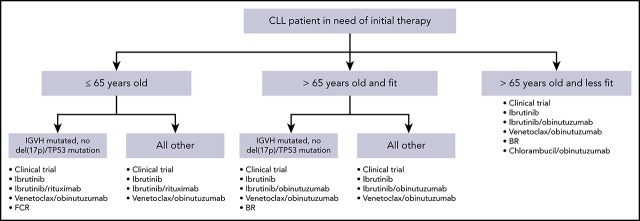
The management of chronic lymphocytic leukemia (CLL) has undergone dramatic changes over the previous 2 decades with the introduction of multiple new therapies and new combinations. Management of the newly diagnosed asymptomatic patient has not significantly changed outside of the development of a number of prognostic factors and the CLL International Prognostic Index, which is helpful in discussions regarding prognosis and likelihood of requiring treatment. When therapy is required, initial treatment of most patients now includes either the Bruton tyrosine kinase inhibitor ibrutinib or the B-cell lymphoma 2 inhibitor venetoclax in combination with obinutuzumab. Current frontline trials are focused on the optimal sequencing or combination of targeted therapies. In this review, we will discuss the management of previously untreated CLL with an emphasis on the clinical trials that have formed the standard of care, as well as those newer studies that are likely to form the next generation of therapy.
过去 20 年来,慢性淋巴细胞白血病(CLL)的治疗发生了重大变化,引入了多种新疗法和新组合。除了开发出一些预后因素和 CLL 国际预后指数外,新诊断的无症状患者的管理并没有显著改变,这些因素有助于讨论预后和需要治疗的可能性。当需要治疗时,目前大多数患者的初始治疗包括 Bruton 酪氨酸激酶抑制剂伊布替尼或 B 细胞淋巴瘤 2 抑制剂维奈托克联合奥滨尤妥珠单抗。目前的一线临床试验主要集中在靶向治疗的最佳序贯或联合应用上。在这篇综述中,我们将讨论未经治疗的 CLL 的治疗管理,重点介绍构成护理标准的临床试验,以及那些可能成为下一代治疗方法的新研究。