Centre for Research and Innovation in Care (CRIC), Department of Nursing and Midwifery Sciences, University of Antwerp, Universiteitsplein 1, 2610, Wilrijk, Belgium.
Department of emergency medicine, Antwerp University Hospital, University of Antwerp, Wilrijkstraat 10, 2650, Edegem, Belgium.
BMC Health Serv Res. 2019 Nov 21;19(1):864. doi: 10.1186/s12913-019-4688-7.
Growing evidence indicates that improved nurse staffing in acute hospitals is associated with lower hospital mortality. Current research is limited to studies using hospital level data or without proper adjustment for confounders which makes the translation to practice difficult.
In this observational study we analysed retrospectively the control group of a stepped wedge randomised controlled trial concerning 14 medical and 14 surgical wards in seven Belgian hospitals. All patients admitted to these wards during the control period were included in this study. Pregnant patients or children below 17 years of age were excluded. In all patients, we collected age, crude ward mortality, unexpected death, cardiac arrest with Cardiopulmonary Resuscitation (CPR), and unplanned admission to the Intensive Care Unit (ICU). A composite mortality measure was constructed including unexpected death and death up to 72 h after cardiac arrest with CPR or unplanned ICU admission. Every 4 months we obtained, from 30 consecutive patient admissions across all wards, the Charlson comorbidity index. The amount of nursing hours per patient days (NHPPD) were calculated every day for 15 days, once every 4 months. Data were aggregated to the ward level resulting in 68 estimates across wards and time. Linear mixed models were used since they are most appropriate in case of clustered and repeated measures data.
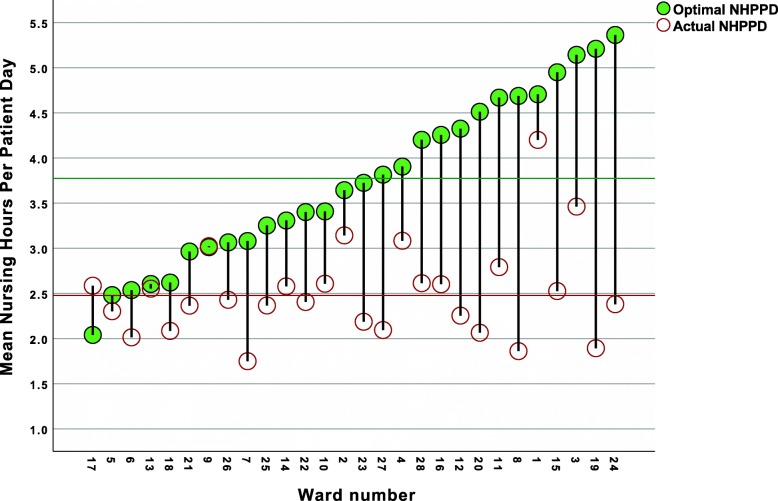
The unexpected death rate was 1.80 per 1000 patients. Up to 0.76 per 1000 patients died after CPR and 0.62 per 1000 patients died after unplanned admission to the ICU. The mean composite mortality was 3.18 per 1000 patients. The mean NHPPD and proportion of nurse Bachelor hours were respectively 2.48 and 0.59. We found a negative association between the nursing hours per patient day and the composite mortality rate adjusted for possible confounders (B = - 2.771, p = 0.002). The proportion of nurse Bachelor hours was negatively correlated with the composite mortality rate in the same analysis (B = - 8.845, p = 0.023). Using the regression equation, we calculated theoretically optimal NHPPDs.
This study confirms the association between higher nurse staffing levels and lower patient mortality controlled for relevant confounders.
越来越多的证据表明,提高急性医院的护士配备水平与降低医院死亡率有关。目前的研究仅限于使用医院层面数据的研究,或者没有对混杂因素进行适当调整,这使得研究结果难以转化为实践。
在这项观察性研究中,我们回顾性分析了比利时 7 家医院的 14 个内科和 14 个外科病房的 stepped wedge 随机对照试验的对照组。在对照期间,所有入住这些病房的患者均纳入本研究。排除孕妇和 17 岁以下的儿童。在所有患者中,我们收集了年龄、未经调整的病房死亡率、意外死亡、心脏骤停伴心肺复苏(CPR)以及非计划转入重症监护病房(ICU)。构建了一个复合死亡率指标,包括意外死亡和心脏骤停伴 CPR 或非计划 ICU 入院后 72 小时内的死亡。每 4 个月,我们从所有病房的 30 名连续入院患者中获得 Charlson 合并症指数。每天计算每位患者每天的护理小时数(NHPPD),每 4 个月计算一次。数据汇总到病房水平,得出 68 个病房和时间的估计值。由于存在聚类和重复测量数据,因此使用线性混合模型。
意外死亡率为每 1000 名患者 1.80 人。每 1000 名患者中有 0.76 人在 CPR 后死亡,每 1000 名患者中有 0.62 人在非计划转入 ICU 后死亡。复合死亡率的平均值为每 1000 名患者 3.18 人。NHPPD 的平均值和护士学士小时的比例分别为 2.48 和 0.59。我们发现,在调整了可能的混杂因素后,每患者每日护理小时数与复合死亡率之间存在负相关(B = -2.771,p = 0.002)。在相同的分析中,护士学士小时的比例与复合死亡率呈负相关(B = -8.845,p = 0.023)。使用回归方程,我们计算了理论上的最佳 NHPPD。
本研究证实了在控制相关混杂因素的情况下,较高的护士配备水平与较低的患者死亡率之间存在关联。