Faculty of Medicine, Dentistry and Health Sciences, The University of Melbourne, Parkville, VIC, Australia.
School of Public Health and Preventive Medicine, Monash University, 553 St Kilda Road, Melbourne, VIC, 3004, Australia.
BMC Med. 2019 Nov 22;17(1):208. doi: 10.1186/s12916-019-1452-0.
Tuberculosis (TB) control efforts are hampered by an imperfect understanding of TB epidemiology. The true age distribution of disease is unknown because a large proportion of individuals with active TB remain undetected. Understanding of transmission is limited by the asymptomatic nature of latent infection and the pathogen's capacity for late reactivation. A better understanding of TB epidemiology is critically needed to ensure effective use of existing and future control tools.
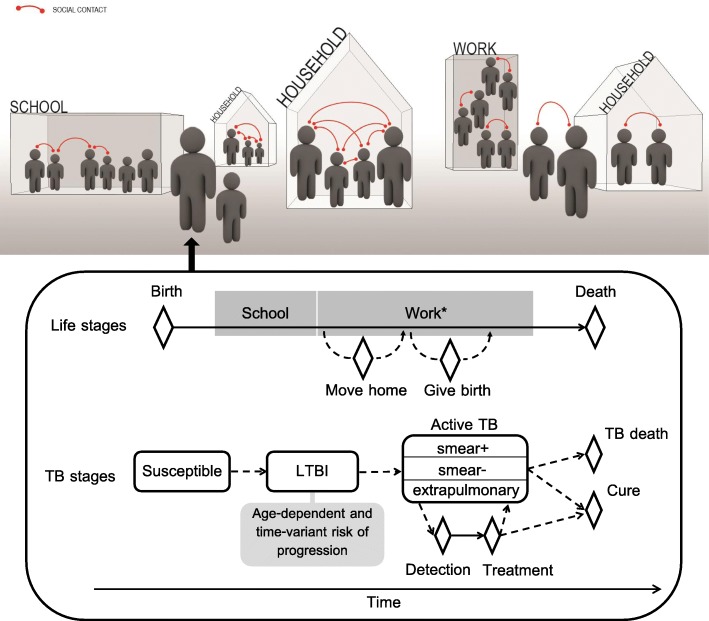
We use an agent-based model to simulate TB epidemiology in the five highest TB burden countries-India, Indonesia, China, the Philippines and Pakistan-providing unique insights into patterns of transmission and disease. Our model replicates demographically realistic populations, explicitly capturing social contacts between individuals based on local estimates of age-specific contact in household, school and workplace settings. Time-varying programmatic parameters are incorporated to account for the local history of TB control.
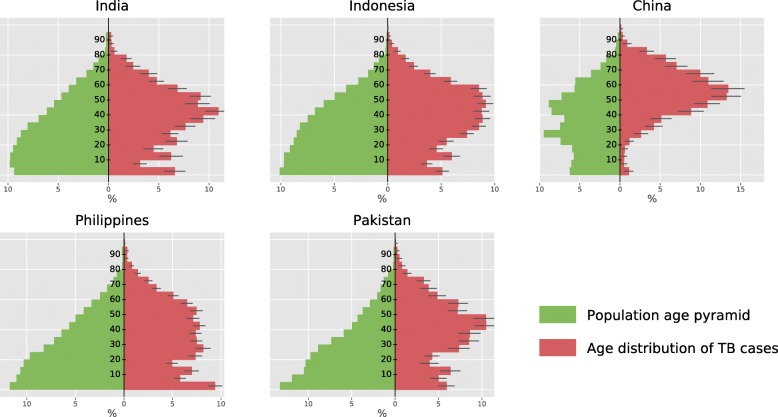
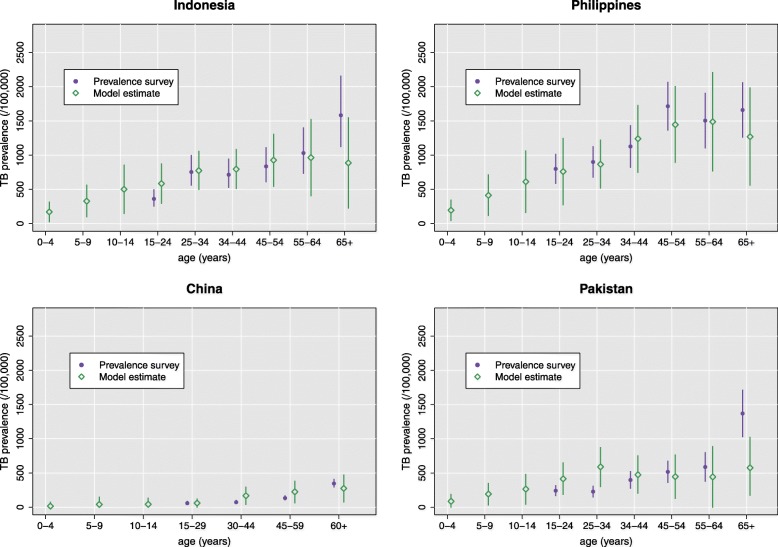
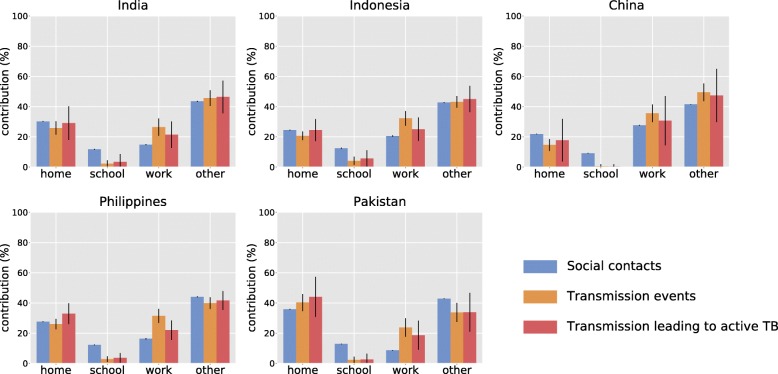
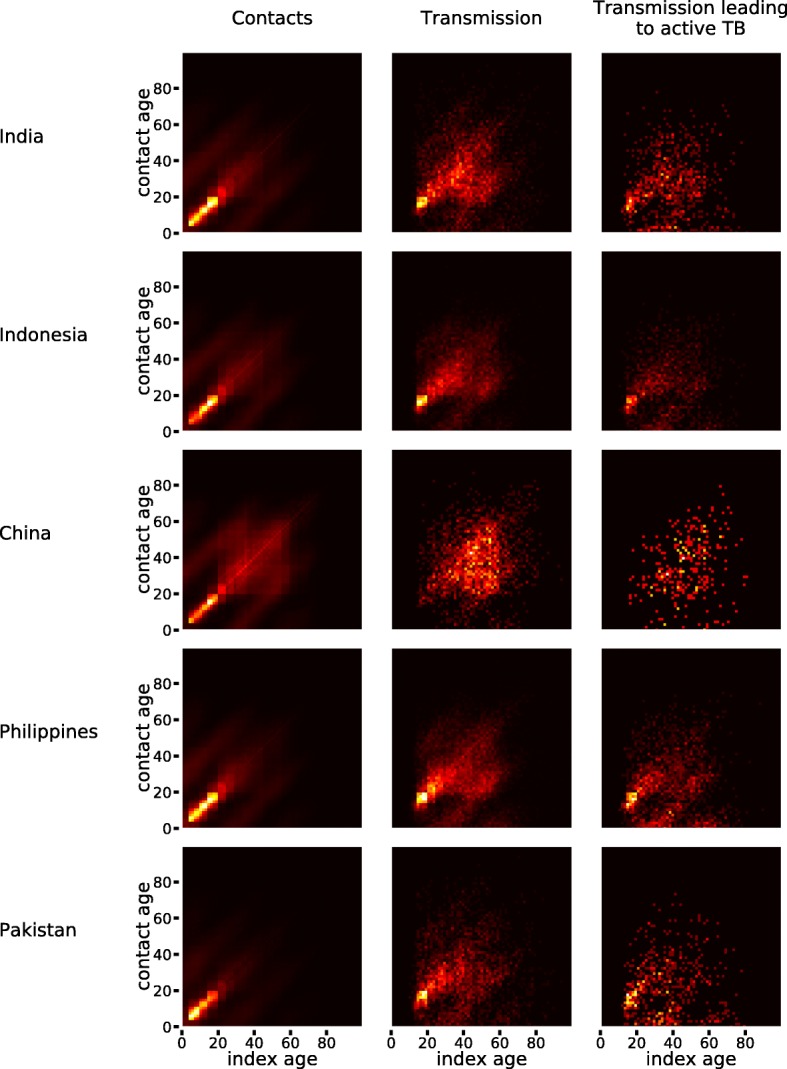
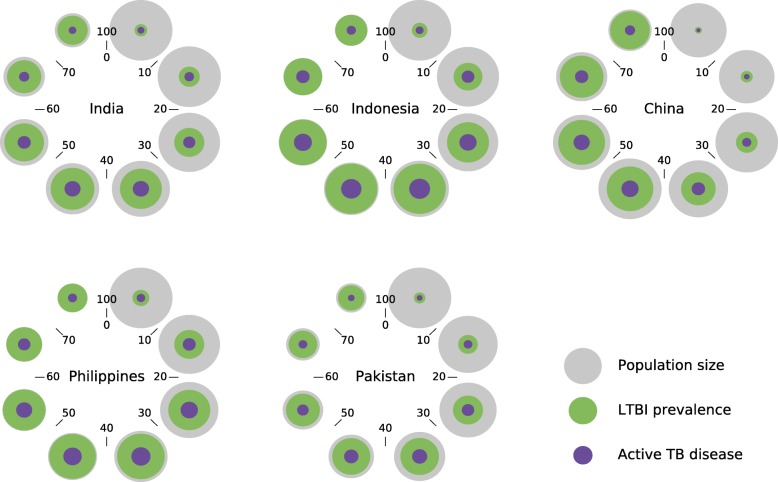
We estimate that the 15-19-year-old age group is involved in more than 20% of transmission events in India, Indonesia, the Philippines and Pakistan, despite representing only 5% of the local TB incidence. According to our model, childhood TB represents around one fifth of the incident TB cases in these four countries. In China, three quarters of incident TB were estimated to occur in the ≥ 45-year-old population. The calibrated per-contact transmission risk was found to be similar in each of the five countries despite their very different TB burdens.
Adolescents and young adults are a major driver of TB in high-incidence settings. Relying only on the observed distribution of disease to understand the age profile of transmission is potentially misleading.
由于对结核病(TB)流行病学的了解不完整,结核病控制工作受到阻碍。由于很大一部分活动性结核病患者未被发现,因此无法了解疾病的真实年龄分布。由于潜伏感染的无症状性质和病原体后期重新激活的能力,对传播的了解受到限制。为了确保有效利用现有和未来的控制工具,迫切需要更好地了解结核病流行病学。
我们使用基于代理的模型来模拟印度、印度尼西亚、中国、菲律宾和巴基斯坦这五个结核病负担最高的国家的结核病流行病学,从而深入了解传播和疾病的模式。我们的模型复制了人口统计学上逼真的人群,根据家庭、学校和工作场所中特定年龄的接触情况,明确捕捉个人之间的社会接触。纳入时变的规划参数以说明当地结核病控制的历史。
我们估计,在印度、印度尼西亚、菲律宾和巴基斯坦,15-19 岁年龄组参与了超过 20%的传播事件,尽管该年龄组仅占当地结核病发病率的 5%。根据我们的模型,儿童结核病约占这四个国家 50%的结核病发病率。在中国,估计有四分之三的结核病发病率发生在≥45 岁的人群中。尽管五个国家的结核病负担非常不同,但我们发现每个国家的每个接触传播风险的校准值相似。
青少年和年轻人是高发地区结核病的主要驱动因素。仅依靠观察到的疾病分布来了解传播的年龄分布可能具有误导性。