Counotte Michel Jacques, Meili Kaspar Walter, Taghavi Katayoun, Calvet Guilherme, Sejvar James, Low Nicola
Institute of Social and Preventive Medicine, University Bern, Bern, Switzerland.
Acute Febrile Illnesses Laboratory, Evandro Chagas National Institute of Infectious Diseases, Oswaldo Cruz Foundation, Rio de Janeiro, Rio de Janeiro, Brazil.
F1000Res. 2019 Aug 14;8:1433. doi: 10.12688/f1000research.19918.1. eCollection 2019.
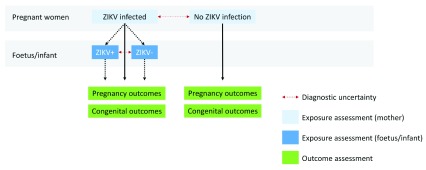
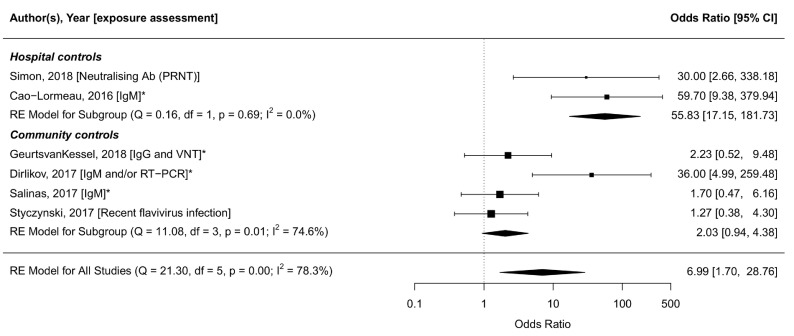
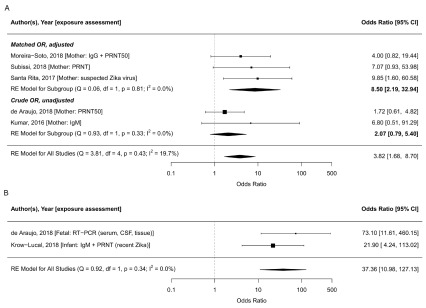
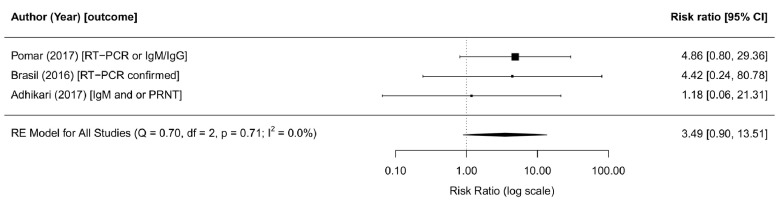
The Zika virus (ZIKV) caused a large outbreak in the Americas leading to the declaration of a Public Health Emergency of International Concern in February 2016. A causal relation between infection and adverse congenital outcomes such as microcephaly was declared by the World Health Organization (WHO) informed by a systematic review structured according to a framework of ten dimensions of causality, based on the work of Bradford Hill. Subsequently, the evidence has continued to accumulate, which we incorporate in regular updates of the original work, rendering it a living systematic review. We present an update of our living systematic review on the causal relation between ZIKV infection and adverse congenital outcomes and between ZIKV and GBS for four dimensions of causality: strength of association, dose-response, specificity, and consistency. We assess the evidence published between January 18, 2017 and July 1, 2019. We found that the strength of association between ZIKV infection and adverse outcomes from case-control studies differs according to whether exposure to ZIKV is assessed in the mother (OR 3.8, 95% CI: 1.7-8.7, I =19.8%) or the foetus/infant (OR 37.4, 95% CI: 11.0-127.1, I =0%). In cohort studies, the risk of congenital abnormalities was 3.5 times higher after ZIKV infection (95% CI: 0.9-13.5, I =0%). The strength of association between ZIKV infection and GBS was higher in studies that enrolled controls from hospital (OR: 55.8, 95% CI: 17.2-181.7, I =0%) than in studies that enrolled controls at random from the same community or household (OR: 2.0, 95% CI: 0.8-5.4, I =74.6%). In case-control studies, selection of controls from hospitals could have biased results. The conclusions that ZIKV infection causes adverse congenital outcomes and GBS are reinforced with the evidence published between January 18, 2017 and July 1, 2019.
寨卡病毒(ZIKV)在美洲地区引发了大规模疫情,导致2016年2月宣布国际关注的突发公共卫生事件。世界卫生组织(WHO)根据布拉德福德·希尔的研究成果,按照因果关系的十个维度框架进行系统综述后宣布,感染与小头畸形等不良先天性后果之间存在因果关系。随后,证据不断积累,我们将其纳入对原始研究的定期更新中,使其成为一项动态系统综述。我们针对寨卡病毒感染与不良先天性后果以及寨卡病毒与格林-巴利综合征(GBS)之间因果关系的四个维度:关联强度、剂量反应、特异性和一致性,展示我们动态系统综述的更新内容。我们评估了2017年1月18日至2019年7月1日期间发表的证据。我们发现,病例对照研究中寨卡病毒感染与不良后果之间的关联强度,因评估寨卡病毒暴露是在母亲(比值比3.8,95%置信区间:1.7 - 8.7,I² = 19.8%)还是胎儿/婴儿(比值比37.4,95%置信区间:11.0 - 127.1,I² = 0%)而异。在队列研究中,寨卡病毒感染后先天性异常的风险高出3.5倍(95%置信区间:0.9 - 13.5,I² = 0%)。在从医院招募对照的研究中,寨卡病毒感染与GBS之间的关联强度(比值比:55.8,95%置信区间:17.2 - 181.7,I² = 0%)高于从同一社区或家庭随机招募对照的研究(比值比:2.0,95%置信区间:0.8 - 5.4,I² = 74.6%)。在病例对照研究中,从医院选择对照可能会使结果产生偏差。2017年1月18日至2019年7月1日期间发表的证据进一步强化了寨卡病毒感染会导致不良先天性后果和GBS的结论。