Liu Rongrong, Cheng Shiyi, Tian Lei, Yi Ji
1Department of Biomedical Engineering, Northwestern University, Evanston, IL 60208 USA.
2Department of Electrical and Computer Engineering, Boston University, Boston, MA 02215 USA.
Light Sci Appl. 2019 Nov 20;8:102. doi: 10.1038/s41377-019-0216-0. eCollection 2019.
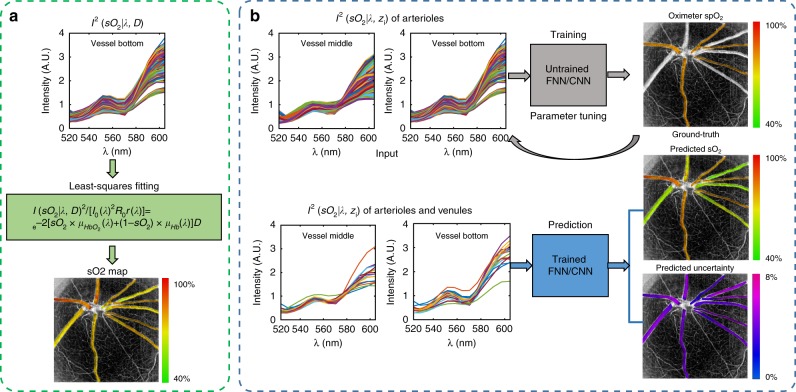
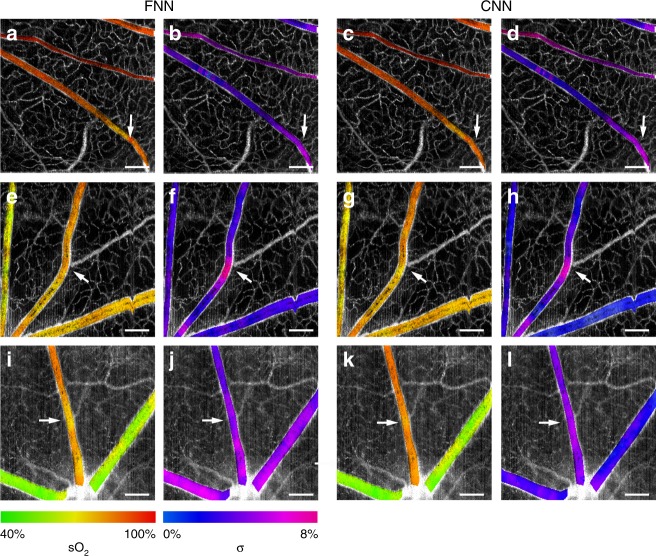
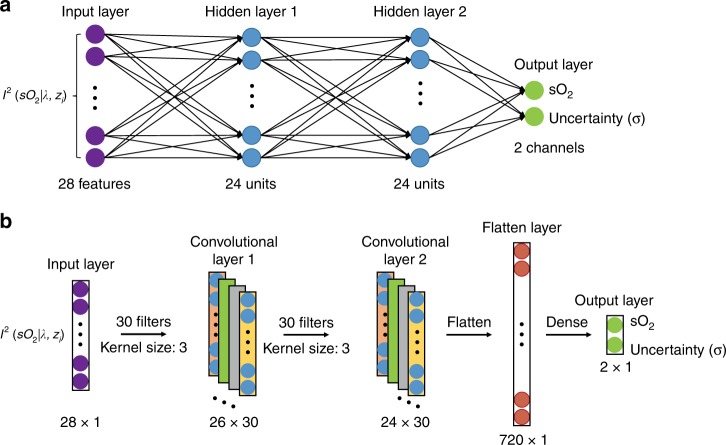
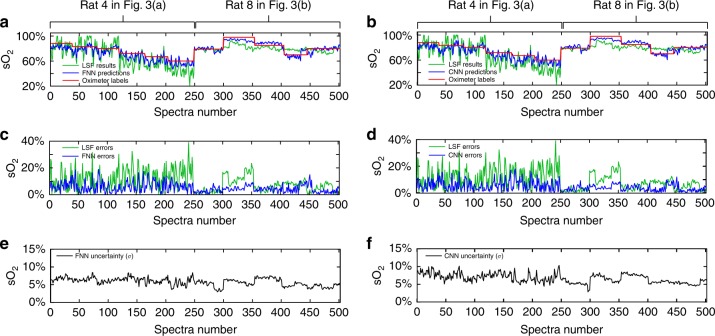
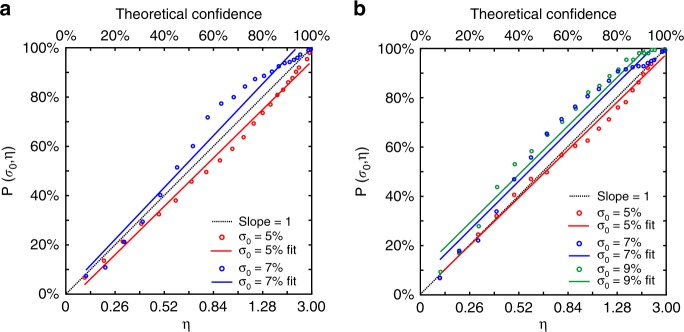
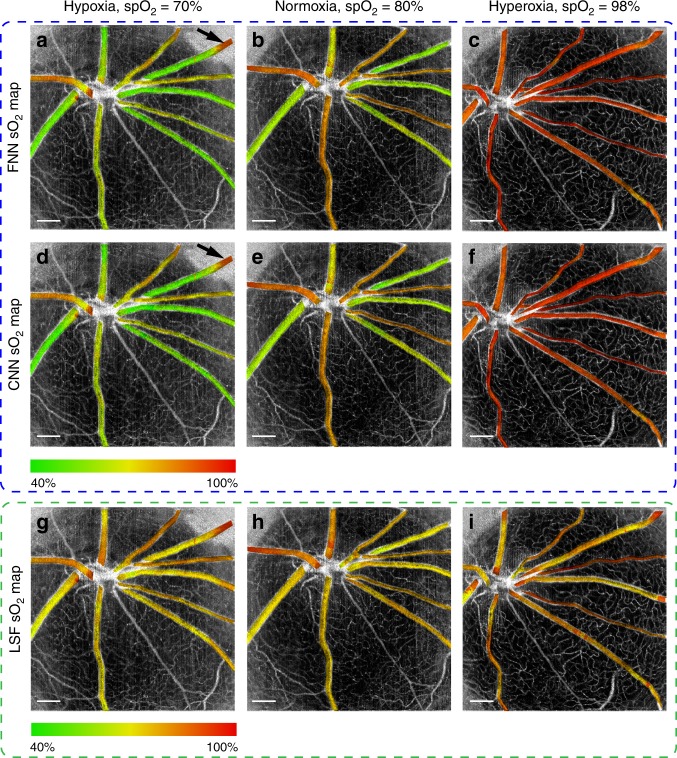
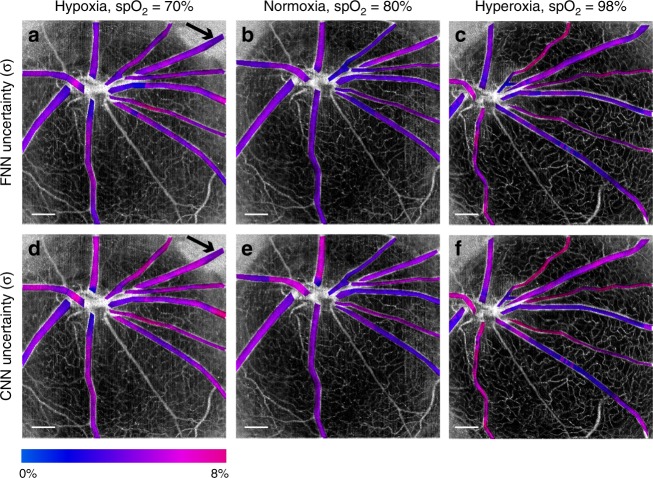
Measurement of blood oxygen saturation (O) by optical imaging oximetry provides invaluable insight into local tissue functions and metabolism. Despite different embodiments and modalities, all label-free optical-imaging oximetry techniques utilize the same principle of O-dependent spectral contrast from haemoglobin. Traditional approaches for quantifying O often rely on analytical models that are fitted by the spectral measurements. These approaches in practice suffer from uncertainties due to biological variability, tissue geometry, light scattering, systemic spectral bias, and variations in the experimental conditions. Here, we propose a new data-driven approach, termed deep spectral learning (DSL), to achieve oximetry that is highly robust to experimental variations and, more importantly, able to provide uncertainty quantification for each O prediction. To demonstrate the robustness and generalizability of DSL, we analyse data from two visible light optical coherence tomography (vis-OCT) setups across two separate in vivo experiments on rat retinas. Predictions made by DSL are highly adaptive to experimental variabilities as well as the depth-dependent backscattering spectra. Two neural-network-based models are tested and compared with the traditional least-squares fitting (LSF) method. The DSL-predicted O shows significantly lower mean-square errors than those of the LSF. For the first time, we have demonstrated maps of retinal oximetry along with a pixel-wise confidence assessment. Our DSL overcomes several limitations of traditional approaches and provides a more flexible, robust, and reliable deep learning approach for in vivo non-invasive label-free optical oximetry.
通过光学成像血氧测定法测量血氧饱和度(O),能为局部组织功能和代谢提供宝贵的见解。尽管存在不同的实施方式和模式,但所有无标记光学成像血氧测定技术都利用了血红蛋白依赖于O的光谱对比度这一相同原理。传统的O量化方法通常依赖于通过光谱测量进行拟合的分析模型。在实际应用中,这些方法由于生物变异性、组织几何形状、光散射、系统光谱偏差以及实验条件的变化而存在不确定性。在此,我们提出一种新的数据驱动方法,称为深度光谱学习(DSL),以实现对实验变化具有高度鲁棒性的血氧测定,更重要的是,能够为每个O预测提供不确定性量化。为了证明DSL的鲁棒性和通用性,我们分析了来自两个可见光光学相干断层扫描(vis - OCT)设置的数据,这些数据来自对大鼠视网膜进行的两个独立的体内实验。DSL做出的预测对实验变异性以及深度依赖的后向散射光谱具有高度适应性。测试了两种基于神经网络的模型,并与传统的最小二乘拟合(LSF)方法进行比较。DSL预测的O的均方误差明显低于LSF。我们首次展示了视网膜血氧测定图以及逐像素的置信度评估。我们的DSL克服了传统方法的几个局限性,为体内非侵入性无标记光学血氧测定提供了一种更灵活、鲁棒且可靠的深度学习方法。