Department of Cardiovascular Medicine, The Second Xiangya Hospital, Central South University, #139 Middle Renmin Road, Changsha, Hunan, 410011, People's Republic of China.
Research Institute of Blood Lipid and Atherosclerosis, Central South University, Changsha, Hunan, 410011, People's Republic of China.
Lipids Health Dis. 2019 Nov 25;18(1):206. doi: 10.1186/s12944-019-1146-9.
Postprandial high triglyceride (HTG), marking elevated level of remnant cholesterol (RC), is an independent risk factor of coronary heart disease (CHD). The postprandial cut-off points for HTG and high RC (HRC) after a daily meal are recommended as 2.0 mmol/L and 0.9 mmol/L, respectively, by the European Atherosclerosis Society (EAS), while those after a high-fat meal in Chinese subjects were not explored.
Ninety subjects, including 60 CHD patients (CHD group) and 30 non-CHD controls (CON group), were enrolled in this study. Serum levels of blood lipids, including calculated RC, were monitored at 0, 2, 4 and 6 h after a high-fat meal with 800 kcal and 50 g fat. Analysis of c-statistic was used to determine the cut-off points for postprandial HTG and HRC.
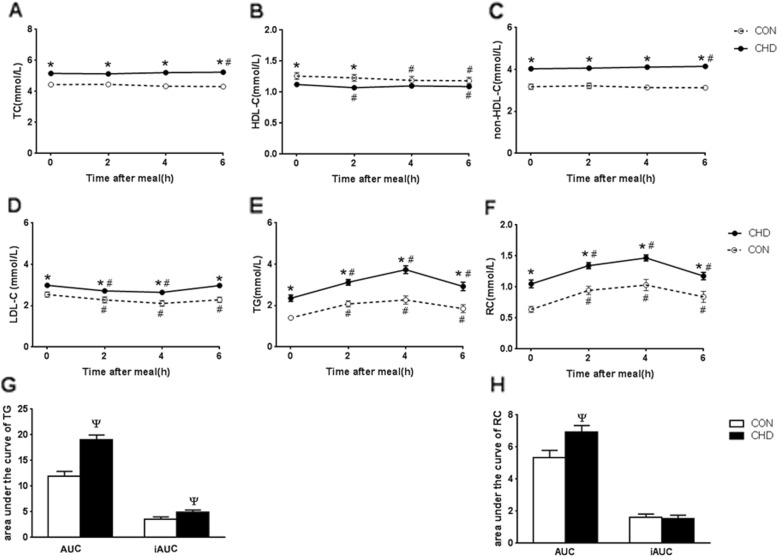
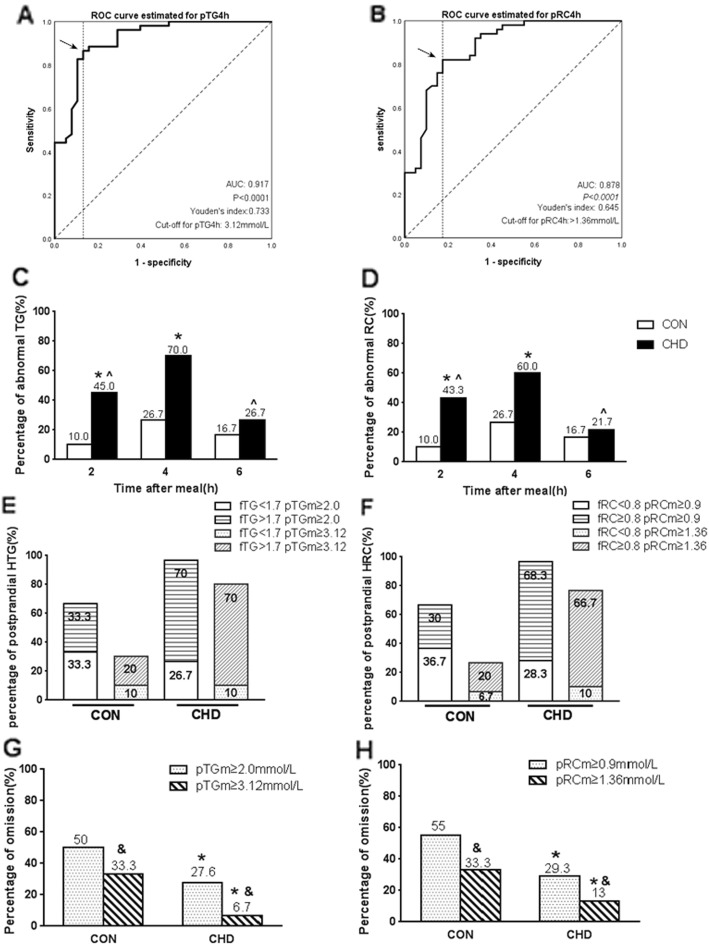
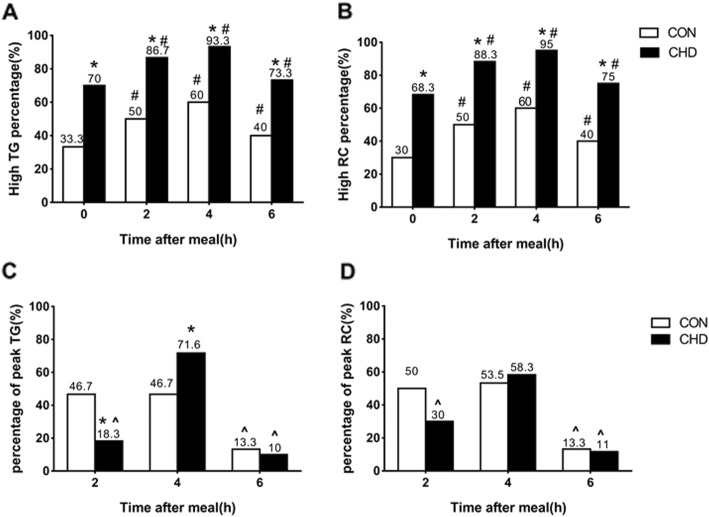
Postprandial levels of triglyceride (TG) and RC significantly increased and peaked at 4 h after a high-fat meal in two groups, although those in CHD group were significantly higher (P < 0.05). The optimal cut-off point to predict HTG at 4 h corresponding to fasting TG ≥ 1.7 mmol/L was 3.12 mmol/L, and that to predict HRC at 4 h corresponding to fasting RC ≥ 0.8 mmol/L was 1.36 mmol/L. According to the new cut-off points, the omissive diagnosis rates of postprandial HTG and HRC decreased obviously.
The cut-off points of postprandial HTG and HRC in Chinese subjects after a high-fat meal were higher than those after a daily meal recommended by the EAS, indicating that specific cut-off points should be determined after a certain high-fat meal.
餐后高甘油三酯(HTG)标志着残余胆固醇(RC)水平升高,是冠心病(CHD)的独立危险因素。欧洲动脉粥样硬化学会(EAS)建议,餐后 HTG 和 HRC 的切点分别为 2.0mmol/L 和 0.9mmol/L,而中国人餐后的相应切点尚未得到探讨。
本研究纳入 90 名受试者,包括 60 名 CHD 患者(CHD 组)和 30 名非 CHD 对照(CON 组)。在摄入 800kcal 和 50g 脂肪的高脂肪餐后 0、2、4 和 6h 监测血脂,包括计算 RC。使用 C 统计分析来确定餐后 HTG 和 HRC 的切点。
两组餐后 TG 和 RC 水平均显著升高,在 4h 时达到峰值,尽管 CHD 组显著更高(P<0.05)。预测 4h 时 HTG 的最佳切点为空腹 TG≥1.7mmol/L 时的 3.12mmol/L,预测 4h 时 HRC 的最佳切点为空腹 RC≥0.8mmol/L 时的 1.36mmol/L。根据新的切点,餐后 HTG 和 HRC 的漏诊率明显降低。
中国人餐后 HTG 和 HRC 的切点高于 EAS 推荐的每日餐后切点,表明应针对特定的高脂肪餐后确定具体的切点。