Department of Medical Imaging, Henan Key Laboratory of Neurological Imaging, Henan Provincial People's Hospital, People's Hospital of Zhengzhou University, People's Hospital of Henan University, Zhengzhou, Henan, China.
School of Biomedical Engineering, Shanghai Jiao Tong University, Shanghai, China; CAS Key Laboratory of Molecular Imaging, Institute of Automation, Chinese Academy of Sciences, Beijing, China.
EBioMedicine. 2019 Dec;50:355-365. doi: 10.1016/j.ebiom.2019.11.010. Epub 2019 Nov 22.
Identification of pregnancies with postpartum haemorrhage (PPH) antenatally rather than intrapartum would aid delivery planning, facilitate transfusion requirements and decrease maternal complications. MRI has been increasingly used for placenta evaluation. Here, we aim to build a nomogram incorporating both clinical and radiomic features of placenta to predict the risk for PPH in pregnancies during caesarian delivery (CD).
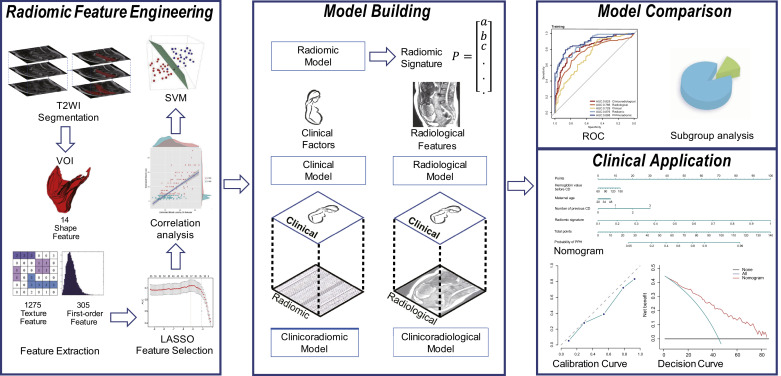
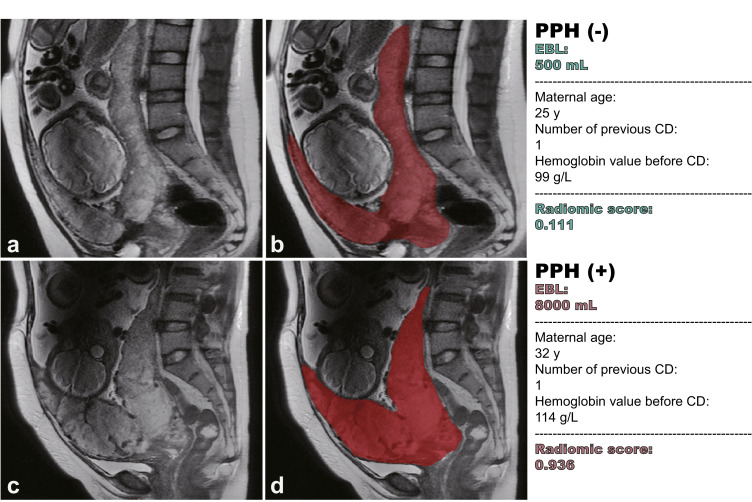
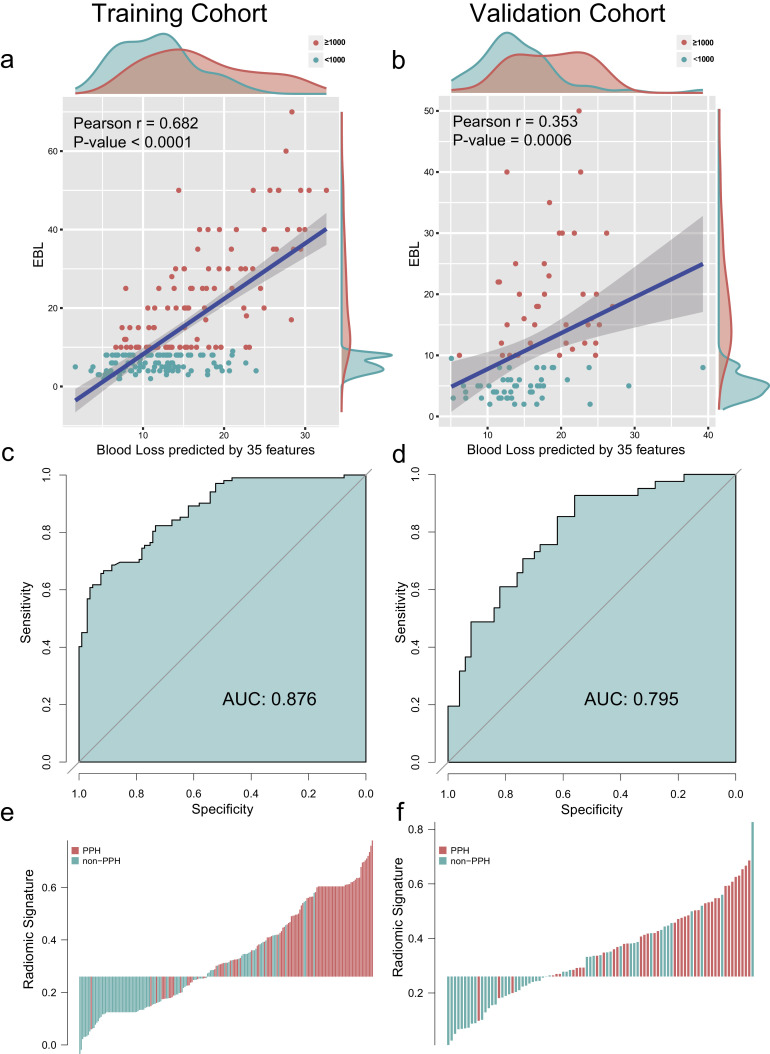
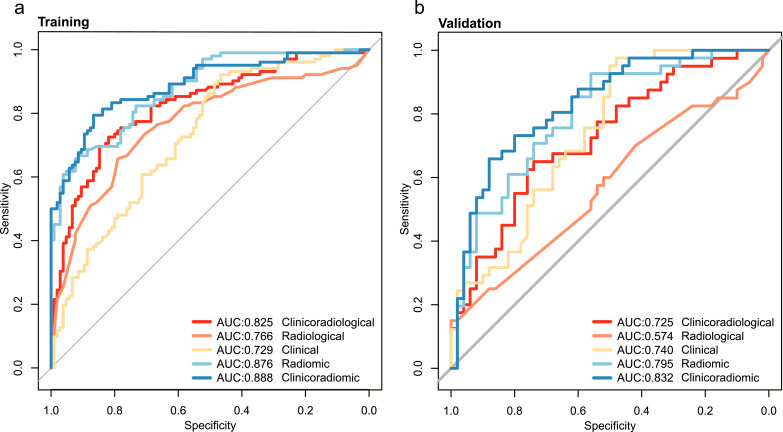
A total of 298 pregnant women were retrospectively enrolled from Henan Provincial People's Hospital (training cohort: n = 207) and from The Third Affiliated Hospital of Zhengzhou University (external validation cohort: n = 91). These women were suspected with placenta accreta spectrum (PAS) disorders and underwent MRI for placenta evaluation. All of them underwent CD and were singleton. PPH was defined as more than 1000 mL estimated blood loss (EBL) during CD. Radiomic features were selected based on their correlations with EBL. Radiomic, clinical, radiological, clinicoradiological and clinicoradiomic models were built to predict the risk of PPH for each patient. The model with the best prediction performance was validated with its discrimination ability, calibration curve and clinical application.
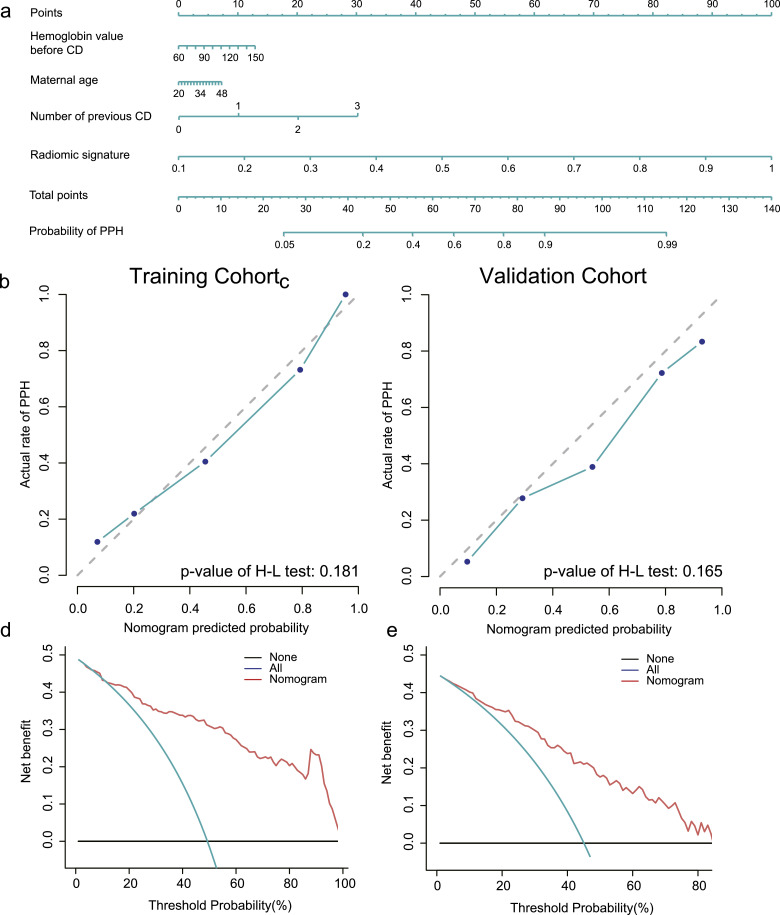
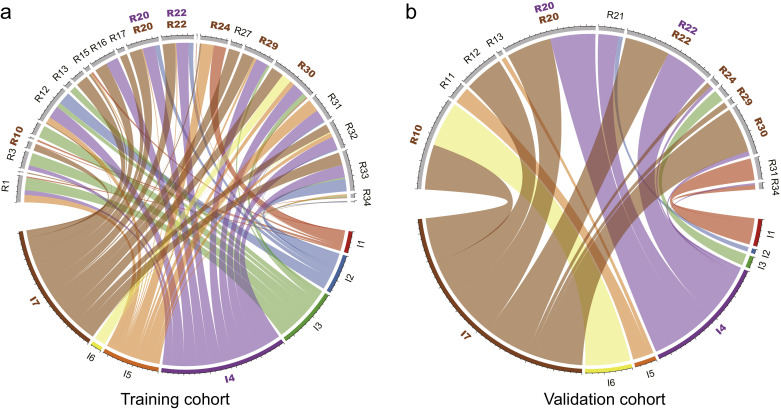
Thirty-five radiomic features showed strong correlation with EBL. The clinicoradiomic model resulted in the best discrimination ability for risk prediction of PPH, with AUC of 0.888 (95% CI, 0.844-0.933) and 0.832 (95% CI, 0.746-0.913), sensitivity of 91.2% (95% CI, 85.8%-96.7%) and 97.6% (95% CI, 92.7%-100%) in the training and validation cohort respectively. For patients with severe PPH (EBL more than 2000 mL), 53 out of 55 pregnancies (96.4%) in the training cohort and 18 out of 18 (100%) pregnancies in the validation cohort were identified by the clinicoradiomic model. The model performed better in patients without placenta previa (PP) than in patients with PP, with AUC of 0.983 compared with 0.867, sensitivity of 100% compared with 90.8% in the training cohort, AUC of 0.832 compared with 0.815, sensitivity of 97.6% compared with 97.2% in the validation cohort.
The clinicoradiomic model incorporating both prenatal clinical factors and radiomic signature of placenta on T2WI showed good performance for risk prediction of PPH. The predictive model can identify severe PPH with high sensitivity and can be applied in patients with and without PP.
产前而非产时识别产后出血(PPH)有助于分娩计划,便于输血需求,并减少产妇并发症。MRI 已越来越多地用于胎盘评估。在此,我们旨在构建一个包含胎盘临床和放射组学特征的列线图,以预测剖宫产(CD)中妊娠 PPH 的风险。
回顾性纳入 298 名来自河南省人民医院(训练队列:n=207)和郑州大学第三附属医院(外部验证队列:n=91)的疑似胎盘植入谱系(PAS)障碍的孕妇。所有孕妇均接受 MRI 评估胎盘。他们均接受 CD,且为单胎妊娠。PPH 定义为 CD 期间估计出血量(EBL)超过 1000ml。根据与 EBL 的相关性选择放射组学特征。为每位患者构建放射组学、临床、放射影像学、临床放射影像学和临床放射组学模型,以预测 PPH 的风险。验证了具有最佳预测性能的模型的判别能力、校准曲线和临床应用。
35 个放射组学特征与 EBL 有很强的相关性。临床放射组学模型对 PPH 风险预测具有最佳的判别能力,在训练队列和验证队列中的 AUC 分别为 0.888(95%CI,0.844-0.933)和 0.832(95%CI,0.746-0.913),敏感性分别为 91.2%(95%CI,85.8%-96.7%)和 97.6%(95%CI,92.7%-100%)。在训练队列中,55 例重度 PPH(EBL 超过 2000ml)患者中,53 例(96.4%)和验证队列中 18 例(100%)患者通过临床放射组学模型识别。在无前置胎盘(PP)患者中,该模型的表现优于有 PP 的患者,训练队列的 AUC 为 0.983,敏感性为 100%,与 0.867、90.8%相比;验证队列的 AUC 为 0.832,敏感性为 97.6%,与 0.815、97.2%相比。
包含产前临床因素和 T2WI 胎盘放射组学特征的临床放射组学模型对 PPH 的风险预测具有良好的性能。预测模型可以高灵敏度识别重度 PPH,并可应用于有和无 PP 的患者。