Univ Lyon, Université Claude Bernard Lyon1, ifsttar, umrestte, umr t_9405, Cité des Mobilités, 25 avenue François Mitterrand, F-69675, Bron, France.
Now at: Technical Agency for Information on Hospital Care, Lyon, France.
Environ Health. 2019 Nov 27;18(1):102. doi: 10.1186/s12940-019-0540-0.
Many studies have demonstrated adverse effects of exposure to aircraft noise on health. Possible biological pathways for these effects include hormonal disturbances. Few studies deal with aircraft noise effects on saliva cortisol in adults, and results are inconsistent.
We aimed to assess the effects of aircraft noise exposure on saliva cortisol levels and its variation in people living near airports.
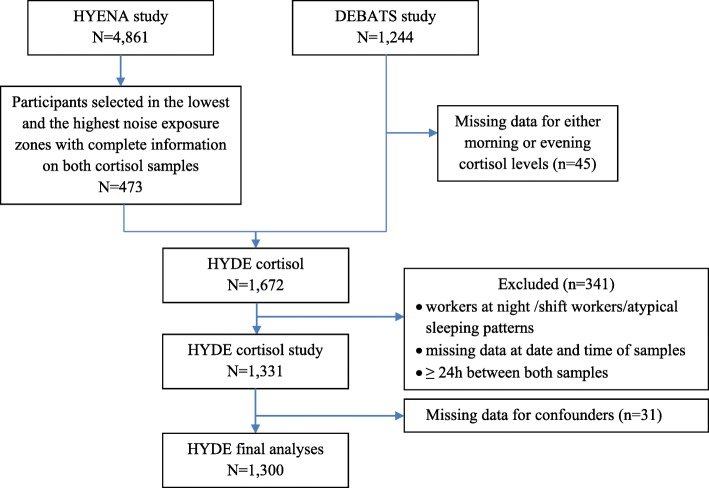
This study focused on the 1300 residents included in the HYENA and DEBATS cross-sectional studies, with complete information on cortisol sampling. All the participants followed a similar procedure aiming to collect both a morning and an evening saliva cortisol samples. Socioeconomic and lifestyle information were obtained during a face-to-face interview. Outdoor aircraft noise exposure was estimated for each participant's home address. Associations between aircraft noise exposure and cortisol outcomes were investigated a priori for male and female separately, using linear regression models adjusted for relevant confounders. Different approaches were used to characterize cortisol levels, such as morning and evening cortisol concentrations and the absolute and relative variations between morning and evening levels.
Statistically significant increases of evening cortisol levels were shown in women with a 10-dB(A) increase in aircraft noise exposure in terms of LA (exp(β) = 1.08; CI95% = 1.00-1.16), L (exp(β) = 1.09; CI95% = 1.01-1.18), L (exp(β) = 1.11; CI95% = 1.02-1.20). A statistically significant association was also found in women between a 10-dB(A) increase in terms of L and the absolute variation per hour (exp(β) = 0.90; CI95% = 0.80-1.00). Statistically significant decreases in relative variation per hour were also evidenced in women, with stronger effects with the L (exp(β) = 0.89; CI95% = 0.83-0.96) than with other noise indicators. The morning cortisol levels were unchanged whatever noise exposure indicator considered. There was no statistically significant association between aircraft noise exposure and cortisol outcomes in men.
The results of the present study show statistically significant associations between aircraft noise exposure and evening cortisol levels and related flattening in the (absolute and relative) variations per hour in women. Further biological research is needed to deepen knowledge of the pathway between noise exposure and disturbed hormonal regulation, and specially the difference in effects between genders.
许多研究表明,暴露于飞机噪声对健康有不良影响。这些影响的可能生物学途径包括激素紊乱。很少有研究涉及飞机噪声对成年人唾液皮质醇的影响,且结果不一致。
我们旨在评估机场附近人群暴露于飞机噪声对唾液皮质醇水平及其变化的影响。
本研究主要关注 HYENA 和 DEBATS 两项横断面研究中纳入的 1300 名居民,这些居民均有完整的皮质醇采样信息。所有参与者均遵循类似的程序,旨在同时采集早晨和傍晚的唾液皮质醇样本。在面对面访谈中获取社会经济和生活方式信息。根据每位参与者的家庭住址评估其室外飞机噪声暴露情况。使用线性回归模型,分别对男性和女性进行了噪声暴露与皮质醇结果之间的相关性分析,模型中调整了相关混杂因素。使用不同的方法来描述皮质醇水平,如早晨和傍晚皮质醇浓度,以及早晨和傍晚水平之间的绝对和相对变化。
在女性中,与 10dB(A)飞机噪声暴露相关的 LA (βexp=1.08;95%CI95%=1.00-1.16)、L (βexp=1.09;95%CI95%=1.01-1.18)、LL (βexp=1.11;95%CI95%=1.02-1.20)的皮质醇水平在傍晚时呈现出显著的升高。在女性中,与 10dB(A)飞机噪声暴露相关的 L 与每小时的绝对变化之间也存在统计学显著的关联(βexp=0.90;95%CI95%=0.80-1.00)。还发现女性的相对变化每小时的下降也具有统计学意义,其中 L 的影响更强(βexp=0.89;95%CI95%=0.83-0.96)。无论噪声暴露指标如何,女性的早晨皮质醇水平均未发生改变。在男性中,飞机噪声暴露与皮质醇结果之间无统计学显著关联。
本研究结果表明,在女性中,暴露于飞机噪声与傍晚皮质醇水平及相关(绝对和相对)每小时变化之间存在统计学显著关联。需要进一步的生物学研究来加深对噪声暴露与激素调节紊乱之间的途径的认识,特别是对两性之间的影响差异的认识。