Ryuk Jin Ah, Kang Suna, Daily James W, Ko Byoung-Seob, Park Sunmin
Korean Medicine Convergence Research Division, Korea Institute of Oriental Medicine, Daejeon, 305-811, South Korea.
Department of Food and Nutrition, Obesity/Diabetes Research Center, Hoseo University, 165 Sechul-Ri, BaeBang-Yup, Asan-Si, ChungNam-Do, 336-795, South Korea.
J Clin Biochem Nutr. 2019 Nov;65(3):223-231. doi: 10.3164/jcbn.19-15. Epub 2019 Sep 11.
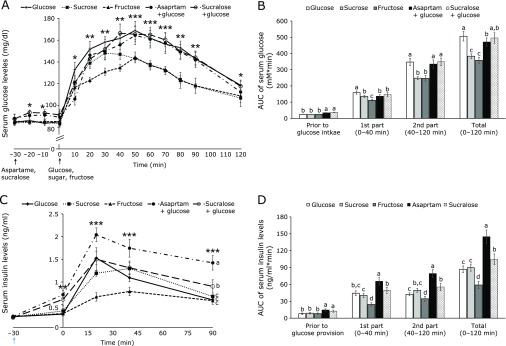
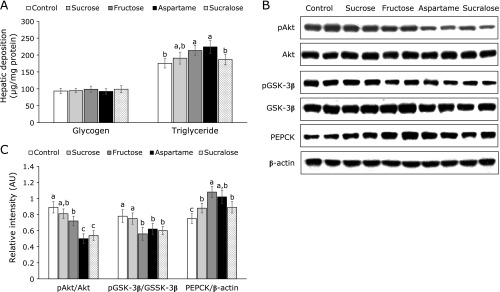
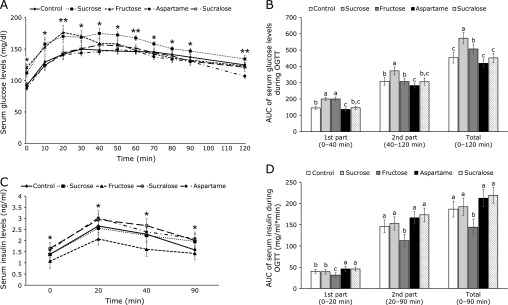
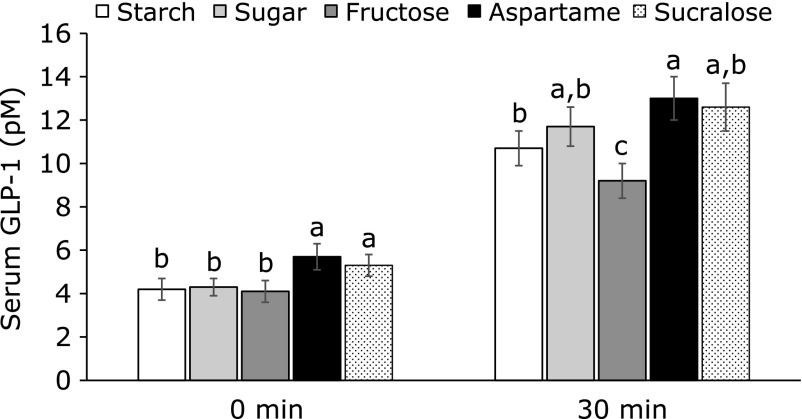
Both nutritive and non-nutritive sweeteners may influence energy and glucose metabolism differently. The hypothesis that sucrose, fructose, aspartame, and sucralose intake differently modulate energy and glucose metabolism was tested in an estrogen-deficient animal model. At 30 min after giving aspartame and sucralose (10 mg/kg body weight), an oral glucose tolerance test (OGTT) was conducted with glucose, sucrose, and fructose in ovariectomized (OVX) rats. After OGTT, they were continuously fed high fat diets including either 10% corn starch (Control), 10% sucrose (Sucrose), 10% fructose (Fructose), 0.05% aspartame + 9.95% starch (Aspartame) or 0.05% sucralose + 9.95% starch (Sucralose) for 8 week. During 30 min after acute administration of aspartame and sucralose, serum glucose concentrations increased despite slightly increased serum insulin levels before glucose infusion. However, glucose tolerance was not significantly different among the groups. In chronic study, serum glucose concentrations were lowest and insulin highest at the overnight-fasted state in Aspartame and Sucralose. Postprandial serum glucagon-like peptide-1 (GLP-1) and insulin levels were higher in Aspartame and Sucralose than Control. Hepatic insulin signaling (pAkt → pGSK-3β) and phosphoenolpyruvate carboxykinase (PEPCK) expression were lower in Sucralose and Aspartame than the Fructose. Serum acetate levels produced by gut microbiota were higher were lower in the fructose group than Aspartame and Sucralose groups. In conclusion, aspartame and sucralose with a meal might be preferable sweeteners to fructose and sucrose in estrogen deficient rats, and possibly post-menopausal women; however, this needs to be confirmed in human studies.
营养性和非营养性甜味剂可能对能量和葡萄糖代谢产生不同的影响。在雌激素缺乏的动物模型中,对蔗糖、果糖、阿斯巴甜和三氯蔗糖摄入不同程度调节能量和葡萄糖代谢的假设进行了测试。在给予阿斯巴甜和三氯蔗糖(10毫克/千克体重)30分钟后,对去卵巢(OVX)大鼠进行了葡萄糖、蔗糖和果糖的口服葡萄糖耐量试验(OGTT)。OGTT后,它们连续8周喂食高脂肪饮食,其中包括10%玉米淀粉(对照)、10%蔗糖(蔗糖)、10%果糖(果糖)、0.05%阿斯巴甜+9.95%淀粉(阿斯巴甜)或0.05%三氯蔗糖+9.95%淀粉(三氯蔗糖)。在急性给予阿斯巴甜和三氯蔗糖后的30分钟内,尽管在输注葡萄糖前血清胰岛素水平略有升高,但血清葡萄糖浓度仍升高。然而,各组之间的葡萄糖耐量没有显著差异。在慢性研究中,阿斯巴甜和三氯蔗糖组在过夜禁食状态下血清葡萄糖浓度最低,胰岛素水平最高。阿斯巴甜和三氯蔗糖组的餐后血清胰高血糖素样肽-1(GLP-1)和胰岛素水平高于对照组。三氯蔗糖和阿斯巴甜组的肝脏胰岛素信号传导(pAkt→pGSK-3β)和磷酸烯醇丙酮酸羧激酶(PEPCK)表达低于果糖组。果糖组肠道微生物群产生的血清乙酸水平低于阿斯巴甜和三氯蔗糖组。总之,对于雌激素缺乏的大鼠,可能还有绝经后女性,用餐时使用阿斯巴甜和三氯蔗糖可能比果糖和蔗糖更适宜;然而,这需要在人体研究中得到证实。