Rehabilitation Sciences, University of Illinois at Chicago, Chicago, USA.
Occupational Therapy, University of Illinois at Chicago, Chicago, USA.
BMC Pediatr. 2020 Jul 3;20(1):330. doi: 10.1186/s12887-020-02182-x.
Young children with developmental disabilities and delays spend significant amounts of time at home, show decreased participation in home-based activities, and receive home-based early intervention services to improve participation in activities. Yet, knowledge about the relationship between EI service use and children's home participation in activities remains poorly understood but needed for program improvement. The purpose of this study was to understand the relationships between EI service use and children's home participation.
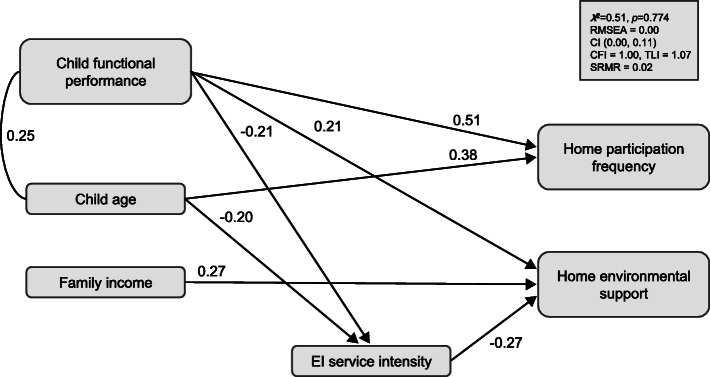
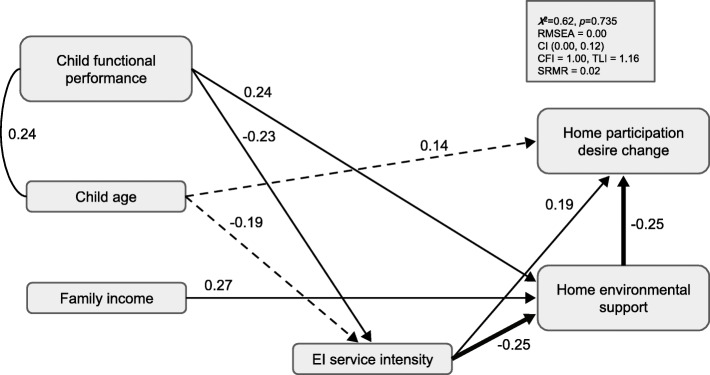
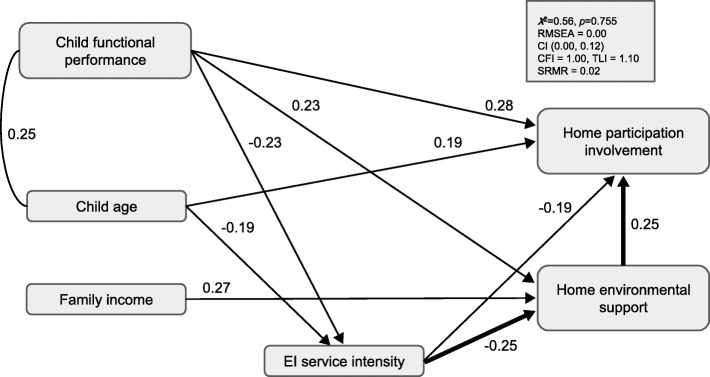
In a cross-sectional design, data were gathered from caregivers (N = 139) who enrolled in a pilot trial of the Young Children's Participation in Environment Measure (YC-PEM) electronic patient-reported outcome (e-PRO), as implemented within 1 month of their child's next EI progress evaluation. A series of path analytic models were used to estimate EI service intensity as a predictor of parent-reported young children's home participation 1) frequency, 2) level of involvement, and 3) desired change, adjusting for family and child social and functional characteristics. Models included caregiver perceptions of home environmental support to test its indirect (i.e., mediation) effects on the relationship between EI service intensity and each of the three home participation dimensions.
All three models fit the data well (comparative fit index = 1.00). EI service intensity was not a significant predictor of participation frequency. However, EI service intensity had a significant direct effect on a child's participation according to level of involvement and desired change, explaining between 13.3-33.5% of the variance in home participation. Caregiver perceptions of environmental support had a small yet significant indirect effect on the relationship between EI service intensity and level of involvement and desired change; these models explained between 18.5-38.1% of the variance in home participation.
EI service intensity has important links with involvement in and desired change for home-based activities. Caregiver perceptions of environmental support appears to be a factor in the relationship between EI service intensity and home participation. Results warrant longitudinal replication with a control group, which would be possible with the implementation of the YC-PEM e-PRO in a routine EI clinical workflow.
NCT03904797 .
发育障碍和发育迟缓的幼儿在家中度过大量时间,在家中参与活动的程度降低,并接受家庭早期干预服务以提高活动参与度。然而,对于 EI 服务使用与儿童家庭活动参与之间的关系,人们的了解仍然很差,但这对于项目改进是必要的。本研究的目的是了解 EI 服务使用与儿童家庭参与之间的关系。
在横断面设计中,数据来自于 139 名照顾者,他们参加了 Young Children's Participation in Environment Measure (YC-PEM) 电子患者报告结果 (e-PRO) 的试点试验,该试验在其孩子下一次 EI 进展评估的 1 个月内实施。使用一系列路径分析模型来估计 EI 服务强度作为父母报告的幼儿家庭参与度的预测因素 1) 频率、2) 参与水平和 3) 期望变化,同时调整家庭和儿童的社会和功能特征。模型包括照顾者对家庭环境支持的感知,以测试其对 EI 服务强度与三个家庭参与维度之间关系的间接(即中介)影响。
所有三个模型都很好地拟合了数据(比较拟合指数=1.00)。EI 服务强度与参与频率没有显著相关性。然而,EI 服务强度对儿童的参与程度有直接影响,包括参与水平和期望变化,解释了家庭参与的 13.3-33.5%的方差。照顾者对环境支持的感知对 EI 服务强度与参与水平和期望变化之间的关系具有小但显著的间接影响;这些模型解释了家庭参与的 18.5-38.1%的方差。
EI 服务强度与家庭活动的参与度和期望变化密切相关。照顾者对环境支持的感知似乎是 EI 服务强度与家庭参与之间关系的一个因素。结果需要与对照组进行纵向复制,这在 YC-PEM e-PRO 在常规 EI 临床工作流程中的实施中是可能的。
NCT03904797。