Bank of Tissues and Cells, Lyon University Hospital (Hospices Civils de Lyon), 69003 Lyon, France.
CarMeN Laboratory, INSERM 1060, INRA 1397, INSA Lyon, 69600 Oullins, France.
Int J Mol Sci. 2019 Nov 26;20(23):5934. doi: 10.3390/ijms20235934.
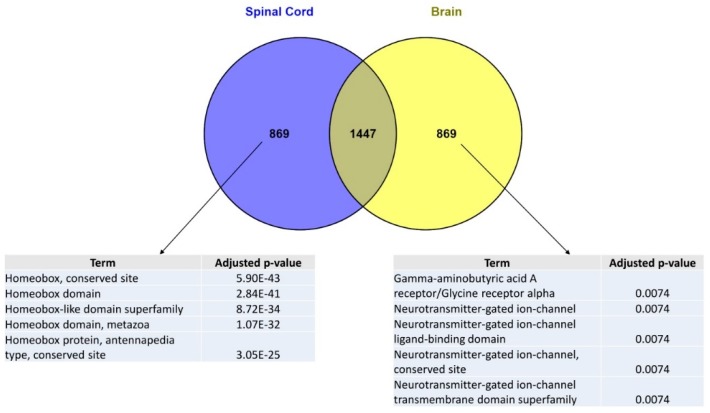
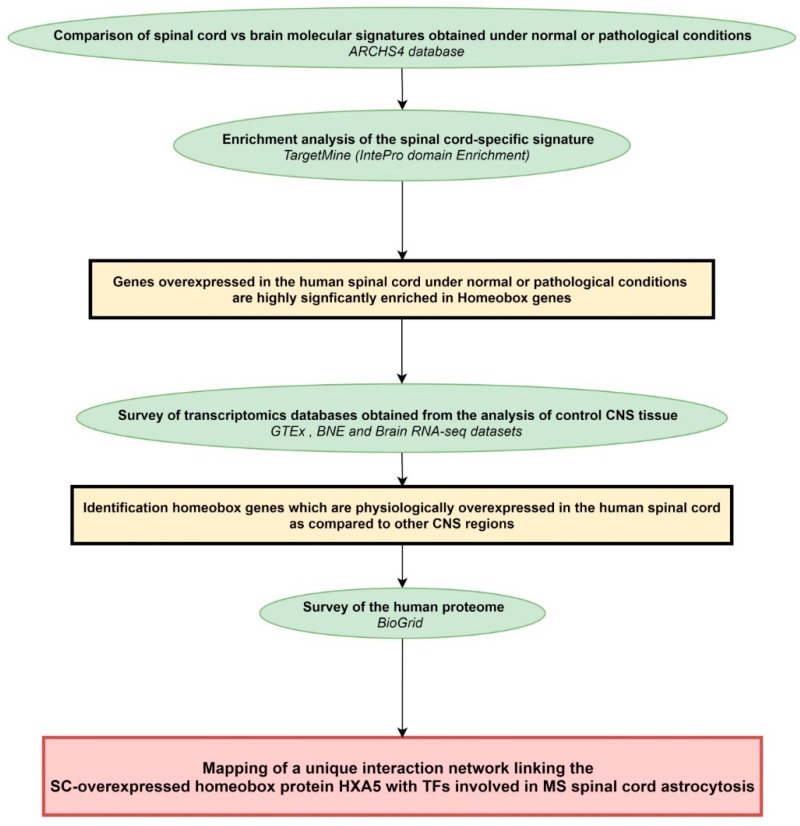
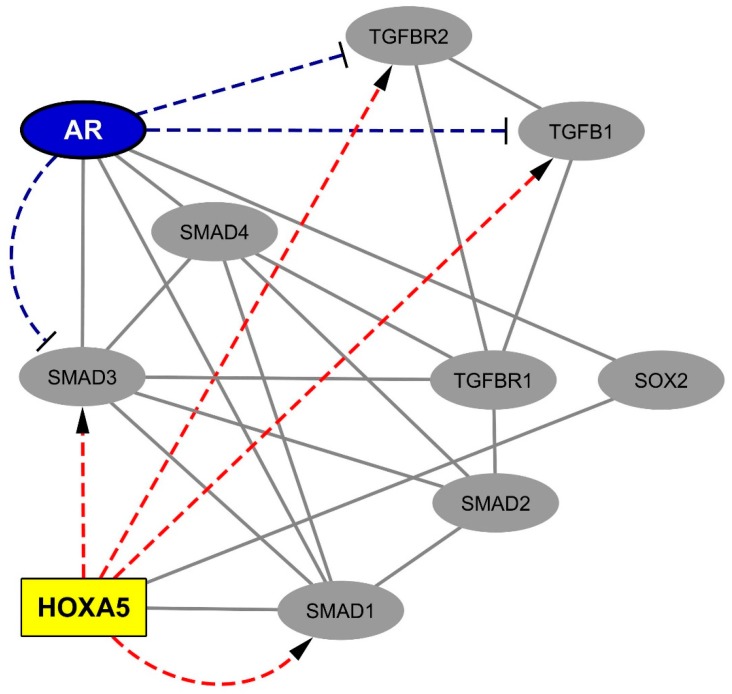
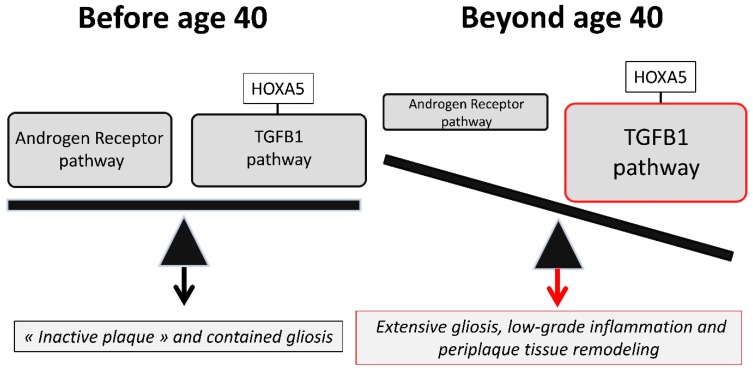
In multiple sclerosis (MS) patients with a progressive form of the disease, spinal cord (SC) functions slowly deteriorate beyond age 40. We previously showed that in the SC of these patients, large areas of incomplete demyelination extend distance away from plaque borders and are characterized by a unique progliotic TGFB1 (Transforming Growth Factor Beta 1) genomic signature. Here, we attempted to determine whether region- and age-specific physiological parameters could promote the progression of SC periplaques in MS patients beyond age 40. An analysis of transcriptomics databases showed that, under physiological conditions, a set of 10 homeobox (HOX) genes are highly significantly overexpressed in the human SC as compared to distinct brain regions. Among these HOX genes, a survey of the human proteome showed that only HOXA5 encodes a protein which interacts with a member of the TGF-beta signaling pathway, namely SMAD1 (SMAD family member 1). Moreover, HOXA5 was previously found to promote the TGF-beta pathway. Interestingly, SMAD1 is also a protein partner of the androgen receptor (AR) and an unsupervised analysis of gene ontology terms indicates that the AR pathway antagonizes the TGF-beta/SMAD pathway. Retrieval of promoter analysis data further confirmed that AR negatively regulates the transcription of several members of the TGF-beta/SMAD pathway. On this basis, we propose that in progressive MS patients, the physiological SC overexpression of HOXA5 combined with the age-dependent decline in AR ligands may favor the slow progression of TGFB1-mediated gliosis. Potential therapeutic implications are discussed.
在多发性硬化症(MS)患者中,进展型疾病患者的脊髓(SC)功能在 40 岁以后会逐渐恶化。我们之前的研究表明,在这些患者的 SC 中,远离斑块边界的大片不完全脱髓鞘区域存在独特的进展性 TGFB1(转化生长因子β 1)基因组特征。在这里,我们试图确定在 40 岁以上的 MS 患者中,是否存在区域和年龄特异性的生理参数来促进 SC 周边斑块的进展。对转录组学数据库的分析表明,在生理条件下,与特定脑区相比,一组 10 个同源盒(HOX)基因在人 SC 中高度显著过表达。在这些 HOX 基因中,对人类蛋白质组的调查显示,只有 HOXA5 编码的蛋白质与 TGF-β信号通路的一个成员 SMAD1(SMAD 家族成员 1)相互作用。此外,HOXA5 先前被发现可促进 TGF-β 通路。有趣的是,SMAD1 也是雄激素受体(AR)的蛋白质伴侣,并且对基因本体术语的无监督分析表明,AR 通路拮抗 TGF-β/SMAD 通路。检索启动子分析数据进一步证实,AR 负调控 TGF-β/SMAD 通路的几个成员的转录。在此基础上,我们提出在进展型 MS 患者中,HOXA5 的生理性 SC 过表达与 AR 配体随年龄下降相结合,可能有利于 TGFB1 介导的神经胶质增生的缓慢进展。讨论了潜在的治疗意义。