Program of Occupational Therapy, Faculty of Health Sciences, Universiti Kebangsaan Malaysia, 50300 Kuala Lumpur, Malaysia.
Int J Environ Res Public Health. 2019 Nov 27;16(23):4750. doi: 10.3390/ijerph16234750.
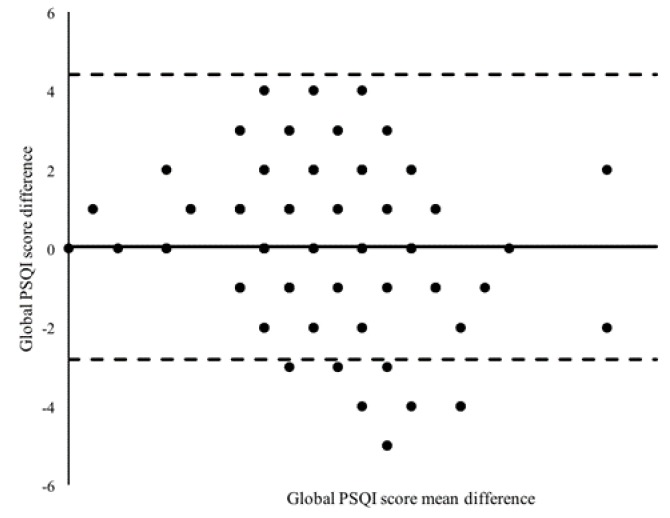
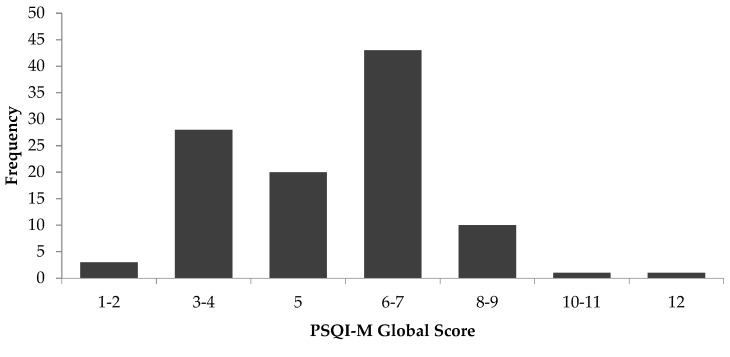
(1) Background: The Pittsburgh Sleep Quality Index (PSQI) is a useful tool for the assessment of subjective sleep quality in non-clinical and clinical settings. This study aimed to determine sleep quality in a general Malaysian adult population using a validated Malay version of the Pittsburgh sleep quality index (PSQI-M); (2) Methods: The original PSQI was translated into Malay following forward and backward translation guidelines. The final Malay version was administered to a sample of healthy working adults ( = 106; mean age: 35.3 ± 7.6 years) without history of sleep disorders. Reliability and agreement were assessed using Cronbach's alpha, intra-class correlations coefficient (ICC), standard error of measurement (SEM), and Bland-Altman plot. Convergent validity of PSQI-M was examined with the Malay version of Epworth sleepiness scale (ESS-M) using Pearson's correlation coefficient; (3) Results: Overall mean PSQI global score was 5.25 ± 1.85. About 45% of the sample had PSQI global score >5, indicating poor sleep quality. Total sleep duration per night was 5.95 ± 1.05 h, below the recommended amount. Sleep quality seems to be affected by age but not gender. Internal consistency as measured by Cronbach's alpha in the whole sample was 0.74, with test-retest reliability (ICC) of 0.58 and SEM of 1.34. The PSQI test-retest scores indicated that most of the respondents (90%) lay within the 95% limits of agreement. The PSQI-M also showed significant correlation with ESS-M scores ( = 0.37, < 0.01); (4) Conclusion: The PSQI-M showed acceptable reliability and is valid to be used in a general Malaysian adult population. Findings also indicate that a majority of the adults in our sample were experiencing inadequate sleep, thus further research is needed to identify the factors associated with poor sleep quality.
(1) 背景:匹兹堡睡眠质量指数(PSQI)是一种评估非临床和临床环境下主观睡眠质量的有用工具。本研究旨在使用经过验证的马来语匹兹堡睡眠质量指数(PSQI-M)评估一般马来西亚成年人群的睡眠质量;(2) 方法:根据正向和反向翻译指南,将原始 PSQI 翻译成马来语。最终的马来语版本被应用于一组没有睡眠障碍病史的健康在职成年人(= 106;平均年龄:35.3 ± 7.6 岁)。使用 Cronbach's alpha、组内相关系数(ICC)、测量标准误差(SEM)和 Bland-Altman 图评估可靠性和一致性。使用马来语 Epworth 嗜睡量表(ESS-M)的 Pearson 相关系数评估 PSQI-M 的会聚效度;(3) 结果:总体 PSQI 总分平均为 5.25 ± 1.85。大约 45%的样本 PSQI 总分>5,表明睡眠质量差。每晚的总睡眠时间为 5.95 ± 1.05 小时,低于推荐量。睡眠质量似乎受年龄影响,但不受性别影响。整个样本的 Cronbach's alpha 内部一致性为 0.74,测试-重测信度(ICC)为 0.58,SEM 为 1.34。PSQI 测试-重测评分表明,大多数受访者(90%)在 95%的一致性界限内。PSQI-M 与 ESS-M 评分也呈显著相关(= 0.37,< 0.01);(4) 结论:PSQI-M 具有可接受的可靠性,可用于一般马来西亚成年人群。研究结果还表明,我们样本中的大多数成年人都存在睡眠不足的情况,因此需要进一步研究确定与睡眠质量差相关的因素。