Department of Clinical and Experimental Medicine, Faculty of Health Sciences, Linköping University, Linköping, Sweden.
National Institute of Environmental Medicine, Division of Nutritional Epidemiology, Karolinska Institute, Stockholm, Sweden.
Sci Rep. 2019 Nov 29;9(1):17958. doi: 10.1038/s41598-019-53238-7.
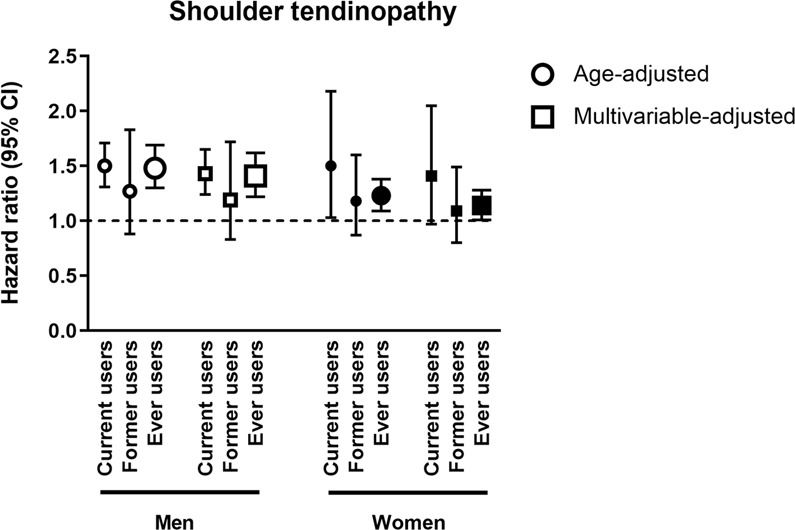
Recent experimental evidence indicates potential adverse effects of statin treatment on tendons but previous clinical studies are few and inconclusive. The aims of our study were, first, to determine whether statin use in a cohort design is associated with tendinopathy disorders, and second, to experimentally understand the pathogenesis of statin induced tendinopathy. We studied association between statin use and different tendon injuries in two population-based Swedish cohorts by time-dependent Cox regression analysis. Additionally, we tested simvastatin in a 3D cell culture model with human tenocytes. Compared with never-users, current users of statins had a higher incidence of trigger finger with adjusted hazard ratios (aHRs) of 1.50 for men (95% confidence interval [CI] 1.21-1.85) and 1.21 (1.02-1.43) for women. We also found a higher incidence of shoulder tendinopathy in both men (aHR 1.43; 1.24-1.65) and women (aHR 1.41; 0.97-2.05). Former users did not confer a higher risk of tendinopathies. In vitro experiments revealed an increased release of matrix metalloproteinase (MMP)-1 and MMP-13 and a weaker, disrupted matrix after simvastatin exposure. Current statin use seems to increase the risk of trigger finger and shoulder tendinopathy, possibly through increased MMP release, and subsequently, a weakened tendon matrix which will be more prone to injuries.
最近的实验证据表明他汀类药物治疗可能对肌腱产生不良影响,但以前的临床研究很少且结论不一致。我们的研究目的首先是确定队列设计中他汀类药物的使用是否与腱病有关,其次是从实验上了解他汀类药物诱导的腱病的发病机制。我们通过时间依赖性 Cox 回归分析,在两个基于人群的瑞典队列中研究了他汀类药物使用与不同肌腱损伤之间的关系。此外,我们还在包含人肌腱细胞的 3D 细胞培养模型中测试了辛伐他汀。与从未使用者相比,目前使用他汀类药物的男性发生扳机指的风险更高,调整后的危险比 (aHR) 为 1.50(95%置信区间 [CI] 1.21-1.85),女性为 1.21(1.02-1.43)。我们还发现男性(aHR 1.43;1.24-1.65)和女性(aHR 1.41;0.97-2.05)的肩部腱病发生率也更高。既往使用者并未增加腱病的风险。体外实验显示,辛伐他汀暴露后基质金属蛋白酶 (MMP)-1 和 MMP-13 的释放增加,基质减弱、破坏。目前他汀类药物的使用似乎会增加扳机指和肩部腱病的风险,这可能是通过增加 MMP 的释放,随后导致肌腱基质减弱,更容易受伤。