Department of Traditional Chinese Medicine Medical College, Xiamen University, Xiamen, Fujian, China (mainland).
LongYan Hospital of Traditional Chinese Medicine, LongYan, FuJian, China (mainland).
Med Sci Monit. 2019 Nov 30;25:9112-9122. doi: 10.12659/MSM.917593.
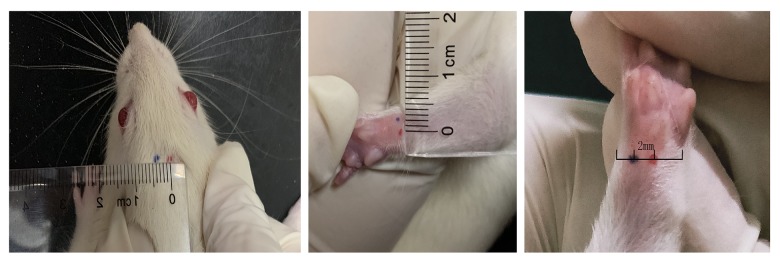
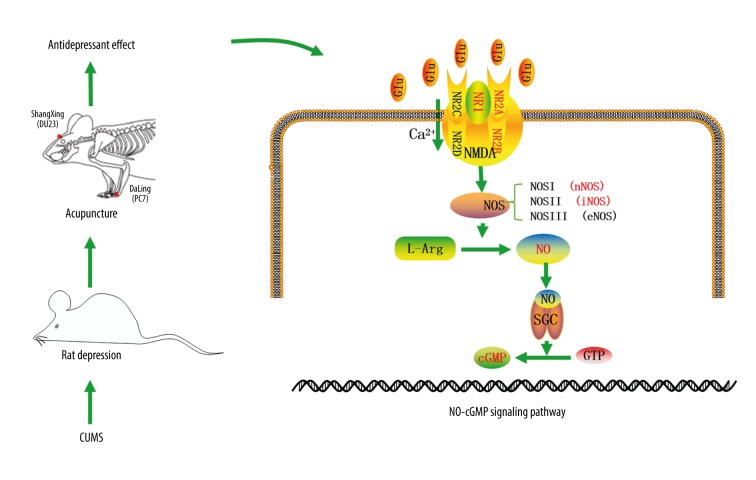
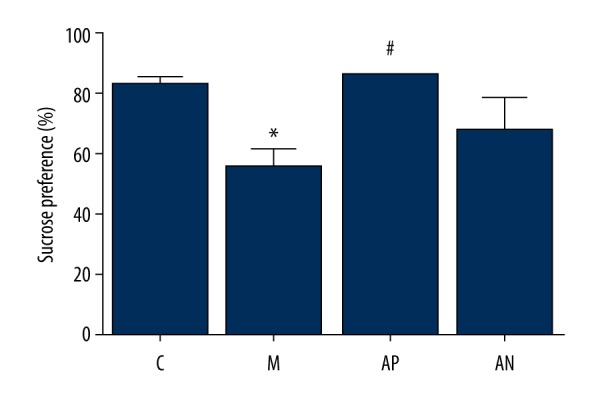
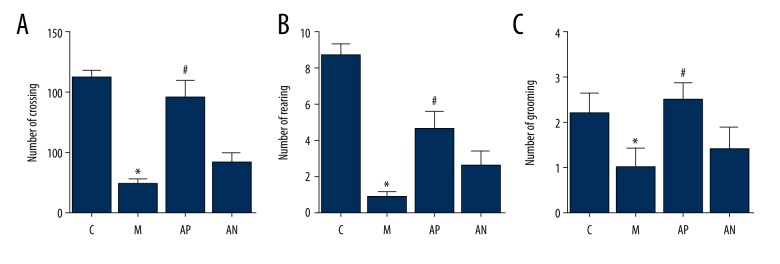
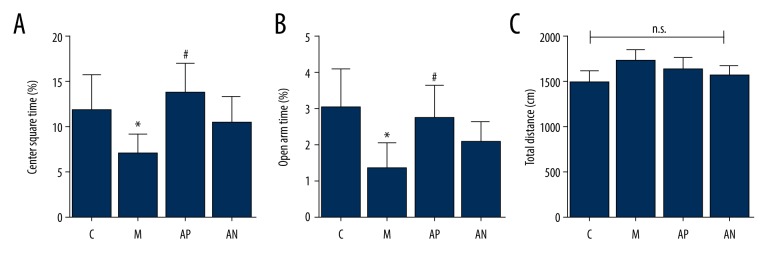
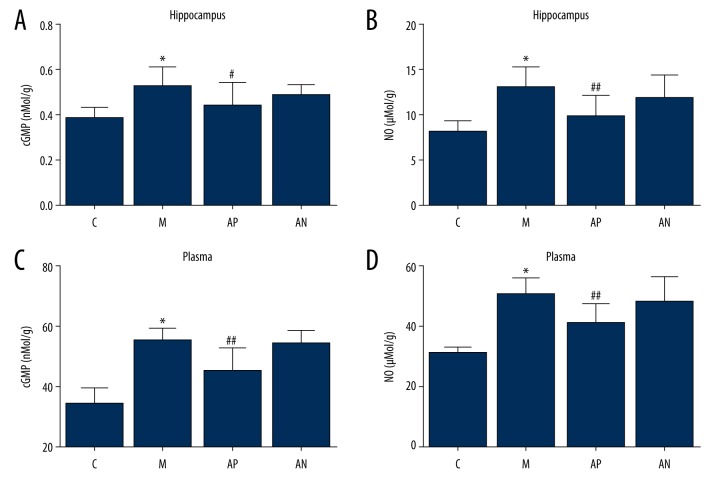
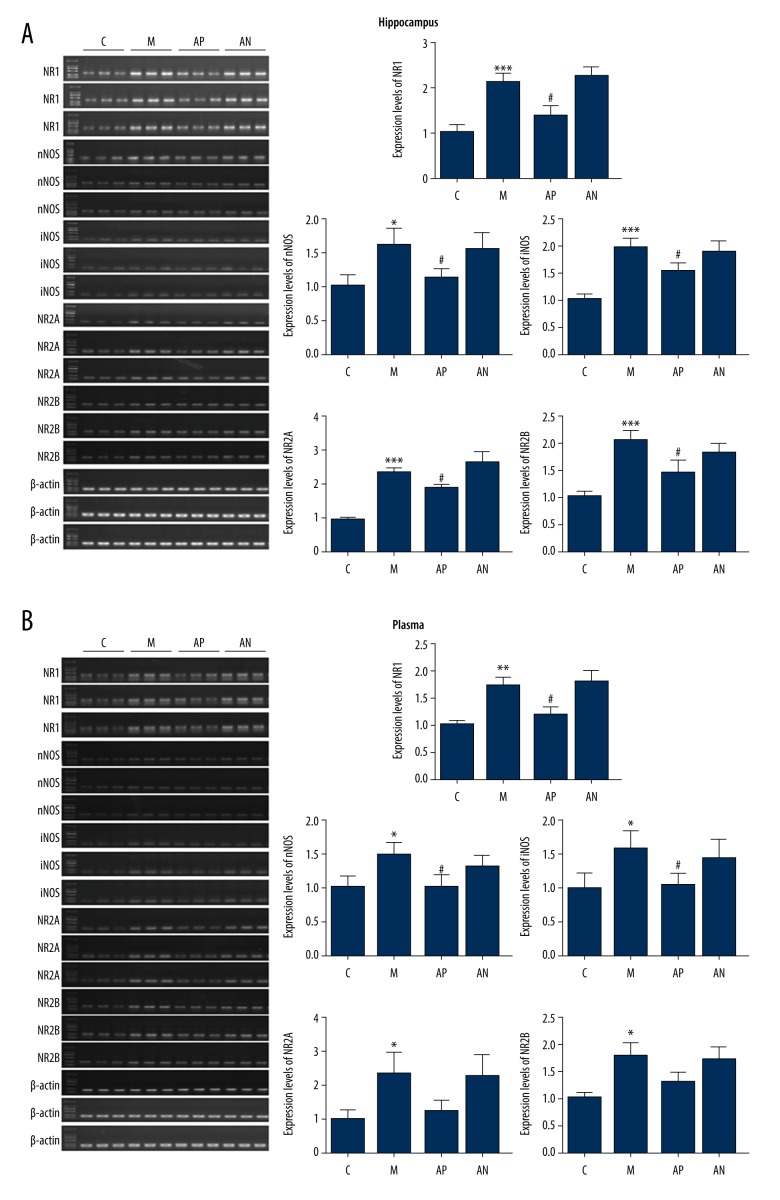
BACKGROUND Depression is a major mood disorder. Some patients have been reported to improve following acupuncture. This study aimed to investigate the effects of acupuncture on behaviors associated with depression in the chronic unpredictable mild stress (CUMS) rat model. The expression of signaling pathway components of nitric oxide (NO) and cyclic guanosine monophosphate (cGMP) in the rat hippocampus and plasma were also measured. MATERIAL AND METHODS Male Sprague-Dawley rats (N=40) were divided into the control group (N=10), the model group (N=10), the acupuncture group (N=10), and the non-acupuncture group (N=10). The rat model was established by orphaning combined with chronic unpredictable mild stress (CUMS) for six weeks. The acupuncture group was given 21 days of treatment using acupoints (AP) or non-acupoints (NP). Rat behaviors associated with depression were tested using the sucrose preference test (SPT), the open field test (OFT), and the elevated plus maze (EPM) test. Enzyme-linked immunoassay (ELISA) and reverse transcription-polymerase chain reaction (RT-PCR) were used to detect the expression of inducible nitric oxide synthase (iNOS), neuronal nitric oxide synthase (nNOS), and the N-methyl-D-aspartate (NMDA) receptor subunits, NR1, NR2A, and NR2B in the rat plasma and hippocampus. RESULTS Acupuncture reversed the behaviors associated with depression in the CUMS rat model and reduced the expression of components of the NO and cGMP pathway in the rat hippocampus and plasma. CONCLUSIONS In the CUMS rat model, treatment with acupuncture reduced behaviors associated with depression, and these effects were associated with changes in the NO and cGMP signaling pathway.
抑郁症是一种主要的情绪障碍。有报道称,一些患者在接受针刺治疗后有所改善。本研究旨在探讨针刺对慢性不可预测轻度应激(CUMS)大鼠模型中与抑郁相关行为的影响。还测量了大鼠海马体和血浆中一氧化氮(NO)和环鸟苷单磷酸(cGMP)信号通路组成部分的表达。
雄性 Sprague-Dawley 大鼠(N=40)分为对照组(N=10)、模型组(N=10)、针刺组(N=10)和非针刺组(N=10)。大鼠模型通过孤养结合慢性不可预测轻度应激(CUMS)建立 6 周。针刺组给予 21 天穴位(AP)或非穴位(NP)治疗。使用蔗糖偏好测试(SPT)、旷场测试(OFT)和高架十字迷宫(EPM)测试评估与抑郁相关的大鼠行为。酶联免疫吸附测定(ELISA)和逆转录聚合酶链反应(RT-PCR)用于检测大鼠血浆和海马体中诱导型一氧化氮合酶(iNOS)、神经元型一氧化氮合酶(nNOS)和 N-甲基-D-天冬氨酸(NMDA)受体亚单位 NR1、NR2A 和 NR2B 的表达。
针刺逆转了 CUMS 大鼠模型中与抑郁相关的行为,并降低了大鼠海马体和血浆中 NO 和 cGMP 通路组成部分的表达。
在 CUMS 大鼠模型中,针刺治疗可减少与抑郁相关的行为,这些作用与 NO 和 cGMP 信号通路的变化有关。