Section of Inflammation, Repair & Development, National Heart & Lung Institute, Imperial College London, London, United Kingdom; Discipline of Child and Adolescent Health, University of Sydney, Sydney, NSW, Australia.
Discipline of Child and Adolescent Health, University of Sydney, Sydney, NSW, Australia; Department of Allergy and Immunology, Children's Hospital at Westmead, Sydney, NSW, Australia.
J Allergy Clin Immunol Pract. 2020 Apr;8(4):1169-1176. doi: 10.1016/j.jaip.2019.11.027. Epub 2019 Nov 28.
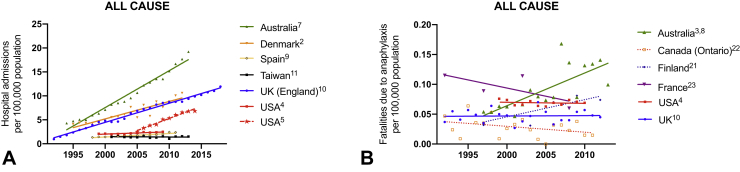
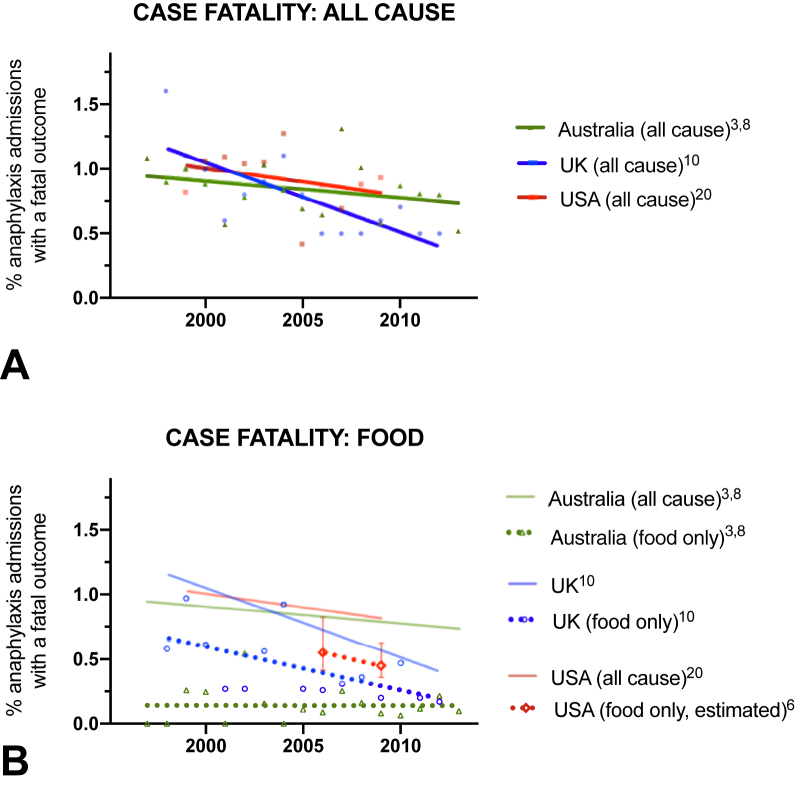
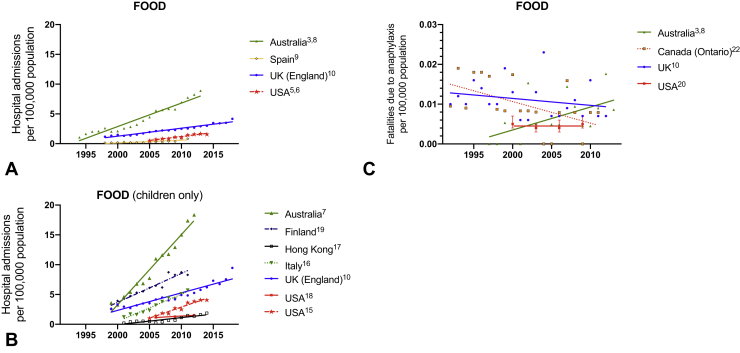
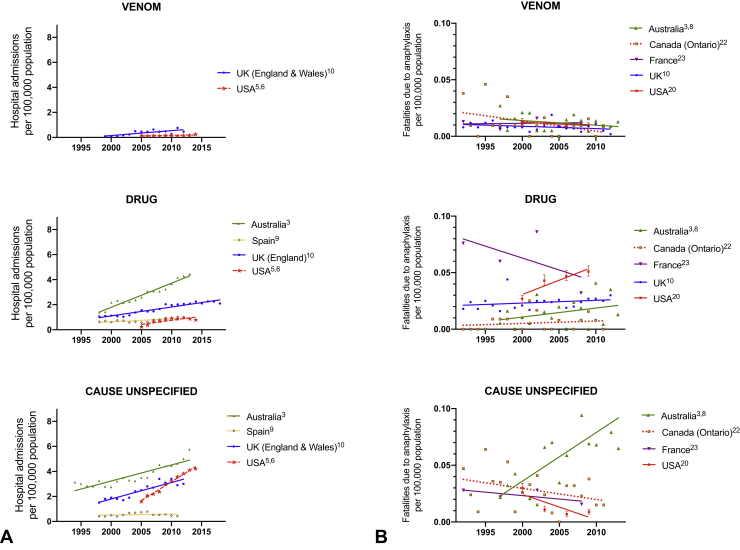
The true global scale of anaphylaxis remains elusive, because many episodes occur in the community without presentation to health care facilities, and most regions have not yet developed reliable systems with which to monitor severe allergic events. The most robust data sets currently available are based largely on hospital admissions, which are limited by inherent issues of misdiagnosis, misclassification, and generalizability. Despite this, there is convincing evidence of a global increase in rates of all-cause anaphylaxis, driven largely by medication- and food-related anaphylaxis. There is no evidence of parallel increases in global all-cause anaphylaxis mortality, with surprisingly similar estimates for case-fatality rates at approximately 0.5% to 1% of fatal outcomes for hospitalizations due to anaphylaxis across several regions. Studying regional patterns of anaphylaxis to certain triggers have provided valuable insights into susceptibility and sensitizing events: for example, the link between the mAb cetuximab and allergy to mammalian meat. Likewise, data from published fatality registers can identify potentially modifiable risk factors that can be used to inform clinical practice, such as prevention of delayed epinephrine administration, correct posturing during anaphylaxis, special attention to populations at risk (such as the elderly on multiple medications), and use of venom immunotherapy in individuals at risk of insect-related anaphylaxis.
过敏性反应的真实全球规模仍然难以捉摸,因为许多病例发生在社区,并未到医疗机构就诊,而且大多数地区尚未建立可靠的系统来监测严重过敏事件。目前可用的最可靠数据集主要基于住院数据,这些数据受到误诊、分类错误和普遍性的固有问题的限制。尽管如此,仍有令人信服的证据表明,所有原因的过敏性反应的全球发生率都在增加,主要是由药物和食物相关的过敏性反应驱动的。没有证据表明全球所有原因的过敏性反应死亡率也在平行增加,在几个地区因过敏性反应住院的死亡病例中,病死率的估计值惊人地相似,约为 0.5%至 1%。研究某些触发因素的区域性过敏性反应模式为易感性和致敏事件提供了有价值的见解:例如,单克隆抗体西妥昔单抗与哺乳动物肉类过敏之间的联系。同样,来自已发表的死亡率登记处的数据可以确定潜在的可改变的危险因素,这些危险因素可用于为临床实践提供信息,例如预防延迟给予肾上腺素、在过敏性反应期间正确保持姿势、特别关注高危人群(如服用多种药物的老年人),以及对有昆虫相关过敏性反应风险的个体使用毒液免疫疗法。