Cejudo Javier, García-Castillo Francisco-Javier, Luna Pablo, Rodrigo-Ruiz Débora, Feltrero Roberto, Moreno-Gómez Alfonso
Department of Psychology, Faculty of Education, University of Castilla-La Mancha, Ciudad Real, Spain.
Faculty of Education, International University of La Rioja, Logroño, Spain.
Front Psychol. 2019 Nov 14;10:2541. doi: 10.3389/fpsyg.2019.02541. eCollection 2019.
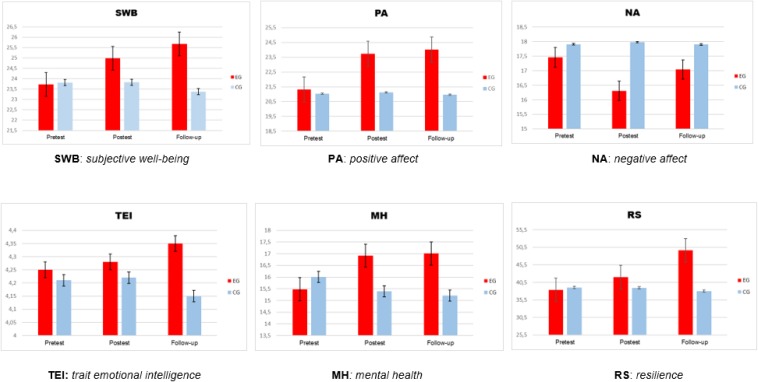
The objective of the present study was to experimentally assess the effects of a mindfulness-based intervention (MBI) for the improvement of subjective well-being, trait emotional intelligence (TEI), mental health, and resilience in a sample of women with fibromyalgia (FM). The sample consisted of 104 women, between 29 and 77 years old ( = 47.59; = 5.93). The measures used were as follows: Satisfaction with Life Scale (SWLS), Positive and Negative Affection Scale (PANAS), Trait Emotional Intelligence Questionnaire Short Form (TEIQue-SF), Mental Health Questionnaire (MH-5), and Resilience Scale (ER-14). A quasi-experimental design of repeated measures with a control group (CG) was used: before and after the application of the treatment and a follow-up assessment 6 months after the completion of the intervention. In order to assess the effect of the program, the participants were randomly assigned to the experimental and control conditions. In the pretest evaluation, a multivariate analysis of variance (MANOVA) and analysis of variance (ANOVA) were carried out. In the post-test evaluation, a multivariate analysis of covariance (MANCOVA) of the study variables as a whole was performed. Then, descriptive analyses and analysis of covariance (ANCOVA) of the post-test scores (covariate pretest score) were performed. In the follow-up evaluation, a MANCOVA of the study variables as a whole was performed. Then, descriptive and ANCOVA analyses of the follow-up scores (covariate pretest score) were performed. In addition, the effect size was calculated using partial eta-squared (μ). The post-test results confirmed statistically significant differences in satisfaction with life (SWL), positive affect (PA), mental health, and resilience. The follow-up results showed statistically significant differences in SWL, PA, TEI, mental health, and resilience. The study provides an effective intervention tool that has been validated experimentally. The general results allow the emphasis of the importance of the implementation of MBIs framed in non-pharmacological treatments in FM.
本研究的目的是通过实验评估基于正念的干预措施(MBI)对改善纤维肌痛(FM)女性样本的主观幸福感、特质情商(TEI)、心理健康和心理韧性的效果。样本包括104名年龄在29至77岁之间的女性(平均年龄 = 47.59岁;标准差 = 5.93岁)。所使用的测量工具如下:生活满意度量表(SWLS)、积极和消极情感量表(PANAS)、特质情商问卷简版(TEIQue-SF)、心理健康问卷(MH-5)和心理韧性量表(ER-14)。采用了带有对照组(CG)的重复测量准实验设计:在治疗应用前后以及干预完成后6个月进行随访评估。为了评估该项目的效果,将参与者随机分配到实验组和对照组。在预测试评估中,进行了多变量方差分析(MANOVA)和方差分析(ANOVA)。在测试后评估中,对整个研究变量进行了多变量协方差分析(MANCOVA)。然后,对测试后分数(协变量预测试分数)进行描述性分析和协方差分析(ANCOVA)。在随访评估中,对整个研究变量进行了MANCOVA。然后,对随访分数(协变量预测试分数)进行描述性和ANCOVA分析。此外,使用偏 eta 平方(μ)计算效应量。测试后结果证实,在生活满意度(SWL)、积极情感(PA)、心理健康和心理韧性方面存在统计学上的显著差异。随访结果显示,在SWL、PA、TEI、心理健康和心理韧性方面存在统计学上的显著差异。该研究提供了一种经过实验验证的有效干预工具。总体结果凸显了在FM的非药物治疗中实施MBIs的重要性。