Université de Bordeaux, Laboratoire Photonique Numérique et Nanosciences, UMR 5298, F-33400 Talence, France.
Institut d'Optique and CNRS, LP2N UMR 5298, F-33400 Talence, France.
Sci Adv. 2019 Sep 27;5(9):eaax1166. doi: 10.1126/sciadv.aax1166. eCollection 2019 Sep.
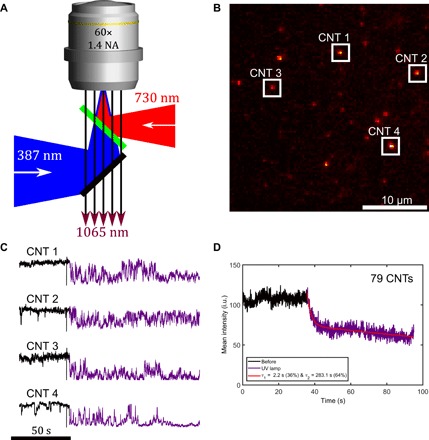
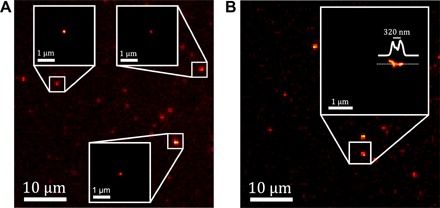
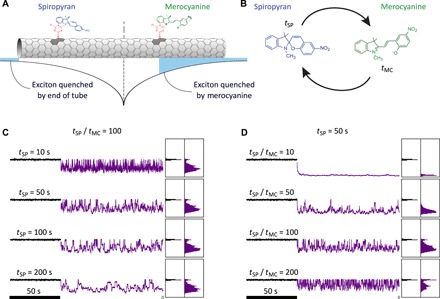
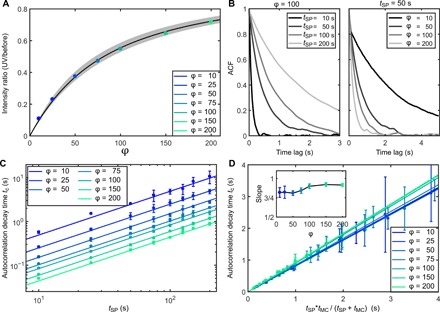
The design of single-molecule photoswitchable emitters was the first milestone toward the advent of single-molecule localization microscopy, setting a new paradigm in the field of optical imaging. Several photoswitchable emitters have been developed, but they all fluoresce in the visible or far-red ranges, missing the desirable near-infrared window where biological tissues are most transparent. Moreover, photocontrol of individual emitters in the near-infrared would be highly desirable for elementary optical molecular switches or information storage elements since most communication data transfer protocols are established in this spectral range. Here, we introduce a type of hybrid nanomaterials consisting of single-wall carbon nanotubes covalently functionalized with photoswitching molecules that are used to control the intrinsic luminescence of the single nanotubes in the near-infrared (beyond 1 μm). Through the control of photoswitching, we demonstrate super-localization imaging of nanotubes unresolved by diffraction-limited microscopy.
单分子光开关发射器的设计是单分子定位显微镜问世的第一个里程碑,为光学成像领域开创了一个新的范例。已经开发出了几种光开关发射器,但它们都在可见光或远红范围内发光,错过了生物组织最透明的理想近红外窗口。此外,由于大多数通信数据传输协议都建立在这个光谱范围内,因此近红外区域中单个发射器的光控对于基本的光学分子开关或信息存储元件将是非常理想的。在这里,我们引入了一种由单壁碳纳米管与光开关分子共价功能化而成的混合纳米材料,用于控制单根纳米管在近红外(超过 1 μm)的本征发光。通过对光开关的控制,我们演示了超分辨定位成像,这种成像方法无法通过传统的衍射极限显微镜来实现。