San Francisco Veteran Affairs Health Care System, San Francisco, California, 94158.
Department of Orthopaedic Surgery, University of California San Francisco, San Francisco, California, 94158.
J Orthop Res. 2020 May;38(5):1113-1121. doi: 10.1002/jor.24550. Epub 2019 Dec 13.
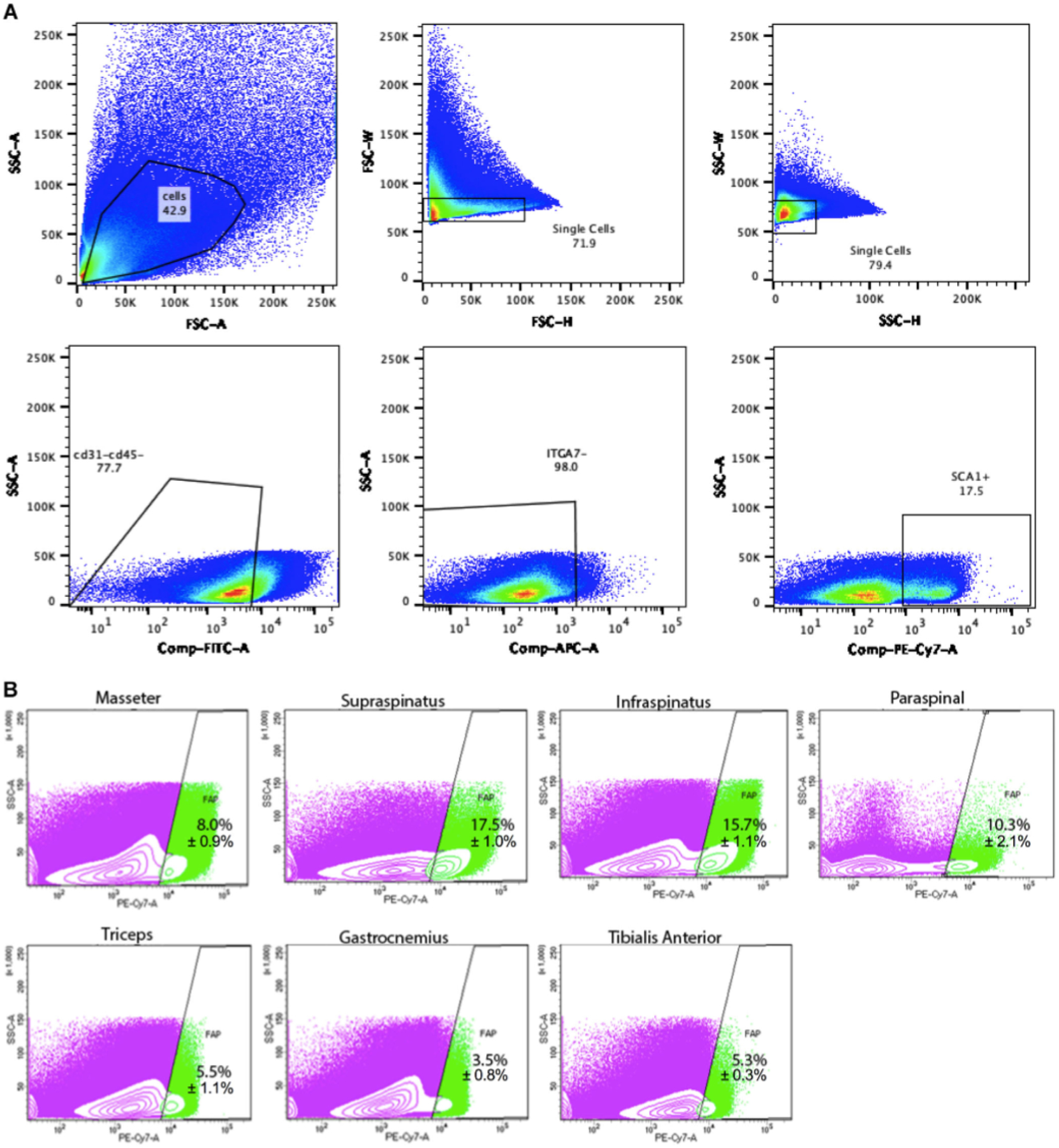
Fatty infiltration (FI) of rotator cuff (RC) muscles is common in patients with RC tears. Studies have demonstrated that fibro-adipogenic progenitors (FAPs), a population of resident muscle stem cells, are the main contributors of FI, which adversely affects muscle quality and RC repair success. Although FI is common in RC injuries, it is not frequently reported after other musculotendinous injuries. Additionally, studies have shown the development of different pathology patterns across muscle groups suggestive of intrinsic differences in cellular composition and behavior. This study evaluates FAP distribution and differentiation properties across anatomic locations in mice. Muscles from seven different anatomic locations were harvested from PDGFRα-eGFP FAP reporter mice. FAPs were quantified using histology and FACS sorting with BD Aria II with CD31 /CD45 /Integrinα7 /Sca-1 and PDGFRα reporter signal (n = 3 per muscle). The cells were analyzed for adipogenesis using immunocytochemistry and for proliferation properties with Brdu-Ki67 staining. In a separate group of mice, RC and tibialis anterior muscles received glycerol injection and were harvested after 2 weeks for FI quantification (n = 4). One-way analysis of variance was used for statistical comparisons among groups, with significance at p < 0.05. FAPs from the RC, masseter, and paraspinal muscles were more numerous and demonstrated greater proliferative capacity and adipogenic potency than those from the tibialis anterior and gastrocnemius. The RC demonstrated significantly greater levels of FI than the tibialis anterior after glycerol-injection injury. Clinical Significance: This study suggests differences in FAP distribution and differentiation characteristics may account for the propensity to develop FI in RC tears as compared with other musculotendinous injuries. © 2019 Orthopaedic Research Society. Published by Wiley Periodicals, Inc. J Orthop Res 38:1113-1121, 2020.
肩袖撕裂患者的肩袖肌肉脂肪浸润(FI)很常见。研究表明,纤维脂肪祖细胞(FAPs)是一种驻留肌肉干细胞群体,是 FI 的主要贡献者,这会对肌肉质量和肩袖修复的成功产生不利影响。尽管 FI 在肩袖损伤中很常见,但在其他肌肉肌腱损伤后并不经常报告。此外,研究表明,不同肌肉群的病理模式发展表明细胞组成和行为存在内在差异。本研究评估了 FAP 在小鼠不同解剖部位的分布和分化特性。从 PDGFRα-eGFP FAP 报告小鼠的七个不同解剖部位采集肌肉。使用组织学和 BD Aria II 进行 FACS 分选,结合 CD31/CD45/Integrinα7/Sca-1 和 PDGFRα 报告信号对 FAP 进行定量(n = 每个肌肉 3 只)。使用免疫细胞化学分析细胞的成脂分化特性,并使用 Brdu-Ki67 染色分析增殖特性。在一组单独的小鼠中,冈上肌和比目鱼肌接受甘油注射,2 周后采集用于 FI 定量(n = 4)。采用单因素方差分析进行组间统计学比较,显著性水平为 p < 0.05。与比目鱼肌和腓肠肌相比,冈上肌、咬肌和脊柱旁肌的 FAP 数量更多,增殖能力和成脂潜能更强。甘油注射损伤后,冈上肌的 FI 水平明显高于比目鱼肌。临床意义:本研究表明,FAP 分布和分化特征的差异可能是冈上肌撕裂较其他肌肉肌腱损伤更易发生 FI 的原因。© 2019 骨科研究协会。由 Wiley Periodicals, Inc. 出版。J Orthop Res 38:1113-1121, 2020.