School of Sport, Exercise and Health Sciences, Loughborough University, Loughborough, UK.
Centro de Investigaciones Educativas, Universidad del Valle de Guatemala, Guatemala City, Guatemala.
Public Health Nutr. 2020 Jun;23(8):1381-1391. doi: 10.1017/S1368980019003239. Epub 2019 Dec 5.
To investigate changes in socio-economic inequalities in growth in height, weight, BMI and grip strength in children born during 1955-1993 in Guatemala, a period of marked socio-economic-political change.
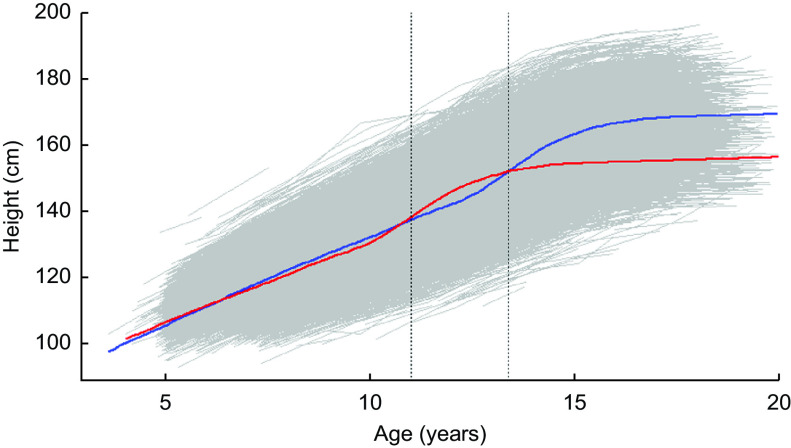
We modelled longitudinal data on height, weight, BMI and hand grip strength using Super-Imposition by Translation and Rotation (SITAR). Internal Z-scores summarising growth size, timing and intensity (peak growth velocity, e.g. cm/year) were created to investigate inequalities by socio-economic position (SEP; measured by school attended). Interactions of SEP with date of birth were investigated to capture secular changes in inequalities.
Urban and peri-urban schools in the region of Guatemala City, Guatemala.
Participants were 40 484 children and adolescents aged 3-19 years of Ladino and Maya ancestry (nobservations 157 067).
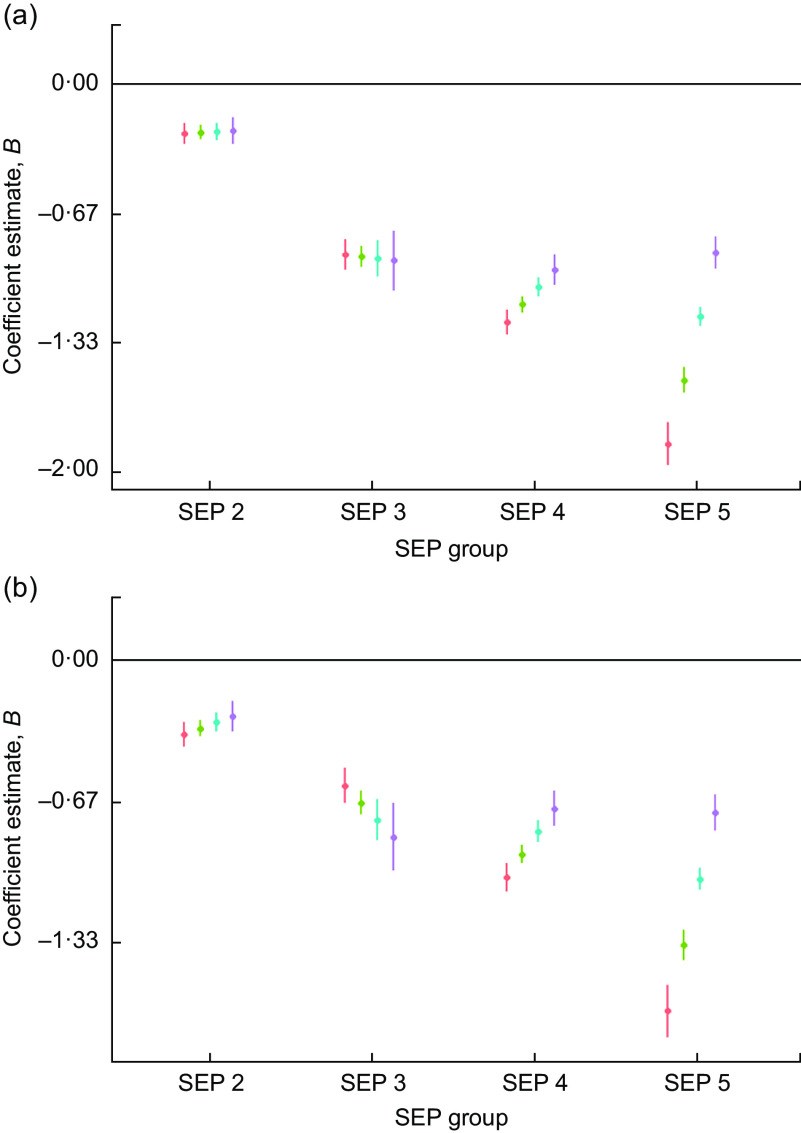
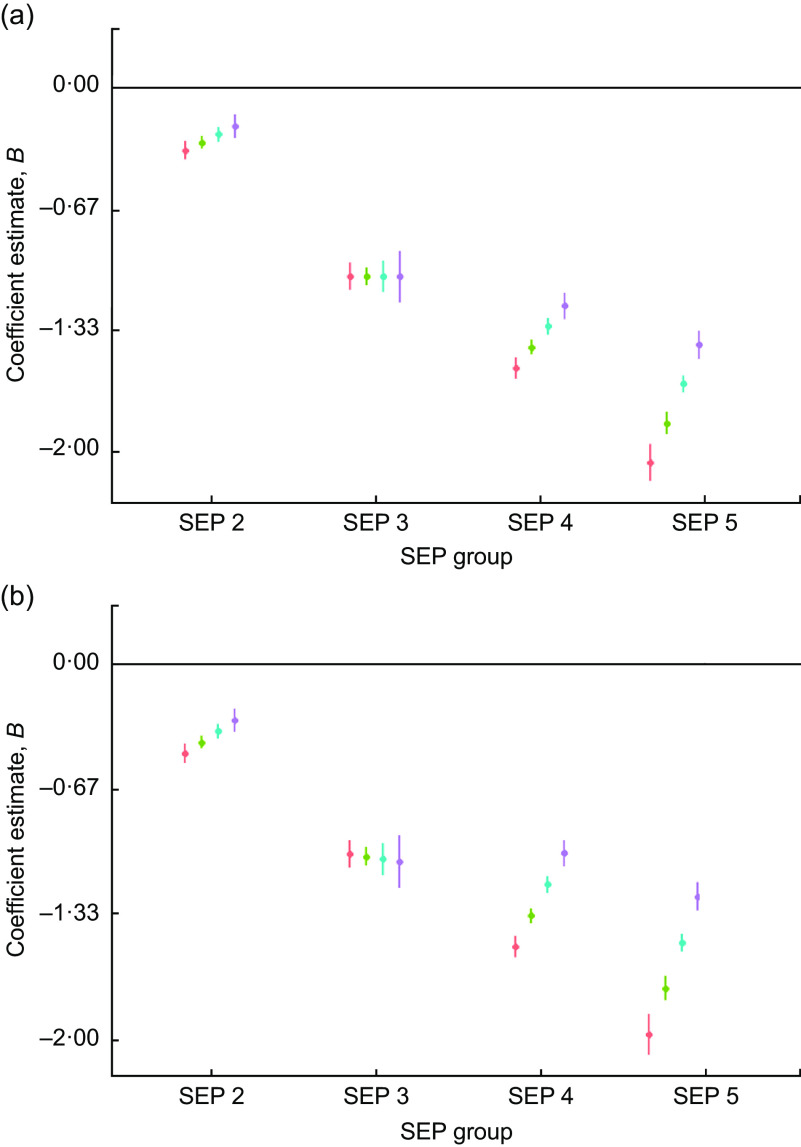
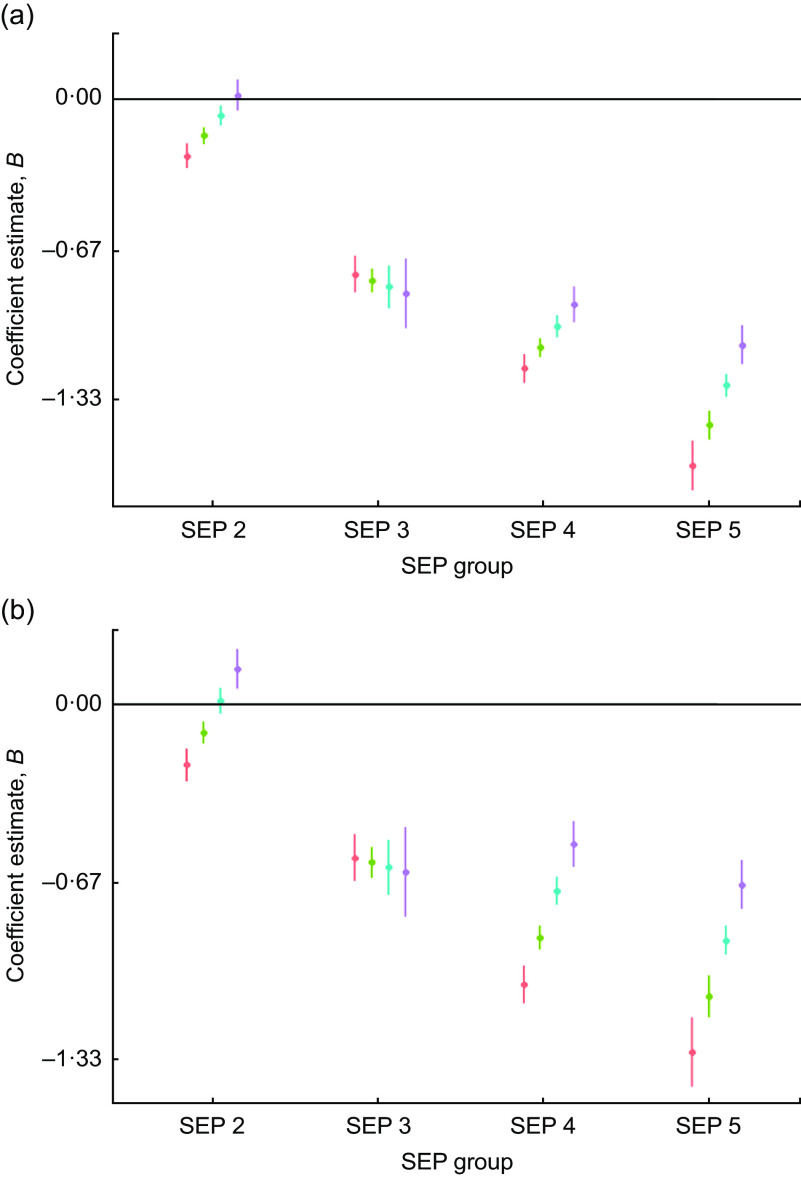
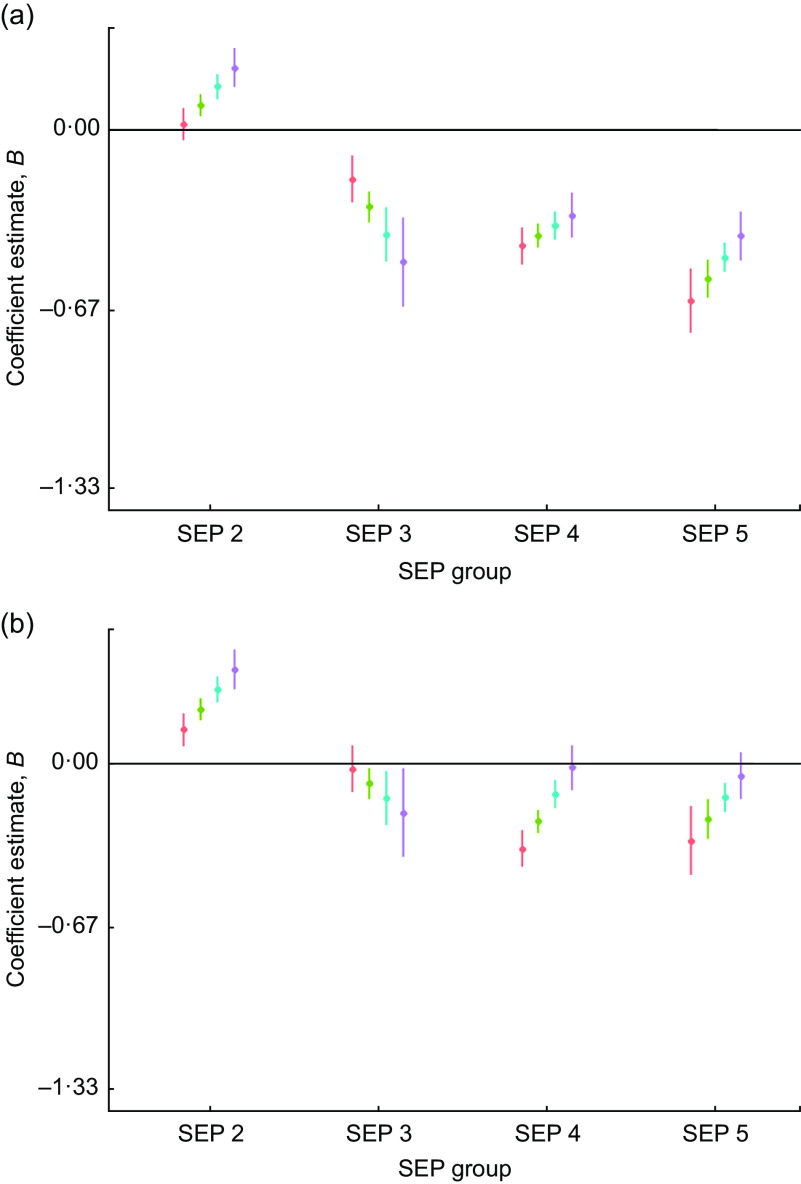
The difference in height (SITAR size) between lowest and highest SEP decreased from -2·0 (95 % CI -2·2, -1·9) sd to -1·4 (95 % CI -1·5, -1·3) sd in males, and from -2·0 (95 % CI -2·1, -1·9) sd to -1·2 (95 % CI -1·3, -1·2) sd in females over the study period. Inequalities also reduced for weight, BMI and grip strength, due to greater secular increases in lowest-SEP groups. The puberty period was earlier and shorter in higher-SEP individuals (earlier SITAR timing and higher SITAR intensity). All SEP groups showed increases in BMI intensity over time.
Inequality narrowed between the 1960s and 1990s. The lowest-SEP groups were still >1 sd shorter than the highest. Risks remain for reduced human capital and poorer population health for urban Guatemalans.
研究 1955 年至 1993 年期间在危地马拉出生的儿童的身高、体重、BMI 和握力增长的社会经济不平等变化,这一时期社会经济政治发生了重大变化。
我们使用平移和旋转叠加法(SITAR)对身高、体重、BMI 和手握力进行了纵向数据分析。创建了内部 Z 分数来总结生长大小、时间和强度(例如,每年增长速度),以研究社会经济地位(SEP;通过就读学校测量)的不平等。研究了 SEP 与出生日期的相互作用,以捕捉不平等的时代变化。
危地马拉危地马拉城地区的城市和城市周边学校。
参与者为具有拉迪诺和玛雅血统的 3-19 岁儿童和青少年 40484 人(观察次数 157067 次)。
在男性中,最高和最低 SEP 之间的身高差异(SITAR 大小)从 -2.0(95%CI -2.2,-1.9)标准差缩小到 -1.4(95%CI -1.5,-1.3)标准差,而女性则从 -2.0(95%CI -2.1,-1.9)标准差缩小到 -1.2(95%CI -1.3,-1.2)标准差。在整个研究期间,由于最低 SEP 组的增长幅度更大,体重、BMI 和握力的不平等也有所减少。高 SEP 个体的青春期更早且更短(更早的 SITAR 时间和更高的 SITAR 强度)。所有 SEP 组的 BMI 强度都随着时间的推移而增加。
20 世纪 60 年代至 90 年代,不平等程度缩小。最低 SEP 组仍然比最高组短>1 个标准差。危地马拉城市居民的人力资本减少和人口健康状况较差的风险仍然存在。