Laboratory of Immune Regulation, Department of Microbiology and Immunology, Graduate School of Medicine, WPI Immunology Frontier Research Center, Osaka University, Suita, Japan.
Core Research for Evolutional Science and Technology, Japan Agency for Medical Research and Development, Tokyo, Japan.
Exp Mol Med. 2019 Dec 11;51(12):1-6. doi: 10.1038/s12276-019-0283-6.
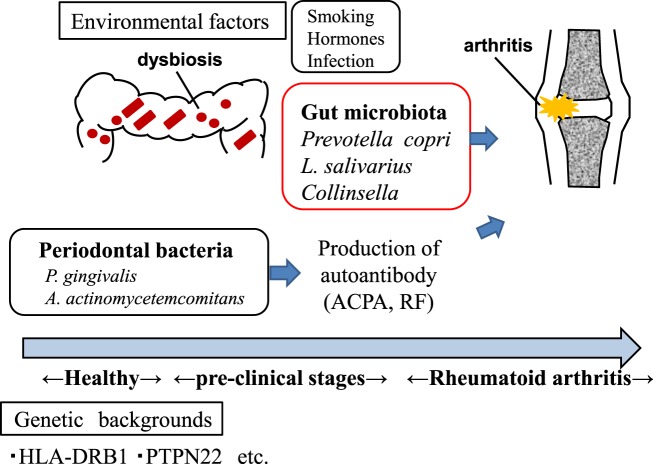
The gut microbiota has been proposed to be an important environmental factor in the development of rheumatoid arthritis (RA). Here, we review a growing body of evidence from human and animal studies that supports the hypothesis that intestinal microbiota play a role in RA. Previous studies from we and others showed an altered composition of the microbiota in early RA patients. A recent study demonstrated that Prevotella species are dominant in the intestine of patients in the preclinical stages of RA. In addition, Prevotella-dominated microbiota isolated from RA patients contributes to the development of Th17 cell-dependent arthritis in SKG mice. Moreover, it was reported that periodontal bacteria correlates with the pathogenesis of RA. In this review, we discuss the link between oral bacteria and the development of arthritis. However, many questions remain to be elucidated in terms of molecular mechanisms for the involvement of intestinal and oral microbiota in RA pathogenesis.
肠道微生物群被认为是类风湿关节炎(RA)发展的一个重要环境因素。在这里,我们回顾了越来越多的来自人类和动物研究的证据,这些证据支持肠道微生物群在 RA 中发挥作用的假说。我们和其他人之前的研究表明,早期 RA 患者的微生物群组成发生了改变。最近的一项研究表明,普雷沃氏菌属在 RA 临床前阶段患者的肠道中占优势。此外,从 RA 患者中分离出的以普雷沃氏菌属为主的微生物群有助于 SKG 小鼠 Th17 细胞依赖性关节炎的发展。此外,据报道牙周细菌与 RA 的发病机制有关。在这篇综述中,我们讨论了口腔细菌与关节炎发展之间的联系。然而,在肠道和口腔微生物群参与 RA 发病机制的分子机制方面,仍有许多问题有待阐明。