Francisco Fernandez Marbelis, Charfi Cyndia, Piloto-Ferrer Janet, Lidia González Maria, Lamy Sylvie, Annabi Borhane
Laboratoire d'Oncologie Moléculaire, Département de Chimie, Centre de Recherche BIOMED, Université du Québec à Montréal, Montreal, Quebec, Canada.
Departamento de Genética Toxicológica, Centro de Investigación y Desarrollo de Medicamentos (CIDEM), Avenida 26, No. 1605 e/Puentes Grandes y Boyeros, La Habana, Cuba.
Evid Based Complement Alternat Med. 2019 Nov 15;2019:6073019. doi: 10.1155/2019/6073019. eCollection 2019.
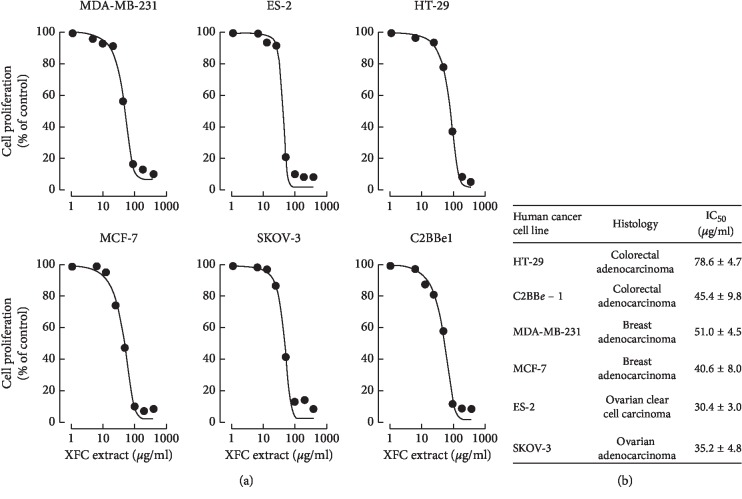
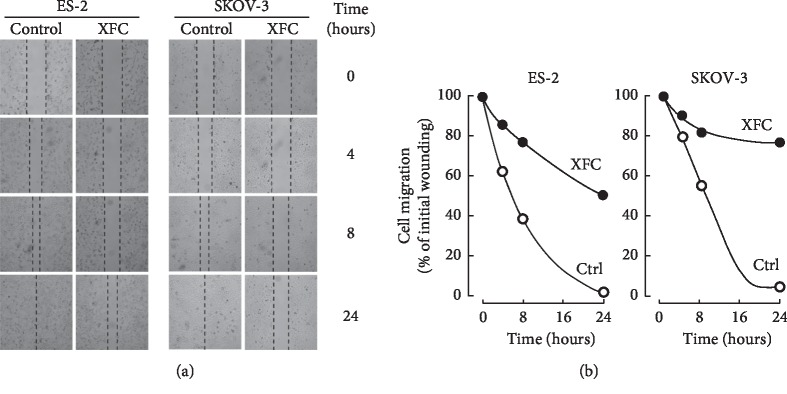
Emerging drugs aim at targeting the genomic integrity and replication machinery in ovarian cancer. While the antiproliferative activity of L. extract (XFC), a traditional herbal medicine, is believed to alter the mitotic apparatus of Chinese hamster ovary epithelial cells, its capacity to target and overcome the chemoresistance phenotype in ovarian cancer is unknown. Among the cancer cell lines tested, we found that the best proliferation inhibitory effect for XFC was against ovarian cancer cells and ranged from 30 to 35 g/mL. XFC efficiently targeted both the cytotoxic drug chemoresistance phenotype of SKOV-3 cells and of the chemosensitive ES-2 cells. Early apoptosis and late apoptosis were effectively induced by XFC extract in ES-2 cells, whereas late apoptosis and necrosis events were triggered in SKOV-3 cells. Cell cycling regulation was trapped by XFC extract in the G2/M phase in both the ES-2 and SKOV-3 cell models. This effect was, in part, attributable to increased dose-dependent tubulin polymerization, which was increased in SKOV-3 cells. Whereas XFC extract triggered poly (ADP-Ribose) polymerase (PARP) cleavage in both ES-2 and SKOV-3 cells, it only lowered Nrf2 in ES-2 cells and phosphorylated Akt levels in SKOV-3 cells. Interestingly, cell cycling regulators Cdk4, Cyclin D3, and p27 were all decreased in SKOV-3 cells. XFC extracts were effective in inhibiting migration in both ovarian cancer cell models. Our data support the potential anticancer targeting of chemoresistant human ovarian cancer cells phenotype by XFC extract.
新兴药物旨在针对卵巢癌中的基因组完整性和复制机制。虽然传统草药L.提取物(XFC)的抗增殖活性被认为会改变中国仓鼠卵巢上皮细胞的有丝分裂装置,但其靶向并克服卵巢癌化疗耐药表型的能力尚不清楚。在测试的癌细胞系中,我们发现XFC对卵巢癌细胞的增殖抑制效果最佳,浓度范围为30至35μg/mL。XFC有效地靶向了SKOV-3细胞和化疗敏感的ES-2细胞的细胞毒性药物耐药表型。XFC提取物在ES-2细胞中有效诱导早期凋亡和晚期凋亡,而在SKOV-3细胞中触发晚期凋亡和坏死事件。在ES-2和SKOV-3细胞模型中,XFC提取物在G2/M期捕获细胞周期调控。这种作用部分归因于剂量依赖性微管蛋白聚合增加,在SKOV-3细胞中更为明显。虽然XFC提取物在ES-2和SKOV-3细胞中均触发聚(ADP-核糖)聚合酶(PARP)裂解,但它仅降低ES-2细胞中的Nrf2并降低SKOV-3细胞中的磷酸化Akt水平。有趣的是,细胞周期调节因子Cdk4、细胞周期蛋白D3和p27在SKOV-3细胞中均减少。XFC提取物在两种卵巢癌细胞模型中均有效抑制迁移。我们的数据支持XFC提取物对化疗耐药的人卵巢癌细胞表型具有潜在的抗癌靶向作用。