Iben Axén, Lise Hestbaek, Charlotte Leboeuf-Yde
1Karolinska Institutet, Institute of Environmental Medicine, Unit of Intervention and Implementation Research for Worker Health, Nobels väg 13, 171 77 Stockholm, Sweden.
Et Liv I Bevegelse (The Norwegian Chiropractic Research Foundation), Storgt 10a, 0155 Oslo, Norway.
Chiropr Man Therap. 2019 Nov 21;27:63. doi: 10.1186/s12998-019-0283-6. eCollection 2019.
Maintenance Care is a traditional chiropractic approach, whereby patients continue treatment after optimum benefit is reached. A review conducted in 1996 concluded that evidence behind this therapeutic strategy was lacking, and a second review from 2008 reached the same conclusion. Since then, a systematic research program in the Nordic countries was undertaken to uncover the definition, indications, prevalence of use and beliefs regarding Maintenance Care to make it possible to investigate its clinical usefulness and cost-effectiveness. As a result, an evidence-based clinical study could be performed. It was therefore timely to review the evidence.
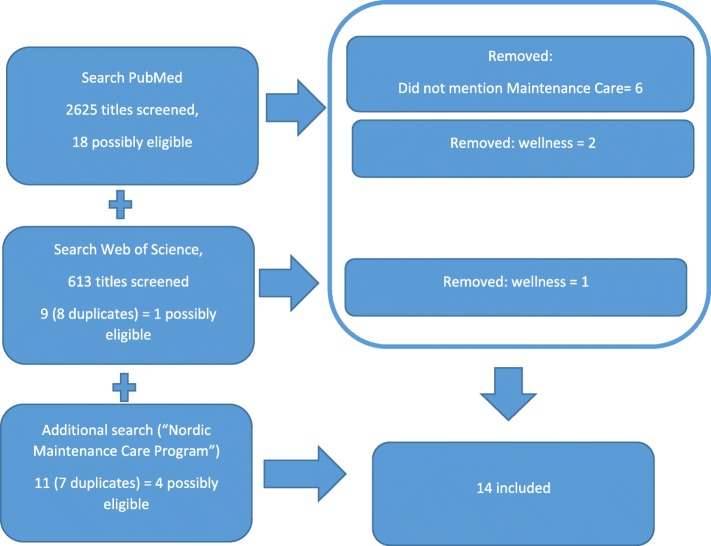
Using the search terms "chiropractic OR manual therapy" AND "Maintenance Care OR prevention", PubMed and Web of Science were searched, and the titles and abstracts reviewed for eligibility, starting from 2007. In addition, a search for "The Nordic Maintenance Care Program" was conducted. Because of the diversity of topics and study designs, a systematic review with narrative reporting was undertaken.
Fourteen original research articles were included in the review. Maintenance Care was defined as a secondary/tertiary preventive approach, recommended to patients with previous pain episodes, who respond well to chiropractic care. Maintenance Care is applied to approximately 30% of Scandinavian chiropractic patients. Both chiropractors and patients believe in the efficacy of Maintenance Care. Four studies investigating the effect of chiropractic Maintenance Care were identified, with disparate results on pain and disability of neck and back pain. However, only one of these studies utilized all the existing evidence when selecting study subjects and found that Maintenance Care patients experienced fewer days with low back pain compared to patients invited to contact their chiropractor 'when needed'. No studies were found on the cost-effectiveness of Maintenance Care.
Knowledge of chiropractic Maintenance Care has advanced. There is reasonable consensus among chiropractors on what Maintenance Care is, how it should be used, and its indications. Presently, Maintenance Care can be considered an evidence-based method to perform secondary or tertiary prevention in patients with previous episodes of low back pain, who report a good outcome from the initial treatments. However, these results should not be interpreted as an indication for Maintenance Care on all patients, who receive chiropractic treatment.
维持性护理是一种传统的整脊疗法,即患者在获得最佳疗效后继续接受治疗。1996年进行的一项综述得出结论,该治疗策略缺乏证据支持,2008年的另一项综述也得出了相同结论。从那时起,北欧国家开展了一项系统研究计划,以揭示维持性护理的定义、适应症、使用 prevalence 及相关信念,从而能够对其临床实用性和成本效益进行调查。结果,得以开展一项基于证据的临床研究。因此,及时对证据进行综述很有必要。
从2007年开始,使用搜索词“整脊疗法或手法治疗”以及“维持性护理或预防”在PubMed和科学网进行搜索,并对标题和摘要进行资格审查。此外,还搜索了“北欧维持性护理计划”。由于主题和研究设计的多样性,采用了叙述性报告的系统综述方法。
该综述纳入了14篇原创研究文章。维持性护理被定义为一种二级/三级预防方法,推荐给既往有疼痛发作且对整脊治疗反应良好的患者。约30%的斯堪的纳维亚整脊患者接受维持性护理。整脊医生和患者都相信维持性护理的疗效。确定了四项调查整脊维持性护理效果的研究,这些研究在颈部和背部疼痛的疼痛和残疾方面结果不一。然而,这些研究中只有一项在选择研究对象时利用了所有现有证据,发现与被邀请“必要时”联系整脊医生的患者相比,接受维持性护理的患者下腰痛天数更少。未发现关于维持性护理成本效益的研究。
整脊维持性护理的知识有了进展。整脊医生对于维持性护理是什么、应如何使用及其适应症达成了合理共识。目前,维持性护理可被视为一种基于证据的方法,用于对既往有下腰痛发作且初始治疗效果良好的患者进行二级或三级预防。然而,这些结果不应被解释为所有接受整脊治疗的患者都适合进行维持性护理的指征。