Picower Institute for Learning and Memory, Department of Brain and Cognitive Sciences, Massachusetts Institute of Technology, Cambridge, MA 02139, USA.
Center for Integrative Brain Research, Seattle Children's Research Institute, Seattle, WA 98101, USA.
Cereb Cortex. 2020 Apr 14;30(4):2555-2572. doi: 10.1093/cercor/bhz260.
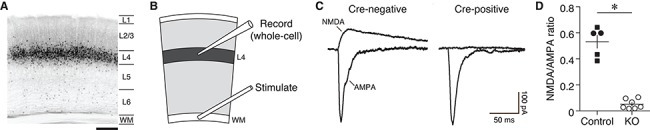
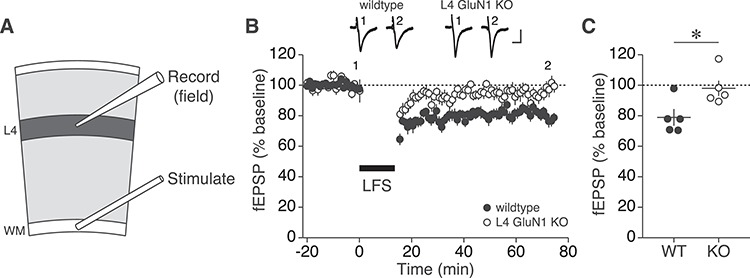
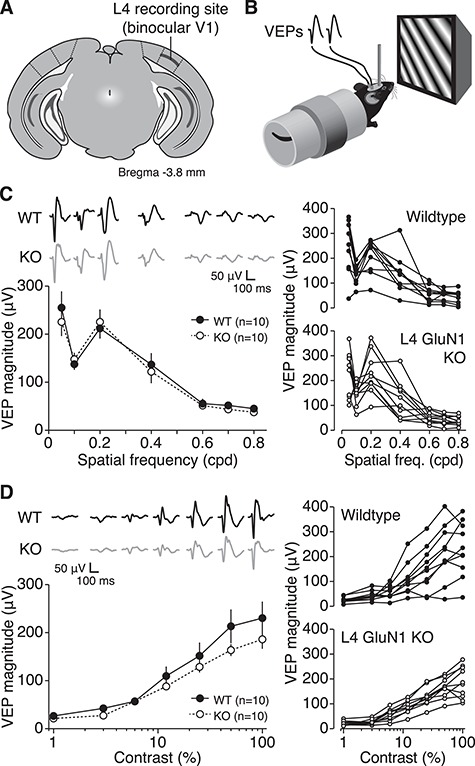
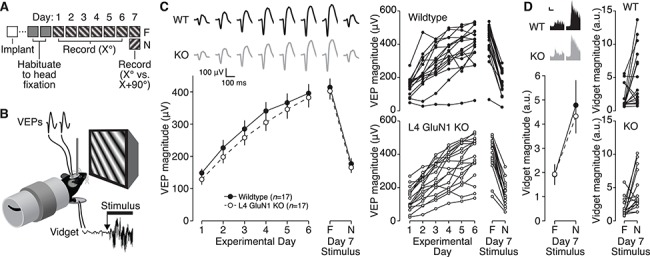
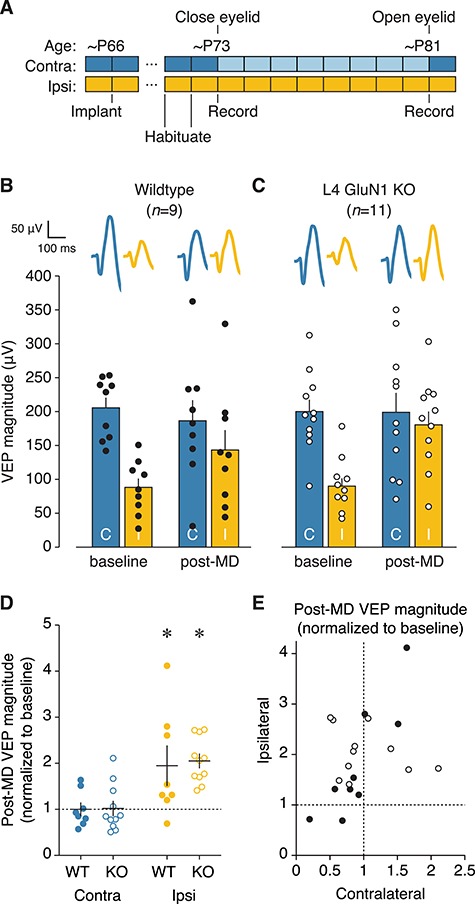
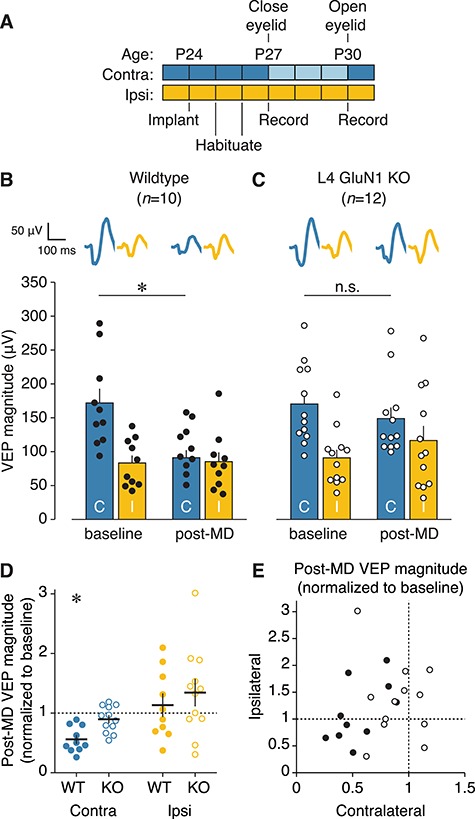
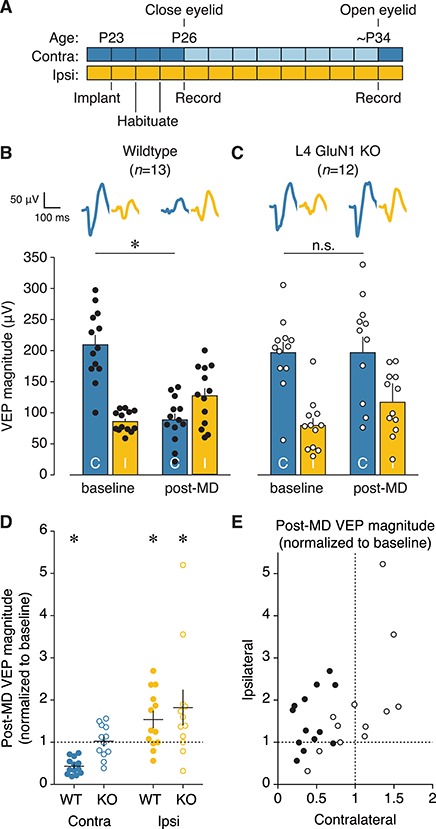
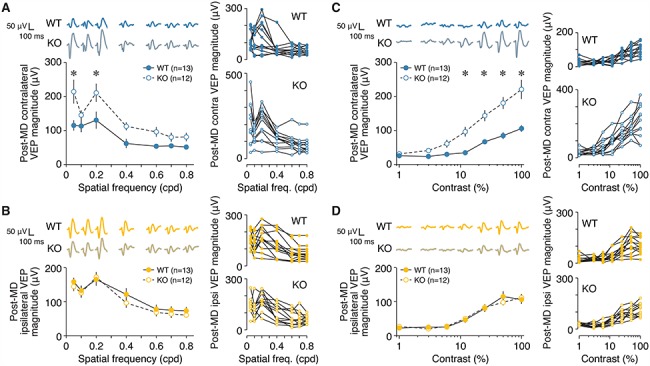
Primary visual cortex (V1) is the locus of numerous forms of experience-dependent plasticity. Restricting visual stimulation to one eye at a time has revealed that many such forms of plasticity are eye-specific, indicating that synaptic modification occurs prior to binocular integration of thalamocortical inputs. A common feature of these forms of plasticity is the requirement for NMDA receptor (NMDAR) activation in V1. We therefore hypothesized that NMDARs in cortical layer 4 (L4), which receives the densest thalamocortical input, would be necessary for all forms of NMDAR-dependent and input-specific V1 plasticity. We tested this hypothesis in awake mice using a genetic approach to selectively delete NMDARs from L4 principal cells. We found, unexpectedly, that both stimulus-selective response potentiation and potentiation of open-eye responses following monocular deprivation (MD) persist in the absence of L4 NMDARs. In contrast, MD-driven depression of deprived-eye responses was impaired in mice lacking L4 NMDARs, as was L4 long-term depression in V1 slices. Our findings reveal a crucial requirement for L4 NMDARs in visual cortical synaptic depression, and a surprisingly negligible role for them in cortical response potentiation. These results demonstrate that NMDARs within distinct cellular subpopulations support different forms of experience-dependent plasticity.
初级视皮层 (V1) 是多种形式的经验依赖性可塑性的所在地。将视觉刺激限制在一只眼睛上,已经揭示出许多这样的形式的可塑性是眼睛特异性的,这表明突触的修饰发生在丘脑皮质输入的双眼整合之前。这些形式的可塑性的一个共同特征是 V1 中需要 NMDA 受体 (NMDAR) 的激活。因此,我们假设,在接收最密集的丘脑皮质输入的皮质层 4 (L4) 中的 NMDAR 对于所有形式的 NMDAR 依赖性和输入特异性 V1 可塑性都是必需的。我们在清醒的小鼠中使用基因方法来选择性地从 L4 主细胞中删除 NMDAR,从而检验了这一假设。出乎意料的是,我们发现,在缺乏 L4 NMDAR 的情况下,刺激选择性反应增强和单眼剥夺 (MD) 后睁眼反应的增强仍然存在。相比之下,在缺乏 L4 NMDAR 的小鼠中,MD 驱动的剥夺眼反应的抑制受损,而 V1 切片中的 L4 长时程抑制也受损。我们的发现揭示了 L4 NMDAR 在视觉皮层突触抑制中的关键作用,以及它们在皮层反应增强中的作用微不足道。这些结果表明,在不同的细胞亚群中的 NMDAR 支持不同形式的经验依赖性可塑性。