Division of Gastroenterology and Hepatology, Center for Basic Research in Digestive Diseases, Mayo Clinic, Rochester, MN.
Division of Gastroenterology and Hepatology, Center for Cell Signaling in Gastroenterology, Mayo Clinic, Rochester, MN.
Hepatology. 2020 Feb;71(2):741-748. doi: 10.1002/hep.31067.
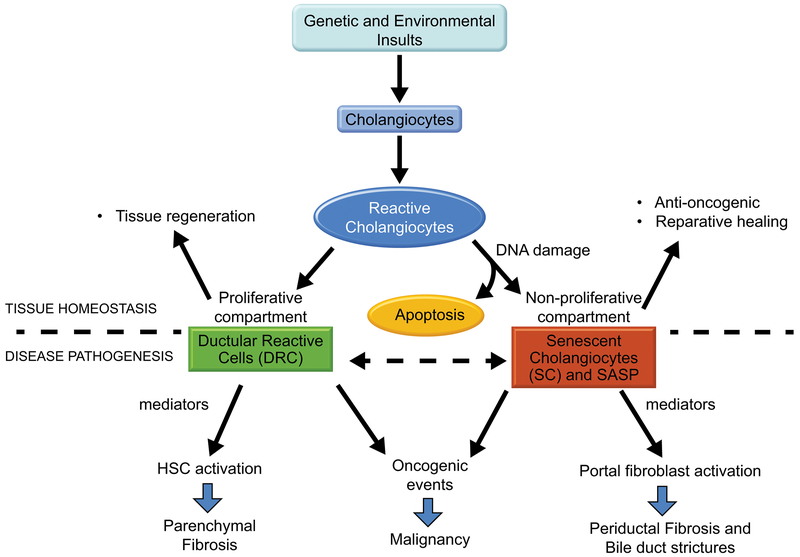
Cholangiocytes are the target of a group of chronic liver diseases termed the "cholangiopathies," in which cholangiocytes react to exogenous and endogenous insults, leading to disease initiation and progression. In primary sclerosing cholangitis (PSC), the focus of this review, the cholangiocyte response to genetic or environmental insults can lead to a heterogeneous response; that is, a subpopulation acquires a ductular reactive and proliferative phenotype, while another subpopulation undergoes senescence and growth arrest. Both ductular reactive cholangiocytes and senescent cholangiocytes can modify the periductal microenvironment through their ability to secrete various cytokines, chemokines, and growth factors, initiating and perpetuating inflammatory and profibrotic responses. This review discusses the similarities and differences, the interrelationships, and the potential pathogenic roles of these reactive proliferative and senescent cholangiocyte subpopulations in PSC.
胆管细胞是一组被称为“胆管疾病”的慢性肝病的靶细胞,在这些疾病中,胆管细胞对外源性和内源性损伤作出反应,导致疾病的发生和进展。在原发性硬化性胆管炎(PSC)中,这篇综述的重点是,胆管细胞对遗传或环境损伤的反应可能导致异质性反应;也就是说,一部分获得了导管反应性和增殖性表型,而另一部分则经历衰老和生长停滞。导管反应性胆管细胞和衰老胆管细胞都可以通过分泌各种细胞因子、趋化因子和生长因子来改变周围的微环境,从而引发和持续炎症和纤维化反应。这篇综述讨论了这些反应性增殖和衰老胆管细胞亚群在 PSC 中的相似之处和不同之处、相互关系以及它们在潜在发病机制中的作用。