Doctoral Program in Public Health, School of Public Health, Faculty of Medicine, University of Chile, Avenida Independencia, 939, Santiago, Chile.
Urban Health Collaborative, Dornsife School of Public Health, Drexel University, Philadelphia, PA, USA.
BMC Public Health. 2022 Aug 5;22(1):1499. doi: 10.1186/s12889-022-13752-2.
Understanding how urban environments influence people's health, especially as individuals age, can help identify ways to improve health in the rapidly urbanizing and rapidly aging populations.
To investigate the association between age and self-reported health (SRH) in adults living in Latin-American cities and whether gender and city-level socioeconomic characteristics modify this association.
Cross-sectional analyses of 71,541 adults aged 25-97 years, from 114 cities in 6 countries (Argentina, Brazil, Colombia, Chile, El Salvador, and Guatemala), as part of the Salud Urbana en America Latina (SALURBAL) Project. We used individual-level age, gender, education, and self-reported health (SRH) data from harmonized health surveys. As proxies for socioeconomic environment we used a city-level socioeconomic index (SEI) calculated from census data, and gross domestic product (GDP) per-capita. Multilevel Poisson models with a robust variance were used to estimate relative risks (RR), with individuals nested in cities and binary SRH (poor SHR vs. good SRH) as the outcome. We examined effect modification by gender and city-level socioeconomic indicators.
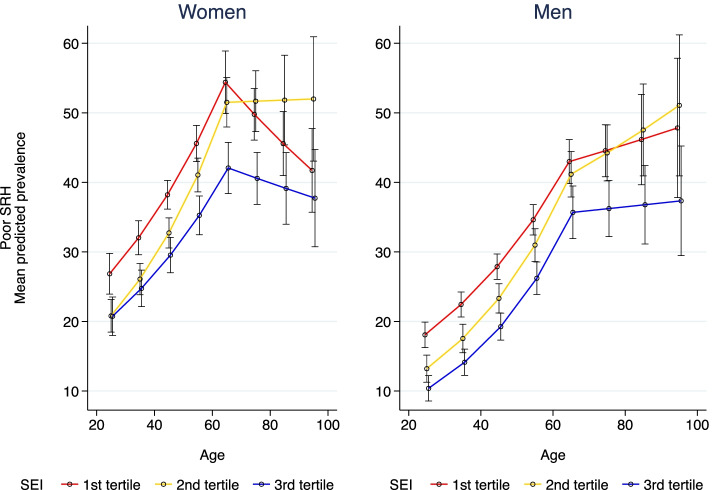
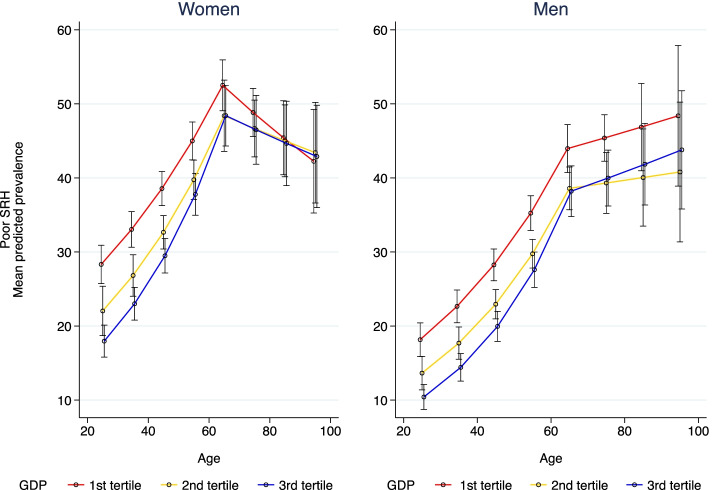
Overall, 31.4% of the sample reported poor SRH. After adjusting for individual-level education, men had a lower risk of poor SRH (RR = 0.76; CI 0.73-0.78) compared to women, and gender modified the association between age and poor SRH (p-value of interaction < 0.001). In gender stratified models, the association between older age and poor SRH was more pronounced in men than in women, and in those aged 25-65 than among those 65+ (RR/10 years = 1.38 vs. 1.10 for men, and RR/10 years = 1.29 vs. 1.02 for women). Living in cities with higher SEI or higher GDP per-capita was associated with a lower risk of poor SRH. GDP per-capita modified the association between age (25-65) and SRH in men and women, with SEI the interaction was less clear.
Across cities in Latin America, aging impact on health is significant among middle-aged adults, and among men. In both genders, cities with lower SEI or lower GDP per-capita were associated with poor SRH. More research is needed to better understand gender inequalities and how city socioeconomic environments, represented by different indicators, modify exposures and vulnerabilities associated with aging.
了解城市环境如何影响人们的健康,尤其是随着个体年龄的增长,这有助于确定如何改善快速城市化和快速老龄化人口的健康状况。
调查拉丁美洲城市中成年人年龄与自我报告健康(SRH)之间的关联,以及性别和城市层面的社会经济特征是否会改变这种关联。
对来自 6 个国家(阿根廷、巴西、哥伦比亚、智利、萨尔瓦多和危地马拉)的 114 个城市中 71541 名 25-97 岁成年人进行了横断面分析,这些成年人是 Salud Urbana en America Latina(SALURBAL)项目的一部分。我们使用了来自协调一致的健康调查的个人层面年龄、性别、教育和自我报告健康(SRH)数据。我们使用了城市层面的社会经济指数(SEI)和人均国内生产总值(GDP)作为社会经济环境的代表。使用个体嵌套在城市中的多水平泊松模型和稳健方差来估计相对风险(RR),二元 SRH(较差的 SRH 与较好的 SRH)作为结果。我们检验了性别和城市层面社会经济指标的调节作用。
总体而言,样本中有 31.4%的人报告说 SRH 较差。在调整了个体层面的教育后,与女性相比,男性的较差 SRH 风险较低(RR=0.76;95%CI 0.73-0.78),性别改变了年龄与较差 SRH 之间的关联(交互作用的 p 值<0.001)。在性别分层模型中,年龄较大与较差 SRH 之间的关联在男性中比在女性中更为明显,在 25-65 岁之间比在 65 岁以上更为明显(RR/10 岁=1.38 比 1.10,男性;RR/10 岁=1.29 比 1.02,女性)。生活在社会经济指数较高或人均 GDP 较高的城市与较差 SRH 的风险较低有关。人均 GDP 改变了年龄(25-65 岁)与男性和女性的 SRH 之间的关联,而社会经济指数的交互作用则不太明显。
在拉丁美洲的各个城市中,中年成年人的衰老对健康的影响是显著的,男性尤为如此。在两性中,社会经济指数较低或人均 GDP 较低的城市与较差的 SRH 相关。需要进一步研究以更好地了解性别不平等现象,以及城市社会经济环境(由不同的指标代表)如何改变与衰老相关的暴露和脆弱性。