Wagner Aneta, Buczyłko Krzysztof, Zielińska-Bliźniewska Hanna, Wagner Waldemar
Allergology and Respiratory Rehabilitation Department, Medical University of Lodz, Lodz, Poland.
NZOZ Allergology Center, Lodz, Poland.
Postepy Dermatol Alergol. 2019 Oct;36(5):538-543. doi: 10.5114/ada.2019.89504. Epub 2019 Nov 12.
Histamine is the major mediator of IgE- and non-IgE-mediated allergic reactions upon allergen or hapten contact. Reduced histamine degradation capacity was associated with atopic eczema as well as with non-immunological histamine intolerance. Higher blood serum histamine level concomitant with decreased intestinal diamine oxidase activity were observed in patients with food allergy.
To evaluate the relationship between patients' blood diamine oxidase (DAO) activity/histamine status and their reactivity to time-resolved histamine skin prick test in respect to vulnerability to allergic diseases.
Fifty-three patients were examined with skin prick tests (SPT) and patch tests for suspected presence of either IgE- or non-IgE-mediated allergy. All individuals were skin prick tested with histamine and the resolution of the wheal was monitored for 50 min. Blood DAO activity and histamine concentration were measured with a radio-extraction radioimmunoassay.
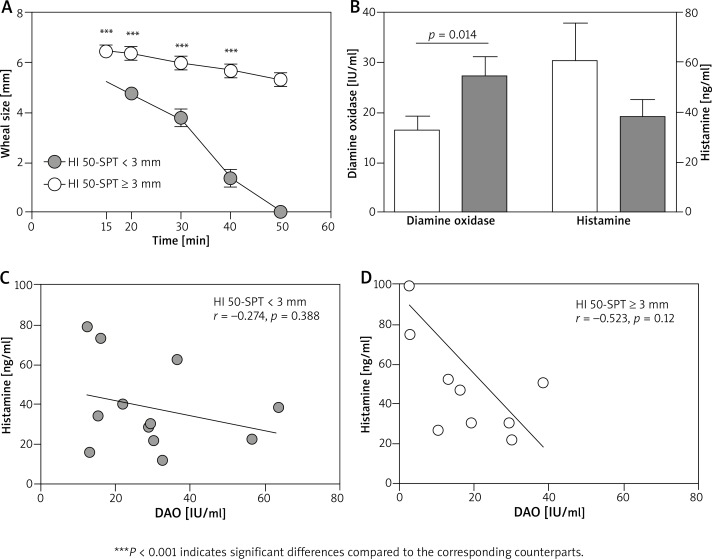
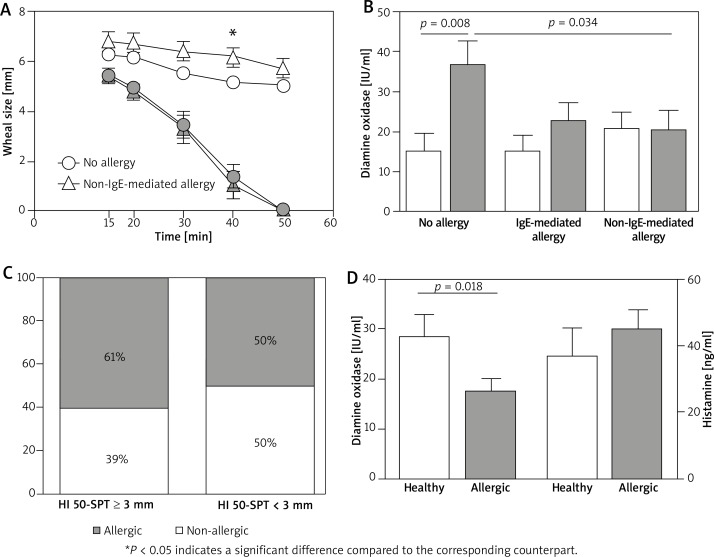
Time-resolved histamine skin prick testing revealed presence of wheals which were 35% larger in diameter in 47% of examined subjects at 20 min of the test. These patients exhibited significantly compromised time-course wheal resolution (wheal ≥ 3 mm at 50 min) compared to a group of patients with the normal-rate of wheal resolution (wheal = 0 mm at 50 min). Within a group of subjects exhibiting impaired wheal resolution, 61% of patients were diagnosed allergic compared to 50% in a group of patients with a normal rate of wheal resolution. Finally, allergic patients were characterized by a significantly lower DAO activity and higher histamine content compared to healthy subjects.
The results of this study indicate that patients with IgE- or non-IgE-mediated allergy are likely to have low DAO blood activity and may concomitantly suffer from histamine intolerance. Furthermore, our results suggest that allergic patients are more likely to develop an excessive SPT reaction. Our results emphasize caution in interpretation of the SPT results in allergic patients with diagnosed histamine intolerance or histamine/DAO activity imbalance.
组胺是变应原或半抗原接触后IgE介导和非IgE介导的过敏反应的主要介质。组胺降解能力降低与特应性湿疹以及非免疫性组胺不耐受有关。食物过敏患者血清组胺水平升高,同时肠道二胺氧化酶活性降低。
评估患者血液中二胺氧化酶(DAO)活性/组胺状态与其对时间分辨组胺皮肤点刺试验的反应性之间的关系,以及对过敏性疾病易感性的影响。
对53例疑似存在IgE介导或非IgE介导过敏的患者进行皮肤点刺试验(SPT)和斑贴试验。所有个体均用组胺进行皮肤点刺试验,并监测风团消退情况50分钟。采用放射萃取放射免疫分析法测定血液DAO活性和组胺浓度。
时间分辨组胺皮肤点刺试验显示,在试验20分钟时,47%的受试对象风团直径增大35%。与风团消退正常的患者组相比,这些患者的风团消退时间过程明显受损(50分钟时风团≥3毫米)。在风团消退受损的受试者组中,61%的患者被诊断为过敏,而风团消退正常的患者组中这一比例为50%。最后,与健康受试者相比,过敏患者的DAO活性显著降低,组胺含量更高。
本研究结果表明,IgE介导或非IgE介导过敏的患者可能血液DAO活性较低,可能同时患有组胺不耐受。此外,我们的结果表明,过敏患者更有可能出现过度的皮肤点刺试验反应。我们的结果强调,在解释已诊断为组胺不耐受或组胺/DAO活性失衡的过敏患者的皮肤点刺试验结果时应谨慎。