Menzies Institute for Medical Research, University of Tasmania, Private Bag 23, Hobart, Tasmania, 7001, Australia.
School of Health Sciences, Faculty of Medicine and Health Sciences, University of East Anglia, Norwich, UK.
BMC Psychiatry. 2019 Dec 16;19(1):398. doi: 10.1186/s12888-019-2385-z.
To investigate whether there are bi-directional associations between anxiety and mood disorders and body mass index (BMI) in a cohort of young adults.
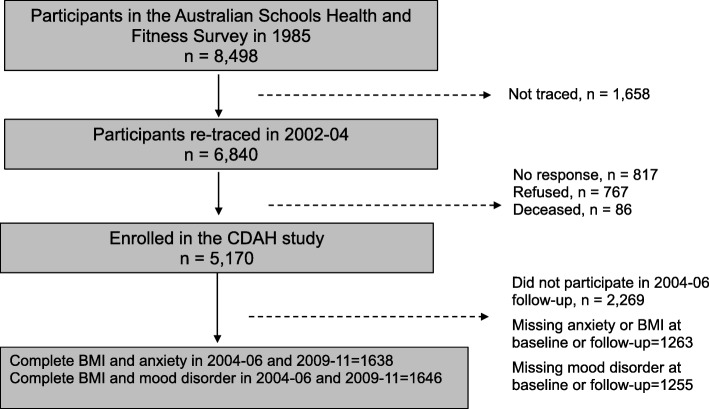
We analysed data from the 2004-2006 (baseline) and 2009-2011 (follow-up) waves of the Childhood Determinants of Adult Health study. Lifetime DSM-IV anxiety and mood disorders were retrospectively diagnosed with the Composite International Diagnostic Interview. Potential mediators were individually added to the base models to assess their potential role as a mediator of the associations.
In males, presence of mood disorder history at baseline was positively associated with BMI gain (β = 0.77, 95% CI: 0.14-1.40), but baseline BMI was not associated with subsequent risk of mood disorder. Further adjustment for covariates, including dietary pattern, physical activity, and smoking reduced the coefficient (β) to 0.70 (95% CI: 0.01-1.39), suggesting that the increase in BMI was partly mediated by these factors. In females, presence of mood disorder history at baseline was not associated with subsequent weight gain, however, BMI at baseline was associated with higher risk of episode of mood disorder (RR per kg/m: 1.04, 95% CI: 1.01-1.08), which was strengthened (RR per kg/m = 1.07, 95% CI: 1.00-1.15) after additional adjustment in the full model. There was no significant association between anxiety and change in BMI and vice-versa.
The results do not suggest bidirectional associations between anxiety and mood disorders, and change in BMI. Interventions promoting healthy lifestyle could contribute to reducing increase in BMI associated with mood disorder in males, and excess risk of mood disorder associated with BMI in females.
在一项年轻成年人队列研究中,调查焦虑和心境障碍与体重指数(BMI)之间是否存在双向关联。
我们分析了 2004-2006 年(基线)和 2009-2011 年(随访)儿童期成人健康决定因素研究的数据。使用复合国际诊断访谈对终生 DSM-IV 焦虑和心境障碍进行回顾性诊断。将潜在的中介因素逐个添加到基本模型中,以评估它们作为关联中介的潜在作用。
在男性中,基线时存在心境障碍史与 BMI 增加呈正相关(β=0.77,95%CI:0.14-1.40),但基线 BMI 与随后发生心境障碍的风险无关。进一步调整协变量,包括饮食模式、身体活动和吸烟,会降低系数(β)至 0.70(95%CI:0.01-1.39),表明 BMI 的增加部分由这些因素介导。在女性中,基线时存在心境障碍史与随后的体重增加无关,但基线 BMI 与心境障碍发作的风险较高相关(每公斤/米 RR:1.04,95%CI:1.01-1.08),在全模型中进一步调整后,这种相关性增强(RR 每公斤/米=1.07,95%CI:1.00-1.15)。焦虑与 BMI 变化之间以及反之没有显著关联。
结果表明焦虑和心境障碍以及 BMI 变化之间没有双向关联。促进健康生活方式的干预措施可能有助于减少男性中与心境障碍相关的 BMI 增加,并降低女性中与 BMI 相关的心境障碍发病风险。