Valenzano Anna, Polito Rita, Trimigno Valentina, Di Palma Antonella, Moscatelli Fiorenzo, Corso Gaetano, Sessa Francesco, Salerno Monica, Montana Angelo, Di Nunno Nunzio, Astuto Marinella, Daniele Aurora, Carotenuto Marco, Messina Giovanni, Cibelli Giuseppe, Monda Vincenzo
Department of Clinical and Experimental Medicine, University of Foggia, 71122 Foggia, Italy.
Department of Medical, Surgical and Advanced Technologies "G.F. Ingrassia", University of Catania, 95123 Catania, Italy.
Antioxidants (Basel). 2019 Dec 13;8(12):643. doi: 10.3390/antiox8120643.
Caloric restriction is a valid strategy to reduce the visceral adipose tissue (VAT) content in obese persons. Hypocretin-1 (orexin-A) is a neuropeptide synthesized in the lateral hypothalamus that strongly modulates food intake, thus influencing adipose tissue accumulation. Therapeutic diets in obesity treatment may combine the advantages of caloric restriction and dietary ketosis. The current study aimed to evaluate the effect of a very low calorie ketogenic diet (VLCKD) in a population of obese patients.
Adiposity parameters and orexin-A serum profiling were quantified over an 8 week period. The effect of the VLCKD on reactive oxygen species (ROS) production and cell viability was evaluated, in vitro, by culturing Hep-G2 cells in the presence of VLCKD sera.
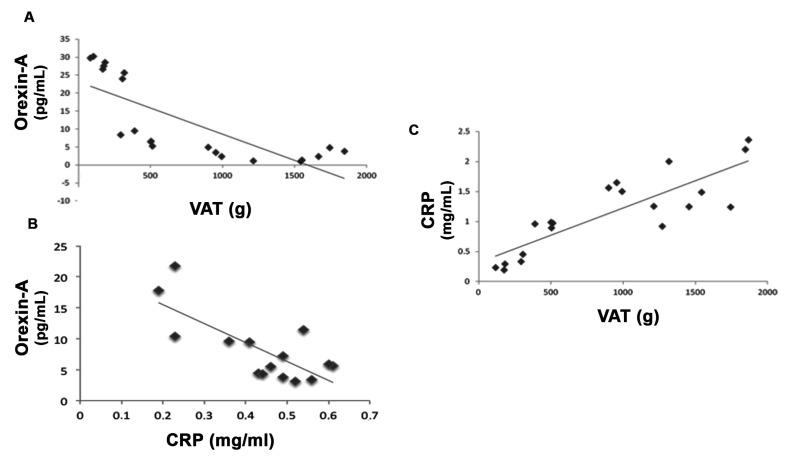
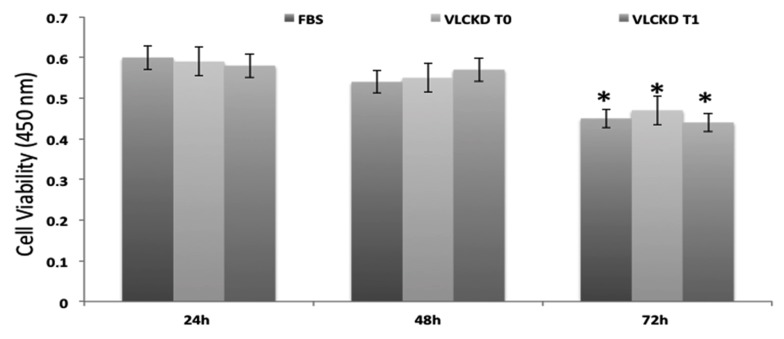
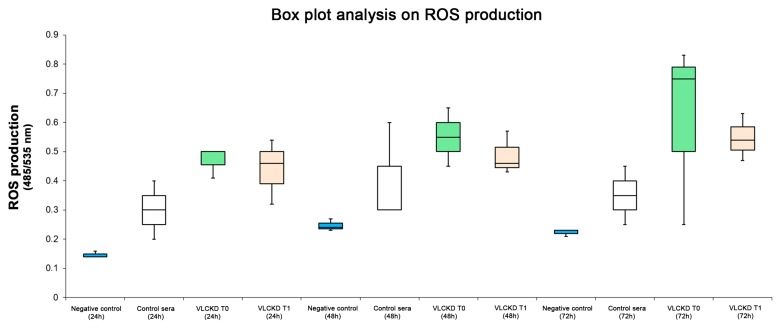
Dietary intervention induced significant effects on body weight, adiposity, and blood chemistry parameters. Moreover, a selective reduction in VAT was measured by dual-energy X-ray absorptiometry. Orexin-A levels significantly increased after dietary treatment. Hep-G2 cell viability was not affected after 24, 48, and 72 h incubation with patients' sera, before and after the VLCKD. In the same model system, ROS production was not significantly influenced by dietary treatment.
The VLCKD exerts a positive effect on VAT decrease, ameliorating adiposity and blood chemistry parameters. Furthermore, short-term mild dietary ketosis does not appear to have a cytotoxic effect, nor does it represent a factor capable of increasing oxidative stress. Finally, to the best of our knowledge, this is the first study that shows an effect of the VLCKD upon the orexinergic system, supporting the usefulness of such a therapeutic intervention in promoting obesity reduction in the individual burden of this disease.
热量限制是减少肥胖者内脏脂肪组织(VAT)含量的有效策略。下丘脑泌素-1(食欲素-A)是一种在下丘脑外侧合成的神经肽,它强烈调节食物摄入,从而影响脂肪组织的积累。肥胖治疗中的治疗性饮食可能会结合热量限制和饮食性酮症的优点。本研究旨在评估极低热量生酮饮食(VLCKD)对肥胖患者群体的影响。
在8周的时间内对肥胖参数和食欲素-A血清谱进行定量分析。通过在VLCKD血清存在的情况下培养Hep-G2细胞,在体外评估VLCKD对活性氧(ROS)产生和细胞活力的影响。
饮食干预对体重、肥胖程度和血液化学参数产生了显著影响。此外,通过双能X射线吸收法测量发现VAT有选择性降低。饮食治疗后食欲素-A水平显著升高。在VLCKD前后,用患者血清孵育24、48和72小时后,Hep-G2细胞活力未受影响。在同一模型系统中,饮食治疗对ROS产生没有显著影响。
VLCKD对降低VAT、改善肥胖程度和血液化学参数具有积极作用。此外,短期轻度饮食性酮症似乎没有细胞毒性作用,也不是能够增加氧化应激的因素。最后,据我们所知,这是第一项显示VLCKD对食欲素能系统有影响的研究,支持了这种治疗干预在减轻个体肥胖疾病负担方面的有用性。