Center for Functional and Molecular Imaging & Department of Neurology, Georgetown University, Washington, DC, USA.
Faculty of Science and Engineering, Flinders University of South Australia (Retiree), Adelaide, SA, Australia.
Sci Rep. 2019 Dec 18;9(1):19374. doi: 10.1038/s41598-019-55861-w.
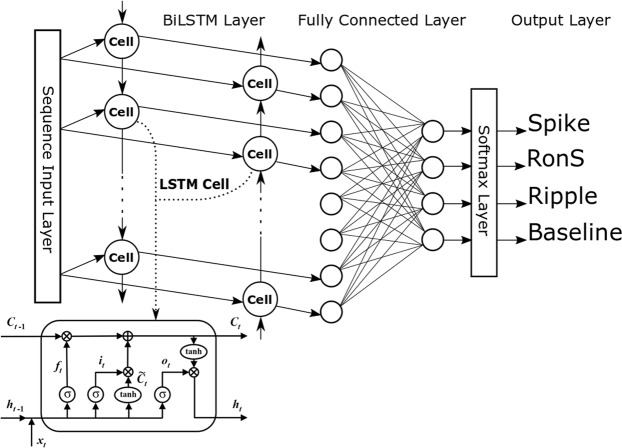
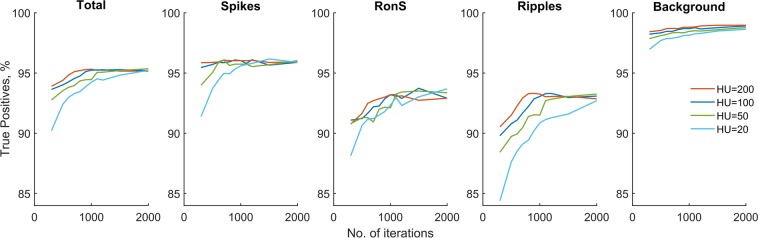
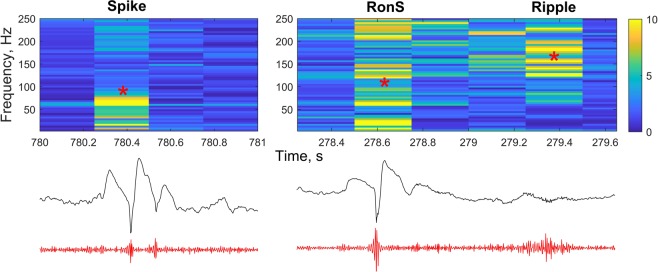
Over the last two decades, the evidence has been growing that in addition to epileptic spikes high frequency oscillations (HFOs) are important biomarkers of epileptogenic tissue. New methods of artificial intelligence such as deep learning neural networks can provide additional tools for automated analysis of EEG. Here we present a Long Short-Term Memory neural network for detection of spikes, ripples and ripples-on-spikes (RonS). We used intracranial EEG (iEEG) from two independent datasets. First dataset (7 patients) was used for network training and testing. The second dataset (5 patients) was used for cross-institutional validation. 1000 events of each class (spike, RonS, ripple and baseline) were selected from the candidates initially found using a novel threshold method. Network training was performed using random selections of 50-500 events (per class) from all patients from the 1 dataset. This 'global' network was then tested on other events for each patient from both datasets. The network was able to detect events with a good generalisability namely, with total accuracy and specificity for each class exceeding 90% in all cases, and sensitivity less than 86% in only two cases (82.5% for spikes in one patient and 81.9% for ripples in another patient). The deep learning networks can significantly accelerate the analysis of iEEG data and increase their diagnostic value which may improve surgical outcome in patients with localization-related intractable epilepsy.
在过去的二十年中,越来越多的证据表明,高频振荡(HFOs)除了癫痫棘波外,也是致痫性组织的重要生物标志物。人工智能的新方法,如深度学习神经网络,可以为 EEG 的自动分析提供额外的工具。在这里,我们提出了一种用于检测棘波、锐波和棘波上锐波(RonS)的长短期记忆神经网络。我们使用了来自两个独立数据集的颅内 EEG(iEEG)。第一个数据集(7 名患者)用于网络训练和测试。第二个数据集(5 名患者)用于机构间验证。使用一种新的阈值方法从候选者中最初选择了每种类别的 1000 个事件(棘波、RonS、锐波和基线)。使用从 1 个数据集中所有患者的随机选择 50-500 个事件(每个类)进行网络训练。然后,将这个“全局”网络应用于两个数据集的每个患者的其他事件上进行测试。该网络能够以良好的泛化能力检测到事件,即在所有情况下,每个类别的总准确率和特异性均超过 90%,而敏感性仅在两种情况下低于 86%(一名患者的棘波为 82.5%,另一名患者的锐波为 81.9%)。深度学习网络可以显著加速 iEEG 数据的分析,并提高其诊断价值,从而可能改善与定位相关的难治性癫痫患者的手术结果。