Department of Tissue Engineering and Regeneration, School and Hospital of Stomatology, Shandong University, Jinan, China.
Shandong Provincial Key Laboratory of Oral Tissue Regeneration & Shandong Engineering Laboratory for Dental Materials and Oral Tissue Regeneration, Jinan, China.
Stem Cell Res Ther. 2019 Dec 19;10(1):403. doi: 10.1186/s13287-019-1504-6.
Billions of dollars are invested annually by pharmaceutical companies in search of new options for treating hair loss conditions; nevertheless, the challenge remains. One major limitation to hair follicle research is the lack of effective and efficient drug screening systems using human cells. Organoids, three-dimensional in vitro structures derived from stem cells, provide new opportunities for studying organ development, tissue regeneration, and disease pathogenesis. The present study focuses on the formation of human hair follicle organoids.
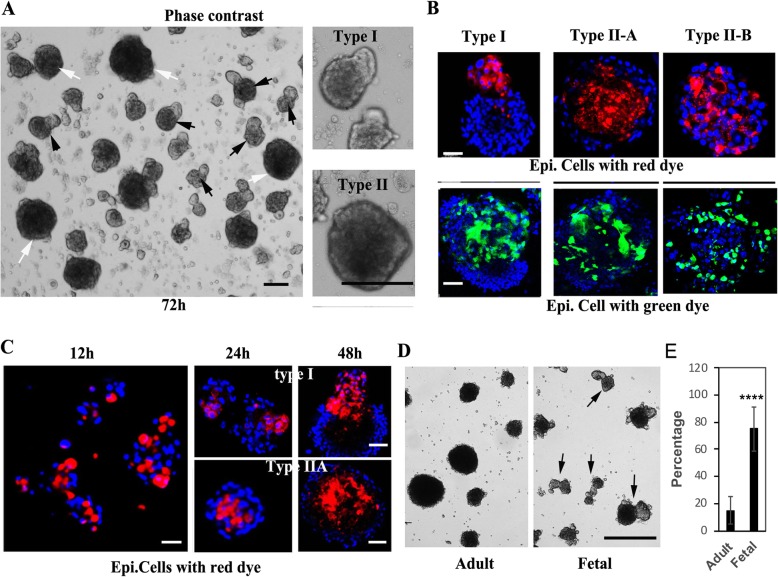
Scalp-derived dermal progenitor cells mixed with foreskin-derived epidermal stem cells at a 2:1 ratio aggregated in suspension to form hair follicle-like organoids, which were confirmed by immunostaining of hair follicle markers and by molecular dye labeling assays to analyze dermal and epidermal cell organization in those organoids. The hair-forming potential of organoids was examined using an in vivo transplantation assay.
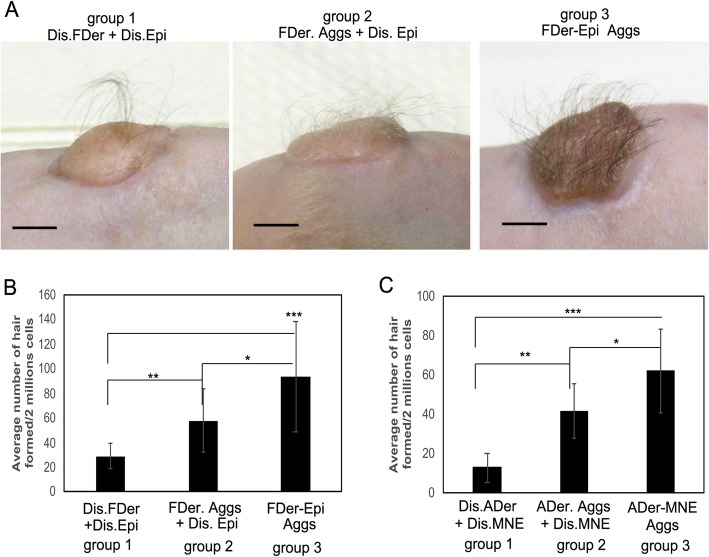
Pre-aggregation of dermal and epidermal cells enhanced hair follicle formation in vivo. In vitro pre-aggregation initiated the interactions of epidermal and dermal progenitor cells resulting in activation of the WNT pathway and the formation of pear-shape structures, named type I aggregates. Cell-tracing analysis showed that the dermal and epidermal cells self-assembled into distinct epidermal and dermal compartments. Histologically, the type I aggregates expressed early hair follicle markers, suggesting the hair peg-like phase of hair follicle morphogenesis. The addition of recombinant WNT3a protein to the medium enhanced the formation of these aggregates, and the Wnt effect could be blocked by the WNT inhibitor, IWP2.
In summary, our system supports the rapid formation of a large number of hair follicle organoids (type I aggregates). This system provides a platform for studying epithelial-mesenchymal interactions, for assessing inductive hair stem cells and for screening compounds that support hair follicle regeneration.
制药公司每年投入数十亿美元寻找治疗脱发的新方法,但这一挑战仍然存在。毛囊研究的一个主要限制是缺乏使用人类细胞的有效和高效药物筛选系统。类器官是从干细胞中衍生出的三维体外结构,为研究器官发育、组织再生和疾病发病机制提供了新的机会。本研究集中在人毛囊类器官的形成上。
头皮衍生的真皮祖细胞与包皮衍生的表皮干细胞以 2:1 的比例混合,在悬浮液中聚集形成毛囊样类器官,通过毛囊标记物的免疫染色和分子染料标记分析来证实这些类器官中真皮和表皮细胞的组织。通过体内移植实验来检查类器官的毛发形成潜力。
真皮和表皮细胞的预聚集增强了体内的毛囊形成。体外预聚集启动了表皮和真皮祖细胞的相互作用,导致 WNT 途径的激活和形成梨形结构,称为 I 型聚集。细胞示踪分析表明,真皮和表皮细胞自行组装成不同的表皮和真皮隔室。组织学上,I 型聚集表达早期毛囊标记物,提示毛囊形态发生的毛发钉状阶段。在培养基中添加重组 WNT3a 蛋白可增强这些聚集的形成,Wnt 效应可被 WNT 抑制剂 IWP2 阻断。
总之,我们的系统支持大量毛囊类器官(I 型聚集)的快速形成。该系统为研究上皮-间充质相互作用、评估诱导性毛囊干细胞和筛选支持毛囊再生的化合物提供了一个平台。