College of Medicine, Mohammed Bin Rashid University of Medicine and Health Sciences, Dubai Health Care City, Dubai, United Arab Emirates.
Centre for Outcomes and Research in Education, Mohammed Bin Rashid University of Medicine and Health Sciences, Dubai, United Arab Emirates.
BMC Med Educ. 2019 Dec 27;19(1):472. doi: 10.1186/s12909-019-1896-0.
Resistance to change is customary and is expected in any organization. However, most of the downsides of change can be avoided if the organization/individual prepares for the change by acknowledging guided strategies. In healthcare, change is the state of nature, which has also translated to medical education (ME). ME in the current era has undergone a shift from a traditional content-based curriculum to a competency-based curriculum. Recently, however, the broader social-accountability movement has accelerated this rate of transformation. One of the key challenges to educators harbingering this transformation to competency-based medical education (CBME) is to redesign the processes of teaching.
Here we define a framework designed using Mento's model of change that will totally agree with introducing positive change in teaching in an institution undergoing transformation from a traditional content-based curriculum to a competency-based curriculum.
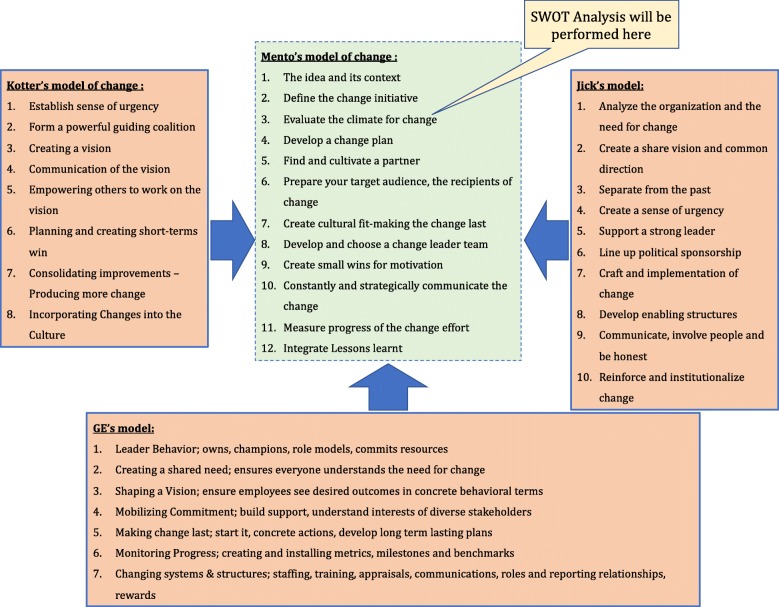
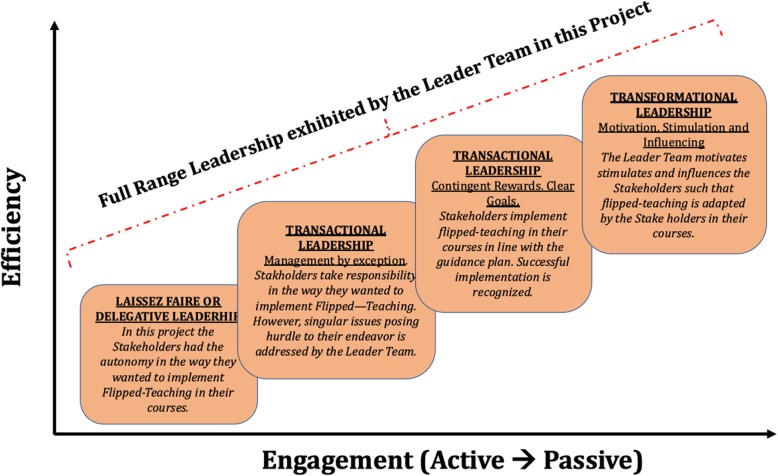
Using Schein's "unfreezing" as a guide term we critically reflected on the popular change-management models, to home in on Kotter's model of change to transform organizations. However, Kotter's change-model draws from Situational and Contingency Leadership Theories, which may not agree with academic organizations involved in ME. As such organizations adhere to Transactional and Transformational Leadership archetypes, where Leadership is constructively executed by "The Leader Team", we decided to adopt Mento's change-model for our study. Mento's model not only draws from the precepts of Kotter's model, but also incorporates axioms of Jick's and GE's change-models.
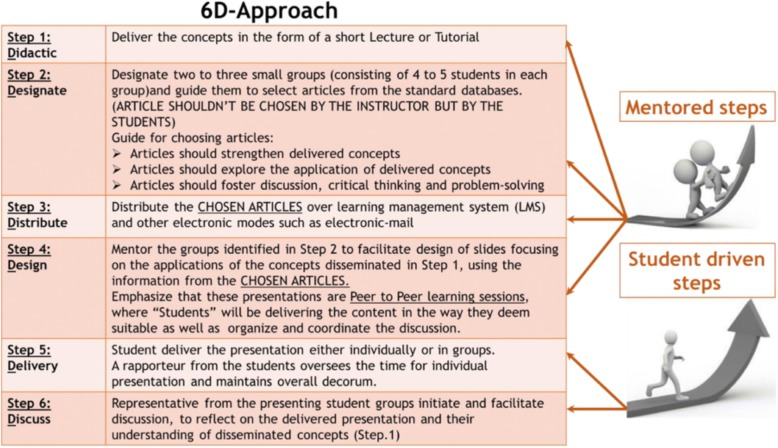
Using Mento's model a framework was blueprinted to implement active learning (AL) strategies in CBME. Here we have elaborated on the framework using the exemplar of flipped teaching. The development of this framework required the design and execution of a faculty development program, and a step by step guidance plan to chaperon, instruct and implement change in teaching to harbinger CBME. Further, we have also reflected on the change process using Gravin's framework.
To our knowledge this is the first report of the use of Mento's model of change in medical education. Also, the blueprinted framework is supported by acknowledged leadership theories and can be translated to implement any curricular change in CBME.
在任何组织中,抵制变革是惯例,也是预期的。然而,如果组织/个人通过承认指导策略为变革做好准备,大多数变革的不利因素都可以避免。在医疗保健领域,变革是自然状态,这也转化为医学教育(ME)。在当前时代,ME 已经从传统的基于内容的课程转变为基于能力的课程。然而,最近,更广泛的社会责任运动加速了这种转变的速度。教育者在向基于能力的医学教育(CBME)转变的过程中面临的一个关键挑战是重新设计教学过程。
在这里,我们使用 Mento 的变革模型定义了一个框架,该框架将完全同意在一个从传统基于内容的课程向基于能力的课程转变的机构中引入积极的教学变革。
我们使用 Schein 的“解冻”作为指导术语,批判性地反思了流行的变革管理模型,以关注 Kotter 的组织变革模型。然而,Kotter 的变革模型借鉴了情境和权变领导理论,这可能与参与医学教育的学术组织不一致。由于这些组织遵循交易和变革型领导原型,领导力由“领导团队”建设性地执行,我们决定在我们的研究中采用 Mento 的变革模型。Mento 的模型不仅借鉴了 Kotter 模型的前提,还包含了 Jick 和 GE 变革模型的公理。
使用 Mento 的模型,我们为在 CBME 中实施主动学习(AL)策略制定了一个框架。在这里,我们使用翻转教学的范例详细阐述了该框架。该框架的开发需要设计和执行一个教师发展计划,以及一个逐步指导计划,以引导、指导和实施教学变革,为 CBME 奠定基础。此外,我们还使用 Gravin 的框架反思了变革过程。
据我们所知,这是 Mento 变革模型在医学教育中首次应用的报告。此外,该蓝图框架得到了公认的领导理论的支持,可以转化为在 CBME 中实施任何课程变革。