Department of Bromatology and Food Technology, University of Córdoba, Campus Rabanales, ed. Darwin - annex. Office of Dr. Rafael Moreno, 14071, Córdoba, ES, Spain.
Nursing department, University of Medicine and Nursing of Córdoba, Córdoba, Spain.
BMC Womens Health. 2019 Dec 27;19(1):167. doi: 10.1186/s12905-019-0864-5.
There is evidence showing the effectiveness of a hypocaloric diet and the increase in physical activity on weight loss. However, the combined role of these factors, not only on weight loss but also body composition, remains unclear. The purpose of this study was to investigate the effect of a hypocaloric diet on the body composition of obese adult women throughout different degrees of physical activity during a weight loss program.
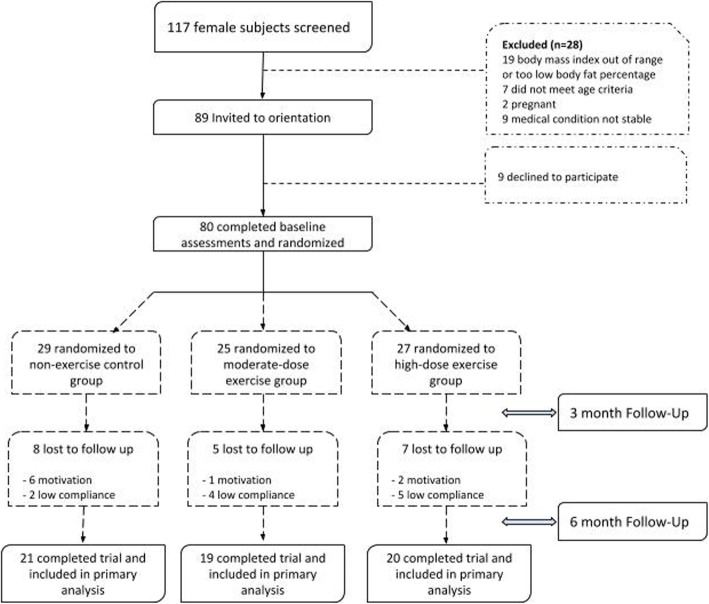
One hundred and seventeen healthy female volunteers were randomly assigned to one of the experimental groups: a control group with a low-level prescription of physical activity (1-4 METs), moderate physical activity group that performed 10.000 steps walking (5-8 METs) and intense physical activity group that trained exercises by at least 70% of VO2max three times a week (> 8 METs). All subjects followed a hypocaloric diet designed with a reduction of 500 kcal/day. Nutritional counseling was provided throughout the study period to help ensure dietary adherence.
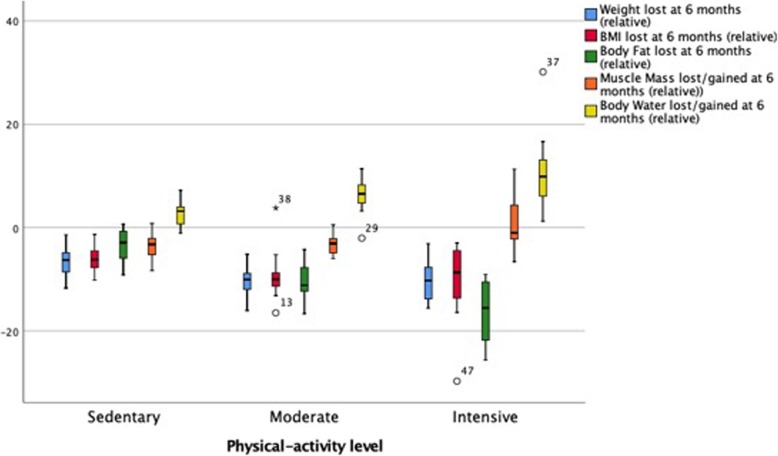
We found no differences in body weight compared to moderate and intense physical activity (ßstand. = - 0.138 vs. ßstand. = - 0.139). Body fat was lower in women following an intense activity (ßstand. = - 0.436) than those with moderate exercise (ßstand. = - 0.231). The high-intense activity also increased muscle mass at the end of the intervention, standing out above the moderate activity (ßstand. = 0.182 vs. ßstand. = 0.008).
These findings indicate that a hypocaloric diet, without prescription of physical activity, is adequate to lose weight in the short term (12 weeks), but physical activity is vital to modify the body composition in women with obesity. Body fat was lower when women practiced a moderate exercise compared to hypocaloric diet only, but an intense physical activity was the most effective protocol to obtain a reduction of body fat and maintain muscle mass.
The study protocol complied with the Declaration of Helsinki for medical studies, it was approved by the bioethical committee of Córdoba University, in the Department of Health at the Regional Government of Andalusia (Act n°284, ref.4156) and retrospectively registered in clinicaltrials.gov (NCT03833791). Registered 2 January 2019.
有证据表明低热量饮食和增加身体活动对减肥有效。然而,这些因素的综合作用,不仅对减肥,而且对身体成分,仍不清楚。本研究的目的是调查低热量饮食对肥胖成年女性身体成分的影响,这些女性在减肥计划中进行不同程度的身体活动。
117 名健康女性志愿者被随机分配到实验组之一:低水平运动处方的对照组(1-4 METs)、完成 10000 步步行的中等运动组(5-8 METs)和每周至少进行 3 次 70%VO2max 的高强度运动组(>8 METs)。所有受试者均遵循热量减少 500 卡路里/天的低热量饮食。在整个研究期间提供营养咨询,以帮助确保饮食依从性。
与中等和高强度身体活动相比,我们发现体重没有差异(ßstand. = -0.138 vs. ßstand. = -0.139)。与中等运动相比,高强度运动的女性体脂含量较低(ßstand. = -0.436)。高强度活动还增加了干预结束时的肌肉量,明显高于中等强度活动(ßstand. = 0.182 vs. ßstand. = 0.008)。
这些发现表明,低热量饮食,没有身体活动的处方,足以在短期内(12 周)减肥,但身体活动对于改变肥胖女性的身体成分至关重要。与仅低热量饮食相比,女性进行中等运动时体脂较低,但高强度身体活动是减少体脂和保持肌肉量最有效的方案。
该研究方案符合医学研究的赫尔辛基宣言,得到了科尔多瓦大学生物伦理委员会的批准,该委员会隶属于安达卢西亚地区政府的卫生部(法案第 284 号,参考号 4156),并在 clinicaltrials.gov 上进行了回顾性注册(NCT03833791)。注册于 2019 年 1 月 2 日。