Deng Jie, Dietrich Mary S, Murphy Barbara
School of Nursing, University of Pennsylvania, 418 Curie Boulevard, Philadelphia, PA, 19104-4217, USA.
School of Nursing, Vanderbilt University, Nashville, TN, USA.
Trials. 2019 Dec 27;20(1):775. doi: 10.1186/s13063-019-3819-0.
Head and neck cancer (HNC) patients are at high risk for developing lymphedema and fibrosis (LEF) following cancer treatment. Once HNC patients develop LEF, they need to conduct life-long self-care to slow LEF progression and reduce associated symptom burden and functional deficits. Data demonstrate that inadequate LEF self-care may be a potentially remediable issue. The objective of this study is to explore the feasibility and preliminary efficacy of an Information-Motivation-Behavioral (IMB) Skills model-driven self-care program (SCP) to improve LEF management and reduce LEF-related symptom burden and functional impairments.
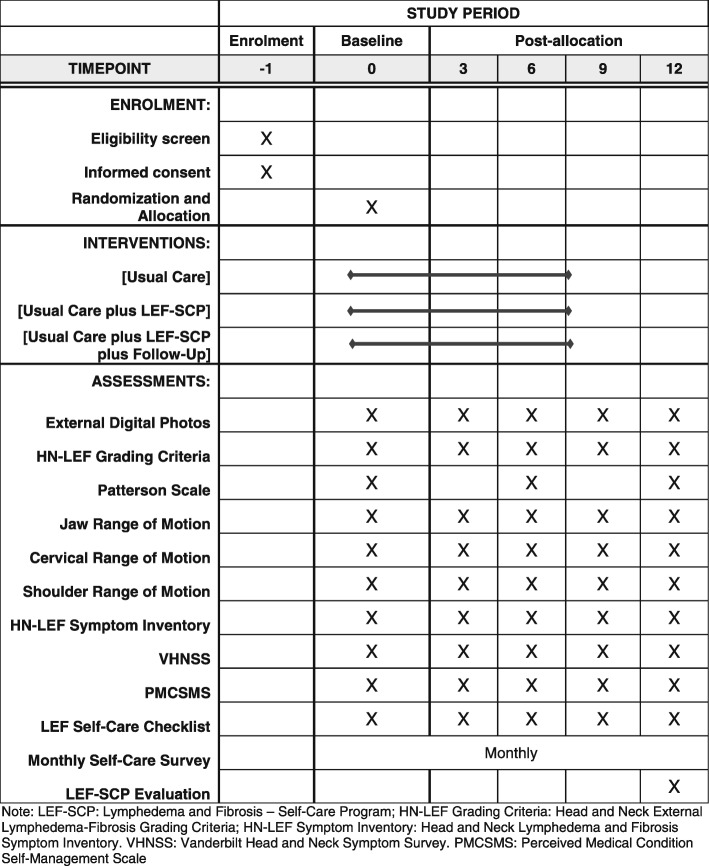
METHODS/DESIGN: This is a three-arm, prospective, randomized controlled clinical trial to compare: Group 1 - Usual Care, Group 2 - Usual Care Plus LEF-SCP, and Group 3 - Usual Care Plus LEF-SCP Plus Follow-Up. Participants will be HNC survivors aged > 18 years of age, who meet predefined inclusion and exclusion criteria. A sample size of 75 participants is targeted. Interventions will be provided by trained staff. The study assessments for all groups will take place at five points: study entry then 3, 6, 9, and 12 months post enrollment. Outcome measures include: (1) feasibility (barriers to implementation, safety, and satisfaction) of the proposed intervention; (2) self-efficacy and adherence to self-care; and (3) preliminary efficacy (LEF progression, symptom burden, and functional status) of the proposed intervention.
This will be the first study to evaluate the feasibility of a LEF-SCP in the HNC population and its impact on self-efficacy and adherence. Furthermore, it will evaluate the potential benefit of routine follow-up on adherence and fidelity to the self-care protocol. We expect that the trial will provide evidence supporting the feasibility of a LEF self-care program. In addition, we anticipate that preliminary data will support improved outcomes including increased adherence and fidelity, and decreased LEF-associated symptoms.
ClinicalTrials.gov, a service of the US National Institute of Health (NCT03030859). Registered on 22 January 2017.
头颈癌(HNC)患者在癌症治疗后发生淋巴水肿和纤维化(LEF)的风险很高。一旦HNC患者发生LEF,他们需要进行终身自我护理,以减缓LEF进展,减轻相关症状负担和功能缺陷。数据表明,LEF自我护理不足可能是一个潜在可补救的问题。本研究的目的是探讨信息-动机-行为(IMB)技能模型驱动的自我护理计划(SCP)改善LEF管理、减轻LEF相关症状负担和功能障碍的可行性和初步疗效。
方法/设计:这是一项三臂、前瞻性、随机对照临床试验,以比较:第1组-常规护理,第2组-常规护理加LEF-SCP,第3组-常规护理加LEF-SCP加随访。参与者将是年龄大于18岁的HNC幸存者,他们符合预先定义的纳入和排除标准。目标样本量为75名参与者。干预将由经过培训的工作人员提供。所有组的研究评估将在五个时间点进行:研究入组时,然后在入组后3、6、9和12个月。结果测量包括:(1)所提议干预措施的可行性(实施障碍、安全性和满意度);(2)自我效能感和自我护理依从性;(3)所提议干预措施的初步疗效(LEF进展、症状负担和功能状态)。
这将是第一项评估LEF-SCP在HNC人群中的可行性及其对自我效能感和依从性影响的研究。此外,它将评估常规随访对自我护理方案依从性和保真度的潜在益处。我们预计该试验将提供证据支持LEF自我护理计划的可行性。此外,我们预计初步数据将支持改善结果,包括提高依从性和保真度,以及减轻LEF相关症状。
ClinicalTrials.gov,美国国立卫生研究院的一项服务(NCT03030859)。于2017年1月22日注册。